If you’ve ever used a web browser, chances are you’ve noticed the option for Private Browsing, Incognito Mode, or InPrivate Mode. Almost every popular browser offers some form of this feature, and many people assume it provides full anonymity online.
But here’s the catch: private browsing isn’t as private as you think. While it does offer certain protections, it has significant limitations that you should understand before relying on it for sensitive activity.
In this article, we’ll cover:
- What private browsing actually is.
- The differences in how Chrome, Firefox, Edge, and Safari name it.
- What private browsing does — and what it doesn’t do.
- Real-world scenarios where it’s useful.
- Safer alternatives for true online privacy.
- Common misconceptions and FAQs.
Let’s get started.
🌍 Different Names, Same Feature
Before diving into the details, it’s worth pointing out that each browser brands its private browsing mode differently:
- Google Chrome → Incognito Mode
- Mozilla Firefox → Private Browsing
- Microsoft Edge → InPrivate Browsing
- Apple Safari → Private Mode
Despite the different labels, they all function in essentially the same way. For simplicity, we’ll use the term private browsing or incognito mode interchangeably throughout this article.
📝 What Private Browsing Actually Does
Let’s start with what private browsing can do.
When you open a private browsing window:
- Your search history will not be saved.
- Cookies and site data are not stored after you close the window.
- Websites treat you like a new visitor every time you open them.
This can be helpful in specific cases. For example:
- Shopping or gift research: If you share a laptop at home, private browsing prevents your family from seeing what you searched for.
- Article limits: Some sites limit the number of free articles you can read. Using private browsing resets the counter since cookies aren’t stored.
- Account switching: You can log into multiple accounts on the same site (like Gmail) without logging out of your main account.
- Neutral search results: If you search on Google, YouTube, or Amazon in private mode, results won’t be influenced by your past activity.
🚫 What Private Browsing Does NOT Do
Here’s where many people are misled. Private browsing does not make you anonymous online. It does not hide your activity from your:
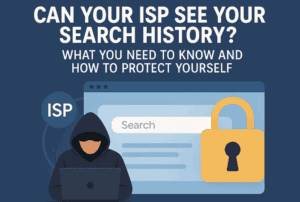
- Internet Service Provider (ISP) → They still see the websites you visit.
- Employer or School Network Administrator → They can log all your traffic.
- Websites themselves → They can still see your IP address and identify you.
Let’s break down some common myths.







❌ Does private browsing hide your location?
No. Your IP address still reveals your approximate geographic location.
❌ Does it encrypt your traffic?
No. Only a VPN (Virtual Private Network) or HTTPS encryption can secure your traffic in transit.
❌ Does it make your browsing anonymous?
No. Your identity can still be tracked through your IP address, device fingerprinting, and online accounts.
🛠️ Real Example: Amazon with and without Private Browsing
To better understand, let’s compare Amazon browsing in normal mode vs incognito mode.
- In normal mode, Amazon recognizes your account, shows your shopping history, and recommends products (e.g., “Keep shopping for…” or “Related to items you viewed”).
- In incognito mode, Amazon treats you like a new visitor. You’re not logged in, and recommendations are generic instead of tailored.
This illustrates the biggest benefit: websites don’t retain personal browsing data between sessions.
📚 When Private Browsing Is Useful
Even though it has limitations, private browsing has several legitimate uses:
- Holiday gift shopping → Avoid spoiling surprises for family members who share your device.
- Researching sensitive topics → Health issues, job applications, or personal finance searches stay hidden from your local history.
- Using shared/public computers → Prevents your login details from being stored.
- Testing websites as a “new user” → Developers and marketers often use incognito to see what fresh visitors experience.
⚠️ The Limitations You Must Remember
While private browsing has value, relying on it for complete privacy is a mistake. Keep these limitations in mind:
- Your ISP and network administrator can still log activity.
- Your IP address remains visible to websites.
- Search engines may still tailor results based on IP and other signals.
- Private browsing only protects data on your local device (like cookies, cache, and history).
🔑 Alternatives for Real Privacy
If your goal is true online privacy, here are safer options:
1. VPN (Virtual Private Network)
A VPN hides your IP address and encrypts your internet traffic. This prevents ISPs, hackers, or even websites from easily identifying you. Popular VPNs include ProtonVPN and NordVPN.
2. Tor Browser
The Tor Browser routes your traffic through multiple servers, making it extremely difficult to trace. It’s slower but offers stronger anonymity.
3. Privacy-focused browsers
Some browsers like Brave or [Firefox with add-ons] focus on privacy by blocking trackers by default.
4. Combine Tools
For maximum protection, you can use private browsing + a VPN + tracker-blocking extensions.
🙋 Frequently Asked Questions
Q1. Is incognito mode completely private?
No. It only hides browsing history and cookies on your device. Your ISP, employer, or websites can still track you.
Q2. Does incognito mode hide downloads?
No. Files you download remain on your device even after closing the incognito window.
Q3. Can private browsing hide my activity from Google?
Partially. While your searches won’t be linked to your local history, Google can still log them on its servers tied to your IP address.
Q4. Is incognito mode safe for online banking?
It doesn’t make banking safer than normal browsing. Security depends more on HTTPS encryption and your device’s safety.
Q5. Should I use incognito mode all the time?
Not necessarily. It’s helpful for certain cases but does not replace tools like VPNs or privacy browsers.
⚖️ Disclaimer
Private browsing is a local privacy feature, not a full anonymity tool. It helps prevent data storage on your device but does not shield your identity online. For complete privacy, consider VPNs, encrypted browsers, or advanced tools like Tor.
✅ Conclusion
Private browsing — whether it’s called Incognito Mode, Private Mode, or InPrivate Browsing — is useful but often misunderstood. It prevents cookies and history from being saved locally, but it does not hide your activity from ISPs, network admins, or websites.
Think of it as a temporary shield for your local device, not a cloak of invisibility online. Use it wisely for gift shopping, account switching, or research, but turn to VPNs or privacy browsers when you need real anonymity.
Tags
private browsing explained, incognito mode guide, does incognito hide IP, vpn vs private mode, internet privacy tips, secure browsing guide, tor vs incognito
Hashtags
#Privacy #Incognito #VPN #CyberSecurity #PrivateBrowsing #InternetSafety #OnlinePrivacy