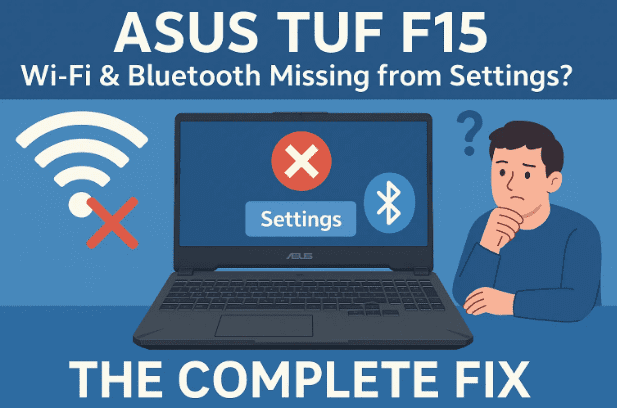
Nothing kills momentum like opening your laptop, ready to get things done (or queue into a game), and… no Wi-Fi. Sometimes Bluetooth joins the strike too—headphones won’t pair, your mouse disappears, and Windows Settings shows… nothing.
If you’re seeing Wi-Fi and/or Bluetooth missing on an ASUS TUF F15 (or any modern Windows 11/10 laptop), don’t panic. This guide walks through every practical fix, from quick checks to deeper driver and system repairs.
We’ll start with the simplest steps and gradually move to advanced ones. As we go, I’ll explain why you’re doing each step and what to expect. If a step feels a bit technical, I’ll add context and safer alternatives. By the end, your wireless radios should be back and behaving.
What we’re fixing (and why it happens)
Before diving into buttons and commands, a quick primer helps you choose the right fix faster.
Typical symptoms:
- The Wi-Fi toggle is missing in Settings → Network & Internet.
- Bluetooth toggle is missing in Settings → Bluetooth & devices.
- Device Manager shows no “Network adapters” for Wi-Fi (e.g., Intel® AX201/AX211/AX210) or no “Bluetooth” device; or it shows them with a yellow warning icon.
- Airplane mode won’t turn off, or it’s stuck grayed out.
- After a Windows update, wireless devices randomly vanish.
Common root causes:
- A driver issue (wrong, outdated, corrupted, or partially installed).
- A power event or crash causing Windows to “forget” devices temporarily.
- System file corruption after updates or sudden shutdowns.
- Radio disabled by hotkey/BIOS setting.
- Third-party software (VPNs, security suites) clashing with the networking stack.
- Rarely, a hardware fault (loose antenna, failing card) — we treat this as last resort.
Good news: in most cases, software/driver resets bring things back.
1) Quick sanity checks (don’t skip)
A few fast checks save time later.
- Restart the laptop (not just sleep). A cold boot clears radio firmware hiccups and reloads drivers.
- Airplane mode: Press your ASUS wireless hotkey (often Fn + F2 on many ASUS models) once or twice to toggle radios. Double-check in Settings → Network & Internet and Bluetooth & devices.
- Physical kill switch? Most TUF F15 models don’t have one, but if yours does, switch it ON.
- Windows Update: Go to Settings → Windows Update → Check for updates, install everything, reboot. Wireless fixes often arrive via cumulative updates.
- External USB devices: Temporarily unplug USB hubs/docks; a misbehaving dock can hijack networking.
If Wi-Fi/Bluetooth are still missing, we’ll get hands-on with drivers.
2) Device Manager: refresh, update, and reinstall adapters
Windows sometimes loses track of a device after a crash/hibernate cycle. Let’s force it to re-detect.
- Open Device Manager
- Right-click the Start button → Device Manager.
- Show hidden devices
- In Device Manager, click View → Show hidden devices.
- Expand Network adapters and Bluetooth.
- Look for entries like Intel(R) Wi-Fi 6/6E/7 AX201/AX211/AX210, MediaTek/Realtek Wi-Fi, and Intel(R) Wireless Bluetooth.
- Scan for hardware changes
- In the top menu, click the computer-with-magnifying-glass icon (Action → Scan for hardware changes).
- If the adapter reappears, great; continue below.
- Update driver (automatic)
- Right-click your Bluetooth adapter → Update driver → Search automatically for drivers.
- Repeat for your Wi-Fi adapter under Network adapters.
- Uninstall & rescan (re-enumeration)
If the device shows errors or won’t work after auto-update:- Right-click the adapter → Uninstall device → check Attempt to remove the driver for this device if available → Uninstall.
- At the top, click Action → Scan for hardware changes. Windows will reinstall a baseline driver.
Why this works: It forces Windows to rebuild the device instance and rebind drivers. If hidden/ghost devices overlap, this clears conflicts.







If Device Manager isn’t restoring them or updates don’t stick, system files might be damaged. Let’s fix that next.
3) Run system repairs (SFC & DISM) the right way
These commands repair corrupted system files and the Windows component store—both can break wireless stacks.
Open Command Prompt as Administrator:
Start → type cmd → right-click Command Prompt → Run as administrator.
Run these in order (each can take time; wait for completion):
sfc /scannow
- SFC will verify and repair protected system files. When it finishes, note its message (repaired/not found).
Now the three DISM commands:
DISM /Online /Cleanup-Image /CheckHealth
DISM /Online /Cleanup-Image /ScanHealth
DISM /Online /Cleanup-Image /RestoreHealth
- /CheckHealth is quick; /ScanHealth is deeper; /RestoreHealth performs repairs.
- When DISM completes, restart the laptop.
- Optional but helpful: run
sfc /scannowonce more after DISM repairs, then reboot again.
Now check Settings → Network & Internet and Bluetooth & devices. If toggles are still missing, we’ll reset the networking stack.
4) Network Reset (Windows 11/10)
This rebuilds the entire network stack (adapters, bindings, Winsock, TCP/IP). You’ll need to re-enter Wi-Fi passwords after this.
- Windows 11: Settings → Network & Internet → Advanced network settings → Network reset → Reset now.
- Windows 10: Settings → Network & Internet → Status → Network reset → Reset now.
The system reboots automatically. After restart, check Wi-Fi and Bluetooth again. If they’re still absent, we need to confirm the background services that manage radios.
5) Ensure essential services are running
Two services commonly impact Wi-Fi/Bluetooth visibility:
- WLAN AutoConfig (controls Wi-Fi profiles/radios)
- Bluetooth Support Service (manages discovery/pairing)
Open Services: press Win + R, type services.msc, press Enter.
- WLAN AutoConfig
- Startup type: Automatic
- Status: Running → if Stopped, start it.
- Bluetooth Support Service
- Startup type: Manual or Automatic (Automatic is fine)
- Status: Running → start if stopped.
Also verify these are not disabled: Device Association Service, Device Install Service, Device Setup Manager.
If services are fine, it’s time to use ASUS-specific tools and OEM drivers.
6) ASUS-specific fixes (hotkeys, MyASUS/Armoury Crate, BIOS, drivers)
We’ve done the Windows side. Now let’s leverage ASUS-provided pieces that often flip the last switch.
A) Hotkey & ASUS function utilities
ASUS hotkey packages control Fn-key radios. If they’re missing or outdated, toggles can misbehave.
- Install/update MyASUS (Microsoft Store) or ASUS Armoury Crate; these also manage drivers/utilities and can push radio fixes.
- Inside these apps, check System Diagnosis/Update sections for wireless-related updates.
B) BIOS/UEFI checks
A firmware toggle may disable radios:
- Reboot and enter BIOS/UEFI (usually F2 or Del on boot).
- Look for Advanced or Onboard Devices style menus:
- Ensure Wireless/WLAN and Bluetooth are Enabled.
- If you see Wireless Radio Control, set it to On.
- Save & Exit (F10).
While you’re there, note the BIOS version. An outdated BIOS can have radio bugs; if needed, update later via the ASUS support page for your exact model.
C) ASUS support drivers
Driver order matters. For TUF F15, install in this order when doing a clean pass:
- Chipset driver (always first)
- Intel Serial IO / ME (Management Engine) (if listed)
- Intel Wireless (Wi-Fi) driver
- Intel Wireless Bluetooth driver
- ASUS Wireless Radio Control / Hotkey packages (if available)
Find your exact model (e.g., TUF Gaming F15 FX506, FX507, etc.) on the ASUS Support website and download drivers for your Windows version.
- ASUS Support: https://www.asus.com/support/
We’ll also discuss Intel’s official installers in the next section, but always prefer ASUS-tuned drivers first for maximum compatibility.
So far we’ve set the stage. Next, let’s do a clean driver install to eliminate corruption.
7) Intel/Realtek driver installs (clean method)
Most TUF F15 units ship with Intel® AX201/AX211/AX210 Wi-Fi and Intel Bluetooth. Some configurations use MediaTek or Realtek; check Device Manager or your ASUS product page.
A) Clean removal
- Device Manager → Network adapters → right-click your Wi-Fi adapter → Uninstall device → check Attempt to remove the driver → Uninstall.
- Device Manager → Bluetooth → do the same for Intel(R) Wireless Bluetooth (or equivalent).
- Reboot the laptop. After reboot, Windows will use a generic baseline or show them as unknown devices—perfectly fine for the next step.
B) Install vendor drivers
- ASUS support page for your model: download and install the Wi-Fi and Bluetooth packages in order. Reboot after each if prompted.
- If ASUS packages are unavailable/outdated for your OS build, use Intel’s official packages:
- Intel® Driver & Support Assistant (DSA): https://www.intel.com/content/www/us/en/support/detect.html
- Or direct downloads from Intel® Wireless and Bluetooth pages.
C) Verify
After installation and reboot:
- Settings → Network & Internet should show Wi-Fi toggle.
- Settings → Bluetooth & devices should show Bluetooth toggle.
- Device Manager should list Intel(R) Wi-Fi … and Intel(R) Wireless Bluetooth without warning icons.
If drivers installed cleanly but radios still vanish intermittently, power management can be the culprit.
8) Power & performance settings that quietly break radios
Windows tries to save power aggressively on laptops, sometimes overdoing it.
A) Disable power saving on adapters
- Device Manager → Network adapters → double-click your Wi-Fi adapter.
- Power Management tab → uncheck “Allow the computer to turn off this device to save power.”
- Do the same under Bluetooth (Device Manager → Bluetooth → adapter → Power Management).
- Reboot.
B) Windows power plan
- Control Panel → Power Options (or Settings → System → Power):
- Set to Balanced or Best performance.
- Under advanced power settings (legacy Control Panel view), ensure Wireless Adapter Settings → Power Saving Mode is Maximum Performance on battery and plugged in.
C) Fast Startup
Fast Startup can cache a broken state:
- Control Panel → Power Options → Choose what the power buttons do → Change settings that are currently unavailable → uncheck “Turn on fast startup.”
- Save → Restart.
If power tweaks don’t help, let’s deep-clean ghosts and rebuild the driver store.
9) Advanced: remove ghost devices & rebuild the driver store
This step is optional but useful after many failed installs/uninstalls.
A) Show and remove ghost devices
- Open Command Prompt (Admin) and run:
set devmgr_show_nonpresent_devices=1 start devmgmt.msc - In Device Manager → View → Show hidden devices.
- Under Network adapters and Bluetooth, right-click any greyed-out duplicates → Uninstall device (do not uninstall physical devices you’re actively using).
- Action → Scan for hardware changes.
B) Rebuild Winsock/TCP/IP (if Wi-Fi returns but no connectivity)
Open Command Prompt (Admin) and run:
netsh winsock reset
netsh int ip reset
ipconfig /release
ipconfig /flushdns
ipconfig /renew
Reboot and test connectivity.
If you’ve made it here and radios still don’t appear, consider the possibility of a hardware issue.
10) When it’s likely hardware (and what to test)
Hardware failure is uncommon but possible—especially after a drop/liquid event or if the card runs hot for long periods.
Signs pointing to hardware:
- The Wi-Fi/Bluetooth devices never appear in Device Manager (even as unknown) after scans and reinstall attempts.
- In Linux live USB boot (Ubuntu, etc.),
lspci/lsusbdoesn’t show the wireless adapter either. - BIOS shows no wireless device or diagnostic fails (if available).
- Radios come and go with lid movement (loose antenna leads).
What to try:
- BIOS update (from ASUS support page) — sometimes fixes PCIe initialization quirks.
- If under warranty, contact ASUS Support for inspection.
- Out of warranty: a technician can reseat/replace the M.2 Wi-Fi/Bluetooth module or check antennas.
11) FAQ
Q1: My Wi-Fi and Bluetooth vanished after a Windows update. Should I roll back?
Try the steps above first (drivers/SFC+DISM/Network Reset). If nothing works, you can Uninstall the latest quality update from Settings → Windows Update → Update history. Then install updated OEM drivers, and reapply Windows updates.
Q2: Device Manager only shows “Other devices → Network Controller” with a yellow icon.
That means Windows sees the hardware but lacks a driver. Install the correct chipset, then Wi-Fi and Bluetooth drivers from ASUS support (or Intel’s site for AX2xx adapters). After install, the device should move under Network adapters/Bluetooth.
Q3: Bluetooth works but Wi-Fi doesn’t (or vice versa).
They’re separate device functions even if they share one M.2 card. Install drivers for both. Also verify WLAN AutoConfig and Bluetooth Support Service are running.
Q4: Can VPN/security software hide my Wi-Fi?
Not literally hide, but they can break the stack. Temporarily disable third-party firewalls/VPNs and test. If it works, reinstall or switch providers.
Q5: Will Network Reset delete my Ethernet or Bluetooth devices?
It removes and reinstalls network adapters and bindings. Devices will reappear after reboot; you’ll need to re-pair Bluetooth devices and re-enter Wi-Fi passwords.
Q6: Which driver should I trust—ASUS or Intel?
Prefer ASUS first (tuned for your model). If ASUS drivers lag your Windows build or fail, install Intel’s latest stable packages.
Q7: I don’t see “Power Management” on my adapter.
Some drivers omit that tab. In that case, set Wireless Adapter Settings → Power Saving Mode to Maximum Performance in Power Options.
Q8: Do I need Armoury Crate/MyASUS for Wi-Fi to work?
Not strictly, but those apps can install required ASUS services and hotkey packages that impact radio toggles. Keeping them updated helps.
12) Final checklist (apply in this order)
Let’s summarize everything into a clear path you can follow:
- Reboot; toggle Airplane mode with Fn hotkey.
- Windows Update all pending patches; reboot.
- Device Manager → Scan for hardware changes; Update driver for Bluetooth and Wi-Fi; if needed, Uninstall device then Scan.
- SFC & DISM repairs (Admin CMD):
sfc /scannow DISM /Online /Cleanup-Image /CheckHealth DISM /Online /Cleanup-Image /ScanHealth DISM /Online /Cleanup-Image /RestoreHealthReboot between steps as directed. - Network Reset (Settings) → reboot.
- Services: set WLAN AutoConfig = Automatic (Running); Bluetooth Support Service = Manual/Automatic (Running).
- ASUS: install/update MyASUS/Armoury Crate; check for device/utility updates; verify BIOS radios are enabled.
- Clean driver install:
- Uninstall Wi-Fi/Bluetooth in Device Manager (remove drivers).
- Reboot.
- Install ASUS chipset → Wi-Fi → Bluetooth (or Intel packages).
- Reboot after each if requested.
- Power settings: disable device power saving; set Wireless Adapter to Maximum Performance; consider disabling Fast Startup.
- Advanced: remove ghost devices; netsh resets if connectivity is flaky.
- If still missing: BIOS update; test with a Linux live USB; contact ASUS Support—likely hardware.
Follow that sequence and you’ll resolve the issue in the vast majority of cases.
13) Disclaimer
This article is for educational purposes. Driver/firmware changes and advanced commands should be performed carefully. Back up important data before major changes. If your ASUS TUF F15 is under warranty or managed by an organization, consult ASUS Support or your IT department before proceeding. Links to vendor tools are provided for convenience—always download from official sites.
Tags & Hashtags
Tags:
ASUS TUF F15 Wi-Fi missing, Bluetooth missing Windows 11, Intel AX201 AX211 driver fix, WLAN AutoConfig not running, network reset Windows, ASUS wireless driver, MyASUS Armoury Crate, SFC DISM network repair, Device Manager Wi-Fi not showing, Windows 11 Bluetooth toggle missing
Hashtags:
#ASUS #TUFF15 #Windows11 #WiFiFix #BluetoothFix #IntelAX201 #NetworkTroubleshooting #MyASUS #ArmouryCrate #TechGuide