Technology never slows down — and this week proved it once again.
Microsoft quietly rolled out what many are calling a “Windows 12 in disguise” update, Android manufacturers began mimicking Apple’s latest iOS 26 visual language, and the debate around wireless charging standards took an unexpected twist.
If you missed the headlines, this article breaks down everything you need to know — what changed, why it matters, and what it reveals about the direction of the tech industry.
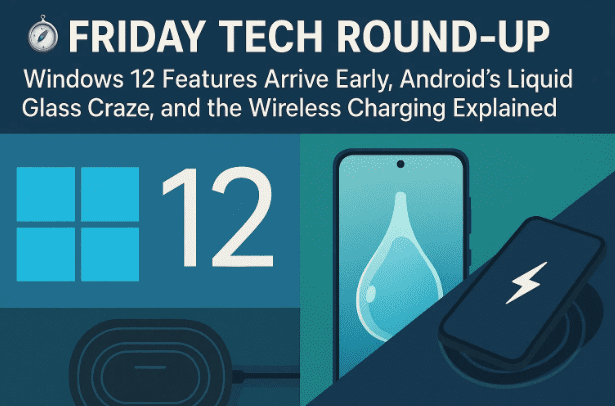
🪟 Windows Update: Is This Windows 12 in Disguise?
Microsoft’s newest update for Windows 11 feels much bigger than a routine patch. In fact, many insiders are calling it “Windows 12 without the name.”
The update introduces deep AI integration through Copilot — not as a chatbot on the side, but as a system-level assistant woven directly into Windows.
According to Microsoft, the goal is to create a computer you can talk to naturally, one that not only understands context but also takes direct action.
At first glance, that might sound futuristic, but this upgrade marks a major philosophical shift:
Windows is no longer just an operating system — it’s becoming a conversational interface.
Let’s unpack the three main Copilot features introduced in this update.
👁️ Copilot Vision: See What Your PC Sees
Imagine being able to show your PC your screen and simply say, “Find this product online” or “Summarize this document.”
That’s exactly what Copilot Vision enables.
It acts like a built-in screen-recognition layer — very similar to Google’s “Circle to Search” on Android phones — but integrated throughout Windows.
You can highlight parts of your screen, ask about them, or even request that Copilot identify visual elements (for instance, a product, a photo, or a text block in a PDF).
The feature works manually, meaning it activates only when you trigger it, which should ease privacy worries. Microsoft says Copilot Vision is rolling out globally, though the exact availability depends on your Windows build and hardware compatibility.
Potential Use Cases
- Identifying unknown objects or products shown in a presentation.
- Extracting text from screenshots or images without opening another app.
- Quickly searching for visual matches across the web.
Let’s move to the next layer — automation.


⚙️ Copilot Actions: Turning Commands Into Tasks
Perhaps the most practical part of the update is Copilot Actions, a feature that can actually control your PC.
In Microsoft’s demonstration, users gave Copilot access to a folder full of images and asked it to:
- Fix orientation on all photos.
- Remove duplicate files.
Copilot then performed the task autonomously, step by step, while keeping the user informed through a progress timeline.
You can interrupt or modify the process midway — something no previous Windows assistant ever allowed.
If Microsoft extends this feature to common file-management tasks (like merging PDFs, renaming batches of files, or clearing redundant downloads), Copilot might finally feel less like a gimmick and more like a productivity tool.
Still, there’s a clear caution: automation must be predictable and reversible. Users should have full visibility into what Copilot changes in real time.
🔗 Copilot Connectors and the Privacy Question
The update also introduces Copilot Connectors — integrations that link Windows to third-party services like OneDrive, Gmail, and Google Drive.
That means Copilot can eventually perform actions on data stored in the cloud, not just locally.
For example, you could ask it to find a spreadsheet in Google Drive and attach it to an Outlook email — all in one sentence.
While that sounds convenient, it also opens major questions about data access and permissions.
Microsoft says connectors work only with explicit user approval, but most experts agree we need detailed control dashboards before these features expand further.
🍏 Android 16 Copies Apple’s “Liquid Glass” Aesthetic
Now to smartphones.
After Apple introduced its new Liquid Glass design language in iOS 26, nearly every major Android manufacturer — Honor, Oppo, Vivo, and OnePlus — announced UI updates that look strikingly similar.
Their Android 16 skins feature:
- Frosted glass widgets and lock screens.
- Translucent clocks that blend into wallpapers.
- Shimmering edge reflections and “bubble-like” animations.
Even Samsung’s One UI 8.5 beta includes subtle floating menus and rounded glassy bubbles clearly inspired by iOS.
The only major brand resisting the trend so far is Google Pixel, which retains its Material You look.
So far, so pretty — but is it originality or imitation?
🎨 Why Android’s iOS Look-Alike Problem Keeps Coming Back
This isn’t the first time Android UIs have mirrored Apple’s design.
We saw the same pattern with notch cut-outs, dynamic islands, and minimal iconography.
To be fair, glass-like translucency isn’t Apple’s invention — Windows 11 and even macOS Big Sur adopted frosted panels years earlier.
But what’s striking this time is the timing: nearly every Android brand jumped aboard within weeks of Apple’s reveal.
Critics argue that Android’s unique strengths — customization, flexibility, widgets, and powerful notifications — risk being diluted by copying Apple’s form instead of improving function.
For example, Vivo’s new notification system reportedly mimics iOS’s stacked cards, which actually reduces information density compared to classic Android layouts.
The best approach would be balance: adopting Apple’s visual polish while keeping Android’s superior usability intact.
⚡ The Nothing Wireless Charging Controversy Explained
Let’s move to the next topic — and it’s a fascinating one.
London-based tech company Nothing recently suggested that Apple’s MagSafe magnetic charging system is essentially locked behind patents and political barriers.
They claimed this legal red tape makes it too expensive for other brands to adopt compatible magnetic arrangements.
According to their public statement, building a comparable system could cost around $10 million in R&D.
However, experts quickly disputed this claim.
The Wireless Power Consortium (WPC) — the group behind the Qi2 charging standard — clarified that magnetic alignment is already part of the open specification and available to any member company under RAND (Reasonable and Non-Discriminatory) terms.
In other words, if a manufacturer joins the WPC, they can use Qi2 magnets without paying Apple-level fees or reinventing the wheel.
It appears Nothing may have misinterpreted how the licensing process works rather than intentionally misleading users.
Still, this confusion highlights how little transparency exists in the wireless-charging ecosystem — and how easily misinformation can spread when “MagSafe-compatible” branding enters the discussion.
So what’s the real takeaway?
- Qi2 is open. Any certified manufacturer can implement magnetic alignment.
- Compatibility matters. Non-standard magnets may cause misaligned coils and heat.
- Membership = Access. Join WPC to avoid extra licensing headaches.
This debate will likely cool down soon, but it serves as a reminder that wireless charging tech is mostly political, not purely technical.
🍎 Apple’s M5 Chip and New Device Lineup
While everyone else experiments with AI and design languages, Apple quietly updated nearly its entire hardware lineup around its new M5 chip.
💻 What’s New
- CPU: Minor speed bump over the M4.
- GPU: Around 45 percent faster, marking the biggest generational leap since M1 → M2.
- Vision Pro (2nd gen): Gains a 120 Hz panel (up from 90 Hz) and a redesigned dual-strap headband for comfort.
- MacBook Pro 14-inch (2025): Ships with M5, faster SSDs, and slightly lower European pricing.
- iPad Pro M5: Adds Apple’s new C1X and N1 wireless chips for better connectivity.
💶 The Charger Controversy
In Europe, Apple has removed the charger from the MacBook box.
Instead, customers can purchase a 65 W or 85 W adapter separately for €65 – €85.
However, prices of the laptops have dropped €100 overall, meaning users who reuse an existing charger actually save money.
While social media labeled it “greedy,” in practice it’s a regulatory compromise — reducing e-waste while keeping costs flexible.
🌍 Other Tech Highlights of the Week
- Samsung S26 Edge Cancelled: Korean outlet News PIM reports, and SamMobile confirms, that Samsung is dropping the Edge model due to poor S25 Edge sales.
- Samsung Project Muhan: Teaser hints at a Vision Pro competitor, launching October 21.
- Austria Goes Open Source: The Austrian military is replacing Microsoft Office with LibreOffice across 16 000 computers to improve digital sovereignty.
- Dutch Government Reclaims Nexperia: Taking back control from Chinese owners over national-security concerns.
- AI-Generated Ads: Both Honor and Samsung released promotional clips clearly made with generative AI — complete with uncanny visuals and distorted faces. The reception? Overwhelmingly negative.
These last items underline a growing tension in the industry: just because AI can generate content doesn’t mean it should. Creativity still needs craftsmanship.
❓ Frequently Asked Questions
Q1. Is Copilot Vision safe to use?
Yes. Microsoft states that Vision activates only when manually triggered and processes data locally or via secure Azure AI endpoints.
Q2. Will these Windows features require new hardware?
Most will run on current Windows 11 PCs, though advanced AI tasks may need NPUs (Neural Processing Units) found in newer Copilot+ PCs.
Q3. What is Qi2 and why does it matter?
Qi2 is the Wireless Power Consortium’s latest open wireless-charging standard that incorporates magnetic alignment (similar to MagSafe) to improve coil efficiency and reduce heat.
Q4. Which Android brand copied Apple the most?
Design-wise, Honor’s new Magic UI 16 shows the closest resemblance to iOS 26’s “Liquid Glass,” though Oppo and Vivo aren’t far behind.
Q5. Is Apple really removing chargers to be eco-friendly?
Partly. EU regulations encourage reducing e-waste, and Apple leverages that policy while cutting costs — but overall pricing still favors consumers in Europe.
🧩 Final Thoughts
This week perfectly captures the contradictions of modern tech:
AI is making PCs smarter, smartphones prettier, and yet the industry keeps recycling old ideas under new names.
Microsoft is quietly rebuilding Windows around conversation.
Android is polishing Apple’s reflections instead of inventing its own.
Apple is refining its chips and hardware while trimming the box contents.
And Nothing proved that even talking about open standards can be misunderstood.
Progress isn’t just about innovation — it’s about interpretation.
The next twelve months will reveal whether these changes truly empower users or simply rebrand the familiar.
⚠️ Disclaimer
Information in this article is based on publicly available data as of October 2025. Features, specifications, and release schedules are subject to change. All brand names and trademarks belong to their respective owners.
#Windows12 #Copilot #Android16 #LiquidGlass #WirelessCharging #Qi2 #AppleM5 #MacBookPro #VisionPro #TechUpdate #FridayCheckout #AIinTech