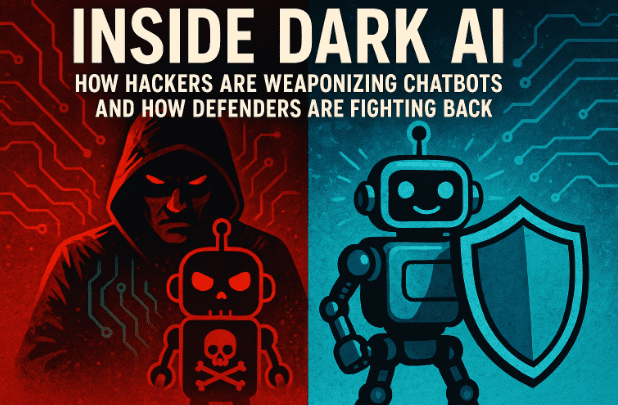
Artificial Intelligence has transformed everything — from art creation to business analytics. But there’s a darker side quietly emerging beneath the surface — a world where AI isn’t used to automate productivity, but to automate crime.
This growing phenomenon is now called “Dark AI” — and its story begins with one notorious tool: WormGPT.
In this article, we’ll explore how dark AI evolved, the mechanics of AI-driven hacking, the ongoing defense strategies from major tech players, and what this arms race means for the future of cybersecurity.
1️⃣ The Birth of Dark AI: From Chatbots to Cyber Weapons
In June 2023, just seven months after OpenAI released ChatGPT’s research preview, a mysterious chatbot named WormGPT appeared on underground forums.
Unlike ChatGPT, it wasn’t designed to write essays or answer questions politely — its job was to help hackers.
Its creator marketed it as a “jailbreak-free AI” with no ethical filters. It could craft scam emails, generate malware code, and even plan phishing campaigns — all things ChatGPT would immediately refuse to do.
For a while, WormGPT was the talk of the cyber underground. Access cost up to €500 per month, and some users paid €5,000 for private installations. Within months, it gained hundreds of paying customers, showing how profitable unfiltered AI could become for malicious purposes.
Eventually, investigative journalist Brian Krebs exposed the developer, Rafael Morais, leading to WormGPT’s shutdown. But the damage was done — the idea of “Dark AI” had already escaped into the wild.
2️⃣ WormGPT and Its Successors: FraudGPT, DarkGPT, and More
WormGPT’s demise didn’t end the trend — it ignited it.
Soon after, FraudGPT, DarkGPT, XXXGPT, and Evil-GPT began to appear across the dark web. Each promised one thing: no guardrails, no morals, total freedom.
FraudGPT, for instance, had over 3,000 paid users in its first few months, marketed as an “AI assistant for professional fraudsters.”
Other versions like Keanu-WormGPT used jailbroken versions of existing chatbots (like X’s Grok) to power their unrestricted systems.
The users ranged from script kiddies to sophisticated threat actors — all exploiting AI’s ability to generate content at scale.
Let’s move to the next section to understand what really separates “dark AI” from simple misuse of AI.
3️⃣ Dark AI vs Misused AI — Understanding the Difference
Not every harmful outcome from AI is the result of dark AI. Sometimes, legitimate AI tools are just misused.
For instance, tricking ChatGPT into writing a phishing email by framing it as “a fictional example” is misuse — but not dark AI itself.









Dark AI tools, however, are built without ethical constraints from the start. They are trained or modified for offensive or unethical use.
Here’s a quick side-by-side comparison:
| Feature / Aspect | Mainstream AI (e.g., ChatGPT, Gemini) | Dark AI (e.g., WormGPT, FraudGPT) |
|---|---|---|
| Guardrails | Yes — trained to reject malicious requests | None — deliberately removed |
| Use Cases | Education, business, research, creativity | Hacking, scams, malware, fraud |
| Accessibility | Public platforms (OpenAI, Google) | Private dark web sales or forums |
| Training Data | Curated, filtered content | Often includes malware, exploits, and leaked data |
| Ethical Controls | Strong (reinforcement learning, moderation) | Absent or disabled |
| Legal Oversight | Regulated and transparent | Unregulated, anonymous development |
So far, we’ve seen what defines dark AI — now let’s dive deeper into how hackers are using it in the real world.
4️⃣ How Hackers Are Exploiting Generative Models
Dark AI tools take advantage of AI’s ability to mimic human behavior, write code, and analyze data faster than any individual.
Common malicious uses include:
- Phishing Automation – generating personalized scam emails by analyzing a victim’s online activity or company data.
- Malware Writing – producing functional code snippets that can disable antivirus or exploit vulnerabilities.
- Deepfakes and Voice Cloning – impersonating individuals for fraud or blackmail.
- Social Engineering Scripts – crafting manipulative conversations or messages to trick targets.
Cybersecurity strategist Crystal Morin (Sysdig, ex–U.S. Air Force analyst) explains:
“Anyone with a GPU and some technical know-how can self-host an LLM and fine-tune it for a specific purpose. That’s exactly how threat actors are bypassing the safeguards built into popular public models.”
In short: even low-skill criminals can now run complex attacks by simply typing prompts.
There’s no need for coding expertise — the AI writes, tests, and improves the code itself.
Let’s see how the good guys are responding.
5️⃣ Fighting Fire with Fire: AI Defenders Rise
As dark AI evolves, so does AI-powered cybersecurity.
Organizations like Microsoft, OpenAI, and Google are actively building systems that fight back using the same weapon — artificial intelligence.
Examples of defense in action:
- Microsoft Threat Intelligence used AI to detect and shut down a large-scale phishing operation suspected to use WormGPT-style automation.
- OpenAI created a tool to detect AI-generated images — combating deepfake and misinformation campaigns.
- Google DeepMind developed Big Sleep, an AI that identifies vulnerabilities in popular software like Chrome before attackers exploit them.
Cybersecurity expert Crystal Morin sums it up:
“Cybersecurity has always been an arms race — and AI just raised the stakes.”
Red teaming — where ethical hackers simulate attacks — has become AI-powered too. Some companies now deploy “attacker AIs” internally to stress-test their own systems before real threats can.
AI in defense is used to:
- Detect abnormal network behavior in real time.
- Analyze millions of emails and spot patterns of phishing.
- Automate software patching and vulnerability scanning.
- Simulate hacker behavior safely to strengthen internal systems.
So far, we’ve looked at the tech. But there’s a deeper issue that complicates everything — the law.
6️⃣ Legal and Ethical Gray Areas
Here’s where things get tricky.
Creating an AI capable of writing malware or scam content isn’t necessarily illegal — it’s what you do with it that counts.
Researchers and security analysts often fine-tune AI models to study cyberattacks or test defense tools. That’s considered good faith use.
But the same code in the wrong hands becomes a cybercrime tool.
The problem? The law hasn’t caught up with AI’s speed.
It’s similar to owning a radar detector for your car — buying it is legal, but using it while driving might not be. Likewise, developing an uncensored model is allowed, but deploying it for phishing or fraud is a crime.
That’s why most arrests related to dark AI target users, not creators.
Until global laws evolve, dark AI developers often operate in a gray zone of “technical legality, moral corruption.”
7️⃣ The Cyber Arms Race Ahead
The rise of dark AI is just another chapter in the long story of cyber warfare.
For decades, every new security innovation has been met with an equally innovative attack.
But now, both sides are learning and evolving at machine speed.
Hackers can create new malware variants in hours.
Defenders can patch systems automatically using AI diagnostics.
Each time this back-and-forth happens, both sides get smarter.
Experts agree we can’t “unring the AI bell.” The key is to build faster, safer, transparent AI systems that detect and neutralize threats before harm occurs.
AI won’t end cybercrime — but it can help ensure humans stay one step ahead of malicious machines.
💬 8️⃣ Frequently Asked Questions (FAQs)
Q1. What exactly is Dark AI?
Dark AI refers to artificial intelligence systems designed or modified for malicious use — such as hacking, fraud, or social manipulation — often sold on the dark web.
Q2. How is Dark AI different from jailbroken ChatGPT models?
Jailbroken models are temporary modifications of legitimate tools; Dark AI models are built without guardrails from the start and often trained on malicious data.
Q3. Is creating Dark AI illegal?
Not necessarily. Creating or studying an unrestricted model is legal in many places, but using it for criminal acts (phishing, data theft, ransomware) is illegal.
Q4. Can AI detect or stop other AI-based attacks?
Yes. AI-based security systems can recognize patterns, detect fake content, and respond automatically — much faster than humans.
Q5. How can individuals protect themselves from AI-driven scams?
Stay skeptical of unexpected messages, verify sources before clicking links, and enable multi-factor authentication. Awareness is your best defense.
✅ Conclusion
Dark AI shows both the power and peril of technology.
Just as WormGPT opened the door to AI-driven cybercrime, new innovations from defenders are closing it — one algorithm at a time.
This battle isn’t about AI vs humans anymore — it’s AI vs AI, where ethics, speed, and innovation will decide who wins the future of cybersecurity.
#DarkAI #CyberSecurity #AIThreats #WormGPT #TechEthics #DataProtection #GenerativeAI #OpenAI #GoogleDeepMind #ArtificialIntelligence