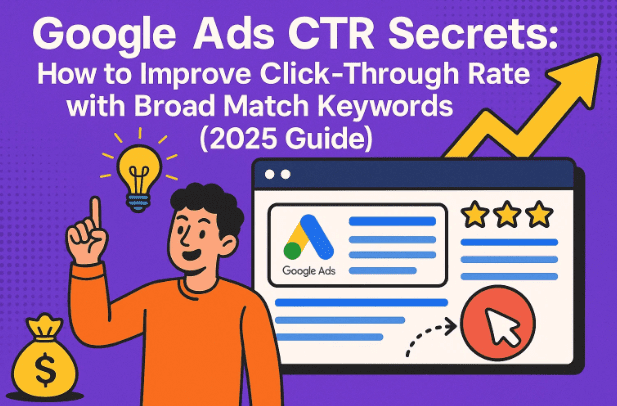
1️⃣ Introduction: Why CTR Still Matters in 2025
Even with AI-powered bidding and automated campaigns, CTR (Click-Through Rate) remains one of the most important metrics in Google Ads. It directly influences your Quality Score, affects Cost per Click (CPC), and ultimately determines how much traffic you attract — without always paying more.
A good CTR means your ad is relevant and engaging. In competitive markets, even a 1% increase in CTR can significantly reduce your CPC and improve conversions.
So the question is:
👉 Can you achieve a good CTR while using Broad Match keywords — the most flexible and risky match type in Google Ads?
Let’s explore that in detail.
2️⃣ What CTR Really Means (and Why It’s Not Just a Number)
CTR, or Click-Through Rate, measures how often people who see your ad actually click on it.
Formula:
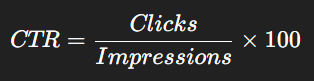
Example:
If your ad received 3 clicks out of 100 impressions, your CTR is 3%.
While this looks simple, CTR isn’t just a percentage — it’s a reflection of how well your ad resonates with your target audience.
- A high CTR means your ad is relevant and appealing.
- A low CTR often signals poor targeting or weak ad copy.
In short, CTR = Relevance × Engagement.
3️⃣ Understanding Keyword Match Types in Google Ads
Before diving into optimization, it’s crucial to understand Google’s keyword match types. These determine how closely a user’s search must match your keyword for your ad to show.
| Match Type | Example Keyword | Search Query Example | Flexibility |
|---|---|---|---|
| Exact Match | [red shoes] | “red shoes” only | 🔒 Low |
| Phrase Match | “red shoes” | “buy red shoes online” | ⚖️ Medium |
| Broad Match | red shoes | “maroon sneakers”, “best footwear for running” | 🔓 High |
- Exact Match gives you tight control but limited reach.
- Phrase Match balances relevance and flexibility.
- Broad Match allows Google’s AI to interpret user intent — reaching a wide audience but risking irrelevant clicks.
In the past, marketers avoided broad match because it wasted budget on unrelated terms. But with AI-driven Smart Bidding, that’s changing.





4️⃣ Why Broad Match Keywords Still Have Potential
Let’s be honest — broad match has a bad reputation. Many advertisers associate it with low relevance and poor CTR. But in 2025, broad match has evolved.
Google now uses advanced semantic understanding and machine learning to match ads with user intent rather than exact keywords.
So when used correctly, broad match can bring high-intent traffic at scale — especially if paired with Smart Bidding and good negative keyword filtering.
Here’s how broad match can work in your favor:
- It helps discover new search terms you may not have thought of.
- It allows Google’s algorithms to find variations that still convert.
- It reduces the need for manual keyword lists, saving time.
But remember — control is key. Without proper structure, broad match can tank your CTR. Let’s see how to prevent that.
5️⃣ Smart Bidding + Broad Match = The Winning Combo
One of the best ways to make broad match work efficiently is by combining it with Smart Bidding strategies.
⚙️ What is Smart Bidding?
Smart Bidding uses Google’s AI to automatically adjust your bids based on real-time data — device, location, audience, time of day, and even likelihood of conversion.
Some popular Smart Bidding strategies include:
- Maximize Conversions
- Maximize Conversion Value
- Target CPA (Cost Per Acquisition)
- Target ROAS (Return on Ad Spend)
When you enable Smart Bidding with Broad Match:
- Google’s system filters irrelevant impressions faster.
- It learns which user intents are profitable.
- It adjusts bids to prioritize high-value clicks.
💡 Pro Tip:
Always start with Maximize Conversions or Target CPA when testing broad match. These strategies give Google enough data to optimize efficiently.
6️⃣ Mastering Negative Keywords to Control Relevance
Now, here’s where most advertisers go wrong — they use broad match without properly managing negative keywords.
Negative keywords tell Google when not to show your ads. This prevents wasted clicks from irrelevant searches.
🧱 Example:
Let’s say your keyword is “running shoes” (Broad Match).
Without negative keywords, your ad may appear for:
- “free running shoes”
- “shoe repair shop”
- “track running events”
To fix this, add negative keywords like:
- free
- repair
- event
- used
By being aggressive with negative keywords, you filter out non-converting traffic — which instantly improves CTR.
🔍 Where to Find Negative Keywords:
- Search Term Reports in your Google Ads dashboard.
- Google Keyword Planner for variations.
- Third-party tools like SEMrush or Ahrefs for competitive filtering.
Keep reviewing your Search Terms weekly to remove irrelevant ones and protect your CTR.
7️⃣ Ad Group Structuring: One Keyword, One Ad Rule
When using broad match, it’s essential to maintain tight ad group control.
A common mistake is stuffing multiple broad keywords into one ad group — this makes your ad copy less relevant.
Instead, follow the One Keyword Per Ad Group (SKAG) rule:
- Create one ad group for each keyword.
- Write a unique ad that matches that keyword’s intent.
Example:
| Ad Group | Keyword | Ad Headline |
|---|---|---|
| Ad Group 1 | running shoes | “Buy Lightweight Running Shoes – Free Shipping” |
| Ad Group 2 | jogging sneakers | “Top Jogging Sneakers for Daily Use” |
By doing this:
- Relevance between keyword, ad, and landing page stays high.
- CTR improves because the ad matches user intent more closely.
So far, we’ve built a strong foundation — now let’s make your ad stand out visually.
8️⃣ Boost CTR Using Ad Assets (Ad Extensions)
To get noticed, your ad must take up more visual space in Google’s search results.
That’s where Ad Assets (formerly known as Ad Extensions) come in. They allow you to add extra information and interactive elements to your ad.
Here’s a breakdown of the most effective ad assets to improve CTR:
| Asset Type | Example Use | Why It Helps |
|---|---|---|
| Sitelink Extensions | “Shop Men’s Shoes”, “Shop Women’s Shoes” | Increases clickable areas |
| Callout Extensions | “Free Returns”, “Fast Delivery”, “24/7 Support” | Highlights selling points |
| Structured Snippets | “Brands: Nike, Adidas, Puma” | Adds extra clarity |
| Price Extensions | “Starting from ₹1,999” | Attracts intent-driven buyers |
| Call Extensions | Click-to-call button | Improves mobile CTR |
| Location Extensions | Show business address | Builds trust and local intent |
Always attach at least 3–4 ad assets per ad group for maximum impact.
💬 Bonus Tip:
Use Advertiser Ratings and Promo Extensions to showcase offers, discounts, or trust badges. These increase visual credibility — which often translates into a higher CTR.
You can explore all ad asset types on Google Ads Help Center.
9️⃣ Practical Example: Turning a Low-CTR Campaign Around
Let’s look at how one advertiser optimized CTR for a fitness product using Broad Match + Smart Bidding.
🏃 Scenario:
A client was advertising “Running Shoes for Men” with a CTR of just 1.2%.
Initial setup:
- 10 broad match keywords in one ad group.
- Generic ad text (“Buy Running Shoes Online”).
- No ad assets.
- Manual CPC bidding.
Optimization steps taken:
- Switched to Smart Bidding (Maximize Conversions).
- Split ad groups into one keyword per ad group.
- Added negative keywords (“free”, “used”, “repair”, etc.).
- Added sitelinks, callouts, and price extensions.
- Rewrote ad copy with strong CTAs and matching intent.
Result after 2 weeks:
CTR increased from 1.2% to 5.8%, CPC dropped by 24%, and conversion rate improved by 35%.
The key takeaway?
➡️ Broad Match works when combined with automation, structure, and control.
🔟 Pro Tips for Long-Term CTR Optimization
Once your campaigns are running smoothly, here’s how to keep improving over time:
- Refresh ad copy every 4–6 weeks.
- Test new headlines, CTAs, and emotional triggers.
- Monitor Search Term Reports weekly.
- Add new negatives regularly.
- Use responsive search ads (RSAs).
- Let Google test multiple headline and description combinations.
- Optimize landing pages.
- CTR is only half the story; the landing page must convert.
- Track Quality Score.
- A higher QS lowers your CPC and boosts CTR indirectly.
- Enable Audience Segments.
- Layer audience targeting to improve relevance.
- A/B test Ad Assets.
- Try different sitelinks, callouts, and promo combinations.
1️⃣1️⃣ Frequently Asked Questions (FAQs)
Q1: Is Broad Match still risky in 2025?
Yes — but less than before. Google’s AI and Smart Bidding have reduced wasted impressions. Still, monitor your search terms closely.
Q2: What is a good CTR benchmark?
Average CTR varies by industry, but 3–5% is considered healthy for search campaigns. For branded terms, it can go beyond 10%.
Q3: Should I use Broad Match for all campaigns?
No. Start with Exact or Phrase Match for control. Use Broad Match strategically in high-budget or discovery campaigns.
Q4: How often should I review my negative keywords?
At least once per week during the learning phase, and bi-weekly afterward.
Q5: Do Ad Assets directly affect CTR?
Absolutely. Ads with multiple assets typically get 10–15% more clicks on average according to Google Ads internal data.
1️⃣2️⃣ Conclusion: CTR Is Relevance + Visibility
CTR is not about luck — it’s about strategy.
Even with Broad Match keywords, you can achieve excellent CTR if you:
- Combine with Smart Bidding
- Control with Negative Keywords
- Use One-Keyword Ad Groups
- Add Compelling Ad Assets
The more relevant, structured, and visually rich your ads are, the better your CTR will perform.
Remember: In Google Ads, the click doesn’t just represent interest — it represents trust.
Disclaimer:
This article is intended for educational purposes only. Performance results may vary based on account history, competition, and audience factors. Always monitor your campaigns regularly and follow Google Ads Policies.
#GoogleAds #CTR #BroadMatch #SmartBidding #AdExtensions #DigitalMarketing #PPC