Technology has always aimed to shrink the distance between humans and information. From bulky computers to slim smartphones, every innovation has brought us closer to the idea of “effortless connection.” And now, a new chapter is unfolding — smart glasses.
Among the companies leading this change, Ray-Ban and Meta have introduced something truly fascinating: the Ray-Ban Meta Smart Glasses.
But the real question is — can these glasses replace your smartphone?
Let’s explore this new frontier of wearable AI in detail — how these glasses work, what features they bring, and why they might shape the next era of personal technology.
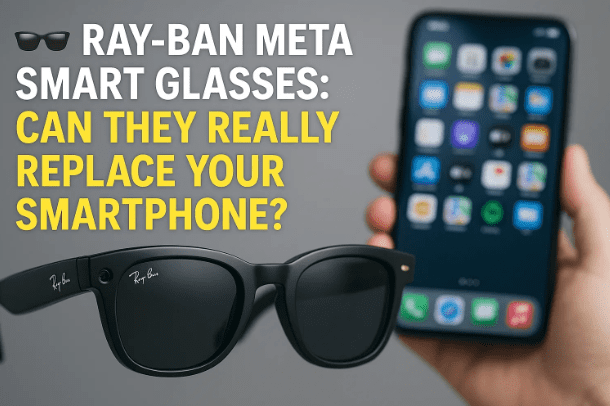
What Are Ray-Ban Meta Smart Glasses?
Ray-Ban Meta Smart Glasses are a result of a unique collaboration between Ray-Ban (a fashion eyewear icon) and Meta (the company behind Facebook, Instagram, and WhatsApp).
The goal was simple yet ambitious — to create AI-powered, camera-enabled, lifestyle glasses that blend fashion with functionality.
Unlike bulky headsets like the Apple Vision Pro, these glasses aim to look and feel just like a normal pair of stylish Ray-Bans — only smarter.
You can use them to:
- Capture photos and videos hands-free
- Stream directly to social platforms like Instagram
- Listen to music
- Make and receive WhatsApp calls
- Interact with Meta AI in real time
And all of this happens without pulling out your phone.
Can Smart Glasses Replace Smartphones?
Let’s be honest — not yet.
Smart glasses have come a long way, but they are still in the “smartphone companion” phase.
They enhance your phone rather than replace it.
For example:
- You still need to pair the glasses with your smartphone to access calls, apps, or internet functions.
- The glasses rely on your phone’s data connection for features like AI, translation, and cloud storage.
However, this doesn’t mean the technology is limited.
Think of it like the early days of smartwatches — at first, they were dependent on phones, but eventually evolved into semi-independent devices.










The same journey is beginning for smart glasses.
Meta’s Approach to Smart Wearables
Meta’s focus is not on making a “mini smartphone” for your eyes, but on integrating technology seamlessly into your lifestyle.
The idea is to make tech disappear — to create something that feels natural, lightweight, and socially acceptable to wear in public.
Instead of strapping a giant headset to your face (like Apple Vision Pro), Meta wants users to blend fashion and function.
That’s why Ray-Ban was the perfect partner — the glasses look stylish, not tech-heavy.
The earlier versions focused purely on camera, mic, and speakers, but the newer models have gone beyond that.
The Ray-Ban Meta Display Edition: A New Step Forward
The latest upgrade to the Meta glasses — called the Display Edition — finally introduces a transparent display inside the lens.
This new display allows users to:
- View notifications, navigation prompts, or translations right in their line of sight.
- Stay aware of surroundings while getting real-time info — a feature known as AR transparency.
- Use Google Maps navigation without looking down at a phone.
With a 600×600 pixel resolution and 500 nits peak brightness, it’s not made for watching videos or gaming — but for contextual, quick information.
Imagine walking in a foreign city, and the glasses quietly translating street signs and directions — that’s the level of utility Meta is targeting.
Core Features of Meta Smart Glasses
Now let’s break down what makes these glasses so interesting.
Each feature has been carefully built to offer real-world usability, not just flashy gimmicks.
🧠 AI Assistant (Meta AI)
Ask questions, get translations, or identify objects — all through voice commands.
Say “Hey Meta,” and you can ask:
- “What building is this?”
- “Translate this text.”
- “What’s the nearest coffee shop?”
The AI processes information via your connected phone and responds directly through built-in speakers.
📸 Dual Camera System
You can capture 12MP photos and 1080p videos hands-free.
Perfect for creators, vloggers, or travelers who want to document moments naturally without holding a phone.
🎤 Microphones and Speakers
The open-ear speakers provide immersive audio while allowing environmental awareness.
You can take WhatsApp or Instagram calls, play music, or even livestream directly.
🌐 Connectivity
The glasses connect via Bluetooth and Wi-Fi and sync with your Meta View app for managing photos, settings, and permissions.
Practical Use Cases in Everyday Life
Now that we know what the glasses can do, let’s imagine how they fit into real-world scenarios.
- Commuting: Use navigation right in your field of view without looking at your phone.
- Cooking: Get AI-guided recipes while your hands are busy.
- Language Translation: Read real-time subtitles of a person speaking another language.
- Travel: Capture moments instantly or identify landmarks using Meta AI.
- Work: Record meetings or transcribe notes with a simple voice command.
So far, so good — but what really makes these glasses stand out is the AI integration.
The Role of AI in Meta Glasses
Meta has gone beyond simple voice commands — the glasses now leverage AI vision recognition.
This means you can literally ask:
“What’s written on that menu?”
“How many calories in this snack?”
“What color is this shirt?”
The AI uses the camera feed to analyze objects and respond contextually.
This real-time processing makes the experience almost futuristic.
And in the future, we can expect Meta to bring multilingual translation overlays, scene analysis, and AI reminders that appear right on the lens display.
Privacy, Battery Life, and Design Challenges
So far, we’ve seen how exciting the technology is — but let’s discuss the practical concerns.
🔋 Battery Life
Currently, the Ray-Ban Meta glasses last around 4 hours of continuous use, which can be limiting for daily wear.
Earlier generations offered up to 8 hours, but newer models with advanced displays consume more power.
🕵️ Privacy
Wearing a camera on your face raises obvious privacy concerns.
To address this, Meta added a visible LED indicator that lights up whenever the camera is active.
However, public perception remains cautious — not everyone is comfortable being recorded in social spaces.
⚙️ Weight and Comfort
Despite advanced hardware, the glasses weigh around 69 grams — fairly light for a device packed with sensors, but still heavier than traditional eyewear.
Meta and Ray-Ban have done an excellent job keeping the design sleek and fashionable.
Competitors: Apple, Google, Xiaomi, and Fire-Boltt
The race for the future of smart glasses is heating up fast.
🍏 Apple
Apple’s Vision Pro is currently the most powerful AR headset, but it’s heavy, expensive, and not suited for everyday use.
However, leaks suggest Apple is developing a lighter transparent AR glass — possibly the Apple Glass.
Google has re-entered the AR race with its Android XR project, rumored to power upcoming lightweight smart glasses in partnership with Samsung.
🇨🇳 Xiaomi
Xiaomi has already demonstrated its AI-powered glasses in China — capable of object recognition and translation.
These could potentially reach global markets soon.
🔥 Fire-Boltt
Even Indian brands are experimenting. The Fire-Boltt Fire Lens was announced as an affordable AI glass.
But as expected, the experience and build quality can’t match premium options like Ray-Ban Meta.
In short, while everyone is racing toward AR glasses, Meta currently holds a lead with real-world usability.
🔮 The Future of Smart Glasses: 5-Year Outlook
So far, we’ve done a good job understanding how these glasses work today.
But where is this technology heading next?
Here’s what experts expect in the next 5 years:
- AI Integration: Glasses will have on-device AI for faster, private responses (no internet needed).
- Prescription Integration: Custom lenses will combine vision correction with AR displays.
- Gesture Control: You’ll be able to control functions with eye movement or simple hand gestures.
- Seamless Smartphone Replacement: Over time, glasses might handle 80% of daily smartphone tasks — calls, navigation, photos, and text.
- Multi-brand Ecosystem: Expect collaboration between eyewear makers (Ray-Ban, Oakley) and tech giants (Google, Samsung, Apple).
By 2030, smart glasses could become as common as smartwatches — not replacing phones entirely, but becoming the next major companion device.
❓ Frequently Asked Questions (FAQs)
Q1. Can Meta Smart Glasses work without a smartphone?
No. They currently need to be paired with a smartphone for calls, AI access, and data connectivity.
Q2. Can you watch videos or movies on them?
Not really. The transparent display is meant for notifications and quick interactions, not entertainment.
Q3. Are they available with prescription lenses?
Yes. Ray-Ban offers compatible prescription options that can be installed at optical stores.
Q4. How long does the battery last?
On average, around 4 hours of active use. The included charging case can recharge them multiple times throughout the day.
Q5. Do they record people without consent?
No. The built-in LED indicator lights up whenever the camera is active, ensuring transparency.
Q6. When will they launch in India?
Meta has not confirmed official India launch dates for the Display Edition, but earlier versions were sold globally through Ray-Ban outlets and meta.com.
⚠️ Disclaimer
This article is for informational and educational purposes only.
Features, pricing, and availability may vary by region.
All product names, logos, and trademarks are property of their respective owners.
Always check official websites for the latest updates — visit https://www.meta.com or https://www.ray-ban.com for accurate product information.
🏷️ Tags & Hashtags
Tags: Ray-Ban Meta Glasses, smart glasses, Meta AI, wearable technology, AR glasses, augmented reality, Android XR, Apple Glass, Fire-Boltt Fire Lens, future of AI wearables
Hashtags: #MetaGlasses #RayBanMeta #SmartGlasses #WearableAI #AugmentedReality #TechTrends #AIInnovation #FutureTech #AndroidXR #ARGlasses