Wi-Fi has become so deeply woven into our daily lives that it’s easy to forget how far the technology has come. Every time you stream a 4K movie, attend a virtual class, or back up data wirelessly, you’re relying on decades of engineering refinements.
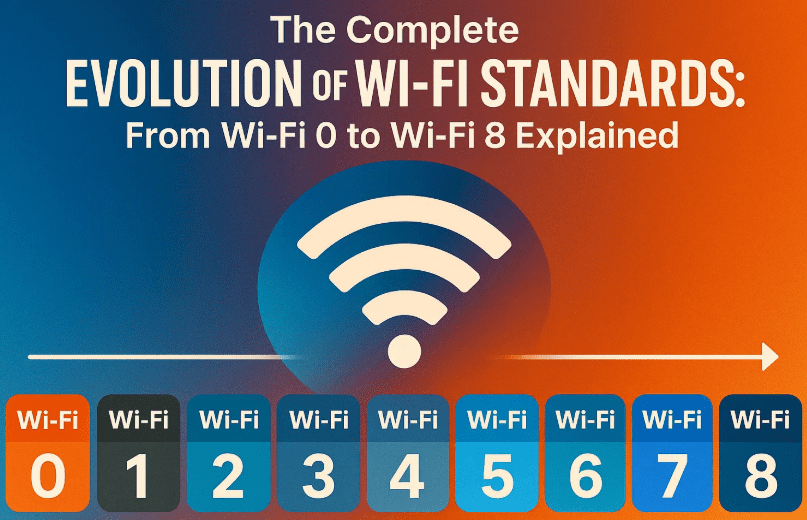
This article takes you on a detailed journey through every Wi-Fi generation — from Wi-Fi 0 (1997) all the way to Wi-Fi 8 (expected 2028) — explaining what changed, how speeds improved, what frequencies are used, and what new technologies each version introduced.
🔹 What Is Wi-Fi and Who Regulates It
Wi-Fi is a wireless networking technology that allows computers, smartphones, and other devices to communicate over radio waves instead of physical cables.
The organization that creates and maintains these wireless standards is the IEEE — Institute of Electrical and Electronics Engineers.
Within IEEE, there is a dedicated working group known as the 802 Committee, which develops standards for networking technologies.
The Wi-Fi family is part of the IEEE 802.11 project — every new generation adds improvements to speed, range, reliability, and efficiency.
🔹 Frequency Bands: 2.4 GHz vs 5 GHz vs 6 GHz
Before diving into each version, it’s important to understand the bands Wi-Fi uses:
| Band | Frequency | Range | Interference | Common Usage |
|---|---|---|---|---|
| 2.4 GHz | Lower frequency | Longer range | High (microwaves, cordless phones, Bluetooth) | Legacy Wi-Fi, IoT devices |
| 5 GHz | Higher frequency | Shorter range | Lower interference | Modern Wi-Fi 5/6 |
| 6 GHz | Very high frequency | Shortest range | Very low | Wi-Fi 6E & 7 for ultra-fast throughput |
The 2.4 GHz band travels farther but is crowded, while 5 GHz and 6 GHz offer much faster data rates with cleaner signals — ideal for modern devices.
🕰️ Wi-Fi 0 (802.11 — 1997)
Let’s begin at the start of the Wi-Fi story.
In 1997, the first Wi-Fi standard (802.11) was released, sometimes retroactively referred to as Wi-Fi 0. It operated only on the 2.4 GHz frequency band and delivered speeds of just 1 to 2 Mbps — slower than a typical dial-up connection today.
This was the birth of wireless networking, mainly used for offices or experimental setups, not yet the household essential we know.
📡 Wi-Fi 1 (802.11b — 1999)
Two years later, in 1999, came 802.11b, or Wi-Fi 1.









It still used 2.4 GHz, but improved data rates up to 11 Mbps, making it the first truly consumer-ready Wi-Fi standard. It was reliable enough for basic internet browsing and email.
However, it also shared the same band used by household devices like microwave ovens and cordless phones, causing interference and slower speeds during heavy use.
⚙️ Wi-Fi 2 (802.11a — 1999)
Released the same year as Wi-Fi 1, 802.11a introduced something new: the 5 GHz band.
At this higher frequency, Wi-Fi 2 reached speeds of 54 Mbps, a huge leap forward. The 5 GHz spectrum was much less crowded, offering cleaner, faster connections — perfect for enterprise networks.
The downside? Higher frequency signals can’t penetrate walls and floors easily, so the range was shorter than 2.4 GHz. In practice, this meant faster Wi-Fi in open spaces but weaker signals through obstacles.
💻 Wi-Fi 3 (802.11g — 2003)
By 2003, Wi-Fi had become mainstream, and 802.11g — or Wi-Fi 3 — hit the sweet spot between speed and range.
It combined the speed of Wi-Fi 2 (54 Mbps) with the range of 2.4 GHz, making it ideal for home routers and laptops.
This generation marked the true popularization of wireless internet, powering early smartphones, laptops, and residential broadband routers.
⚡ Wi-Fi 4 (802.11n — 2009)
Six years later, Wi-Fi 4 introduced a revolutionary technology: MIMO (Multiple Input, Multiple Output).
Instead of one antenna sending one signal, MIMO used multiple antennas to transmit and receive simultaneously — dramatically boosting speed and stability.
- Maximum speed: up to 600 Mbps
- Bands: both 2.4 GHz and 5 GHz
- Key innovation: first dual-band standard and first to use multiple antennas for parallel data streams.
Wi-Fi 4 was the backbone of the 2010s: streaming video, early smart TVs, and smartphones all benefited from it.
🚀 Wi-Fi 5 (802.11ac — 2013)
By 2013, bandwidth demand had exploded. HD streaming, cloud storage, and gaming required more power, and Wi-Fi 5 delivered.
Operating exclusively on the 5 GHz band, it introduced MU-MIMO (Multi-User MIMO), which allowed routers to communicate with multiple devices simultaneously instead of one at a time.
That was a major improvement: previously, routers queued devices, causing congestion.
Wi-Fi 5 also brought beamforming, a technique that directs the signal toward each connected device rather than broadcasting in all directions. This increased both range and signal strength.
Top speed: up to 3.5 Gbps, depending on router and device capabilities.
📲 Wi-Fi 6 and 6E (802.11ax — 2019)
Now we reach the modern era.
Wi-Fi 6 (802.11ax), launched in 2019, focused not just on speed but on efficiency and multi-device performance. With homes full of smart gadgets, routers needed to manage dozens of simultaneous connections smoothly.
Wi-Fi 6 operates on both 2.4 GHz and 5 GHz, with speeds up to 9.6 Gbps. But that figure is shared among devices — the real magic lies in OFDMA (Orthogonal Frequency Division Multiple Access), which splits channels so that multiple devices can communicate in parallel with minimal latency.
It also upgraded MU-MIMO to 12 simultaneous streams, compared to four in Wi-Fi 5.
🌐 Wi-Fi 6E
An extended version, Wi-Fi 6E, opened the new 6 GHz band, adding wide, clean channels for high-capacity traffic — especially useful in offices, stadiums, and apartments full of routers.
Think of Wi-Fi 6E as “Wi-Fi 6 on turbo mode.”
💫 Wi-Fi 7 (802.11be — 2024)
The latest generation, Wi-Fi 7, was finalized in 2024 and carries the code name EHT (Extremely High Throughput).
Where Wi-Fi 6 focused on efficiency, Wi-Fi 7 doubles down on raw speed — reaching up to an astonishing 46 Gbps under ideal conditions.
It operates across 2.4, 5, and 6 GHz, and introduces several powerful new features:
- 320 MHz Channels: double the channel width of Wi-Fi 6, letting more data pass simultaneously.
- 4K QAM (Quadrature Amplitude Modulation): packs more data into each signal, increasing throughput.
- MLO (Multi-Link Operation): allows devices to connect to multiple bands at once for smoother, faster communication.
This makes Wi-Fi 7 ideal for 8K streaming, VR headsets, AR applications, and even real-time industrial automation.
🔮 Wi-Fi 8 (802.11bn — Coming 2028)
Looking ahead, Wi-Fi 8 is under development and is known as UHR — Ultra High Reliability.
Unlike Wi-Fi 7, which prioritized speed, Wi-Fi 8 focuses on connection stability and reliability — ensuring seamless communication in dense environments such as smart cities, autonomous vehicles, and mission-critical networks.
While full specifications are not finalized, Wi-Fi 8 aims to deliver near-zero latency and self-optimizing reliability for future digital ecosystems.
💬 Frequently Asked Questions (FAQ)
Q1. What’s the difference between Wi-Fi 5 and Wi-Fi 6?
Wi-Fi 5 is focused on speed using the 5 GHz band, while Wi-Fi 6 improves efficiency and performance when many devices are connected. Wi-Fi 6 also reuses 2.4 GHz and adds OFDMA and better MU-MIMO.
Q2. Do I need a new router for Wi-Fi 6 or 7?
Yes. Each generation requires compatible hardware. Older routers cannot deliver the newer modulation and channel widths.
Q3. Why do some devices only see 2.4 GHz networks?
Cheaper or IoT devices often include only 2.4 GHz radios for cost and power reasons. Dual-band routers broadcast both 2.4 GHz and 5 GHz simultaneously to support them.
Q4. Is Wi-Fi 7 available everywhere yet?
Not yet. While certification has begun, most consumer routers are expected to adopt it gradually through 2025–2026.
Q5. What about wired Ethernet—does it still matter?
Absolutely. Wired connections still provide the lowest latency and consistent speed, but Wi-Fi 7 and 8 are closing the gap for home and enterprise environments.
🌍 Final Thoughts
From the modest 2 Mbps beginnings of Wi-Fi 0 to the lightning-fast 46 Gbps ceiling of Wi-Fi 7, the evolution of Wi-Fi mirrors our ever-growing appetite for bandwidth and mobility.
Each new standard didn’t just make internet faster — it changed how we live:
- Wi-Fi 3 brought laptops into coffee shops.
- Wi-Fi 4 enabled HD streaming.
- Wi-Fi 6 connected entire smart homes.
- Wi-Fi 7 promises seamless VR and 8K streaming.
As we move toward Wi-Fi 8, expect not just speed but near-perfect reliability, enabling cars, sensors, and smart devices to talk with zero interruptions.
⚠️ Disclaimer
This article is for educational purposes only. Information provided here is based on publicly available IEEE standards and technical references. Always ensure you use certified routers and network equipment from trusted manufacturers.
For more details on official specifications, visit the IEEE 802.11 Working Group website.
#WiFi #Networking #TechExplained #WiFi6 #WiFi7 #WiFi8 #IEEE80211 #WirelessTechnology #Internet #Router