When Steve Jobs unveiled the original iPhone in January 2007, he called it “an iPod, a phone, and an internet communicator” in one. What the audience saw on stage was more than just another gadget—it was the beginning of a design language that would set the tone for the smartphone era.
Over the years, Apple has radically reshaped the iPhone’s look, materials, and ergonomics while still keeping its unmistakable identity. From aluminum and plastic backs to glass sandwiches, from the iconic Home button to the edge-to-edge displays, each generation tells its own story.
Let’s walk through the complete design evolution of every iPhone model from 2007 to 2024, and explore how Apple balanced form, function, and future vision.
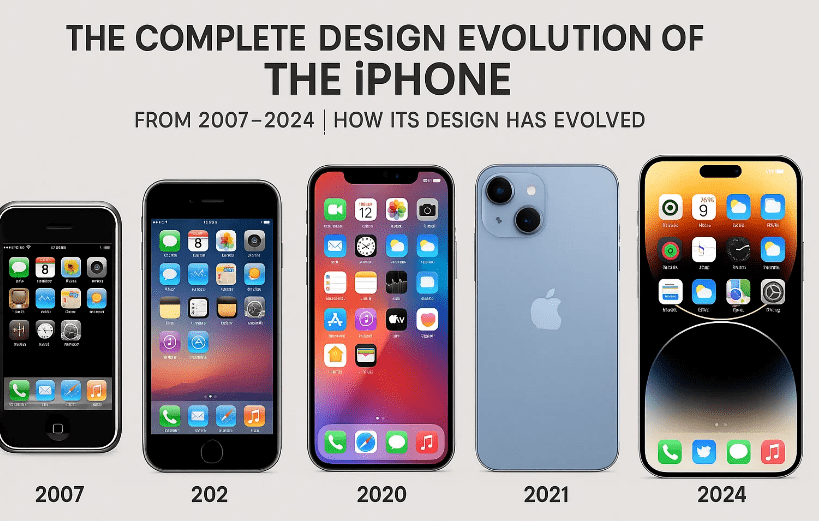
1) The First iPhone (2007)
Apple’s first iPhone arrived with a 3.5-inch capacitive touchscreen, an aluminum back with a small plastic section for antenna signals, and a single Home button on the front.
Design highlights:
- Minimalist: one button, one port, one vision.
- Rounded aluminum body with a black plastic band.
- First mainstream phone to eliminate a physical keyboard in favor of full touch.
The 2007 iPhone didn’t just look futuristic—it changed how all phones would look after it.
2) The Rounded Era: iPhone 3G & 3GS (2008–2009)
A year later, Apple reshaped the iPhone into a more ergonomic, rounded plastic shell. Glossy backs in black or white made the phone lighter and cheaper to produce.
- iPhone 3G (2008): Rounded design, 3G connectivity.
- iPhone 3GS (2009): Same look, faster internals, improved camera.
The 3G and 3GS were friendlier to hold, signaling Apple’s willingness to evolve quickly.
3) Glass Meets Steel: iPhone 4 & 4S (2010–2011)
The iPhone 4 introduced a dramatic design shift:
- Flat glass on front and back.
- Stainless steel frame doubling as antenna.
- Slimmer profile and Retina display.
The iPhone 4S kept the same design but refined internals. This era established the iPhone as a true luxury device, though the infamous “antennagate” reminded Apple of the cost of bold design choices.
4) Slim and Sharp: iPhone 5, 5S, and 5C (2012–2013)
The iPhone 5 extended the screen to 4 inches, slimmed down, and switched to anodized aluminum backs with glass sections at the top and bottom.











- iPhone 5S (2013): Added Touch ID, highlighted by a metallic ring around the Home button.
- iPhone 5C (2013): Colorful, polycarbonate body—cheerful but less premium.
Apple here experimented with fun vs. function, catering to different audiences.
5) Bigger and Softer: iPhone 6, 6 Plus, and 6s Line (2014–2015)
2014’s iPhone 6 and 6 Plus marked Apple’s jump into large screens:
- Rounded aluminum bodies.
- Thinner frames, softer edges.
- Screen sizes grew to 4.7″ and 5.5″.
The 6s/6s Plus (2015) retained the same look but used stronger 7000-series aluminum to address “bendgate.”
This was the beginning of iPhones as we know them: sleek, slim, and bigger.
6) The Return of Compact: iPhone SE (2016)
Apple revived the beloved iPhone 5/5S design in the first iPhone SE:
- Small 4-inch display.
- Boxy aluminum body.
- Internals from the iPhone 6S.
It was proof that many users still loved compact, sharp-edged phones.
7) Polished Glass Era: iPhone 7 & 8 Series (2016–2017)
- iPhone 7/7 Plus (2016): Similar to iPhone 6 design but introduced matte finishes, jet black glossy versions, and removed the headphone jack.
- iPhone 8/8 Plus (2017): First iPhones with glass backs to support wireless charging. Aluminum frames rounded off the premium feel.
This era was transitional, bridging into the radical shift that followed.
8) Radical Shift: iPhone X, XS, and XR (2017–2018)
The iPhone X (2017) completely redefined iPhone design:
- OLED edge-to-edge screen.
- Stainless steel frame, glass back.
- No Home button; Face ID introduced.
- Iconic notch at the top.
Apple also released:
- iPhone XS/XS Max (2018): Refined X design, larger display options.
- iPhone XR (2018): Colorful, aluminum-framed version at a lower price.
This was arguably Apple’s boldest design pivot since 2007.
9) Refining Premium: iPhone 11 Series (2019)
The iPhone 11 brought playful colors back, with aluminum frames and glass backs.
The iPhone 11 Pro and Pro Max introduced matte textured glass and stainless steel for a more professional aesthetic.
The new square camera module stood out, becoming a recognizable design element.
10) Flat Edges Return: iPhone 12 & 13 Series (2020–2021)
Apple revisited the flat-edged look reminiscent of the iPhone 4 and 5.
- iPhone 12 (2020): Aluminum frame, flat edges, Ceramic Shield glass. Pro models used stainless steel.
- iPhone 13 (2021): Continued the design but with smaller notch and diagonal camera arrangement.
This return to flat edges was met with praise—it looked modern, minimalist, and durable.
11) Dynamic Designs: iPhone 14 Series (2022)
The iPhone 14 series built on the 13 with subtle refinements:
- Slimmer bezels.
- New Dynamic Island cutout on Pro models, replacing the notch.
- Same flat-edge design but sleeker finishes.
It was a design update that balanced familiarity with fresh touches.
12) Titanium Strength: iPhone 15 Series (2023)
The iPhone 15 Pro and Pro Max introduced titanium frames, replacing stainless steel.
- More rounded edges for comfort.
- Lighter yet stronger construction.
- Dynamic Island across all models.
Color palette updates and durability improvements made this lineup both stylish and functional.
13) Control and Camera Evolution: iPhone 16 Series (2024)
The iPhone 16 series stayed close to the 15 in size and shape but made significant changes:
- Vertical pill-shaped camera alignment, recalling older designs, but this time supporting spatial video capture.
- New Action Button replacing the mute switch, customizable for quick actions.
- A dedicated camera button for instant access to photography.
- Matte glass finish and vibrant new colors.
Pro models retained titanium frames, signaling Apple’s direction toward lightness and durability.
14) FAQs on iPhone Design Evolution
Q1: Why did Apple switch from aluminum to glass backs?
To support wireless charging starting with iPhone 8. Glass allows energy transfer where metal does not.
Q2: Why did Apple bring back vertical cameras on iPhone 16?
It was primarily for spatial video recording, which works better with lenses arranged vertically.
Q3: Will Apple keep titanium for future Pro models?
Most likely, yes. Titanium offers a balance of lightness and durability, making it ideal for premium devices.
Q4: What’s the biggest design leap in iPhone history?
The iPhone X (2017)—it removed the Home button, introduced OLED full screens, and brought Face ID.
Q5: Why does Apple rarely make drastic design changes?
Apple prefers iterative refinement. Consistency makes iPhones instantly recognizable, while careful updates preserve usability and brand identity.
15) Final Thoughts
From the first iPhone’s rounded aluminum back to today’s titanium-framed flagships, Apple’s design journey reflects both technological progress and cultural influence. Each iPhone tells a story not just of materials and shapes, but of changing expectations: larger screens, stronger builds, smarter features.
Seventeen years in, the iPhone remains an icon of balance—always familiar, yet always evolving. The iPhone 16 is not the end of this story but another chapter in how design shapes our relationship with technology.
⚠️ Disclaimer
This article is based on publicly available product information from Apple’s official website and other reliable sources. For detailed specifications and the latest updates, visit the official Apple iPhone page.
Tags: iPhone design evolution, Apple iPhone history, iPhone 16, iPhone titanium frame, iPhone Dynamic Island, iPhone spatial video, iPhone camera design
Hashtags: #iPhone #Apple #iPhoneDesign #iPhoneHistory #TechEvolution #iPhone16 #SmartphoneDesign