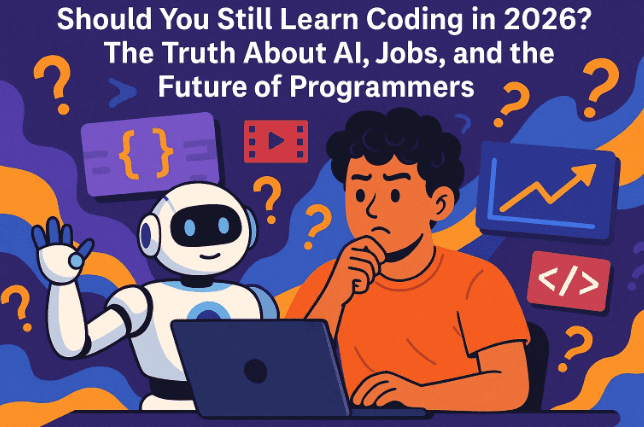
Artificial Intelligence has changed the way we think, create, and work. With tools like ChatGPT, GitHub Copilot, and Notion AI, many people have started wondering: “Do I even need to learn coding anymore?”
This question became more popular after Jensen Huang, CEO of NVIDIA, recently stated that in the near future, AI will handle most of the work, and that “coding will become obsolete.” Elon Musk too has often claimed that AGI (Artificial General Intelligence) is close — first in 2024, now delayed to 2025 or 2026.
So, does that mean coding will really die? Should students and professionals stop learning programming and move to other careers? Or is this just another overhyped claim in a long list of tech revolutions?
Let’s break it all down step-by-step.
⚙️ The “Coding Is Dead” Myth — Where Did It Start?
Let’s start with the root of this belief. When Jensen Huang, the CEO of NVIDIA, said that people won’t need to learn coding because “AI will code for them,” it quickly spread like wildfire.
But here’s what’s often ignored — Jensen isn’t just a neutral observer. He’s the head of the company that builds GPUs powering AI worldwide. When he says “AI will take over coding,” it’s part optimism, part business narrative.
He’s right about one thing: AI will indeed write code, automate workflows, and handle repetitive programming tasks. But that doesn’t mean humans will become irrelevant.
In fact, every powerful AI tool needs human feedback loops — people who know what to build, how to test, and how to prompt the AI correctly.
🧠 Over-Optimism and the Human Loop
Let’s move to the next important point — even if AI gets better at generating code, humans will always remain in the loop.
Why? Because code is only as good as the problem definition behind it. AI can generate syntax, but it can’t yet fully understand context, creativity, or user intent.
For example, you can tell AI to “build a website,” and it might produce a simple template. But unless you understand backend logic, database structures, and middleware — your prompts will be limited.





So, coding isn’t dying. It’s evolving. The new era isn’t about writing every line manually, but about thinking at a higher level, designing systems, and using AI as your assistant rather than your replacement.
🧩 What Happens If You Stop Learning Coding?
Here’s a simple question that flips the debate:
If you decide not to learn coding because “AI will handle it,” what will you do instead?
- Move to data analytics? AI is automating that too.
- Try data collection? Already semi-automated by bots.
- Think about creative fields like cooking or design? AI is already generating recipes, music, and visuals.
Almost every industry is becoming AI-assisted, not AI-proof. So, no matter what career you choose, understanding logic, structure, and computational thinking — the foundation of coding — will give you an edge.
🧭 The AI Bubble: Déjà Vu From the Dot-Com Era
So far, we’ve done a good job understanding why coding still matters. But let’s talk about something bigger — the AI investment bubble.
Journalist Derek Thompson recently wrote a report comparing today’s AI boom with the Dot-Com Bubble of the early 2000s. Back then, people believed every website would become the next Google or Amazon. Investors threw billions into companies like Pets.com — an online pet-supply store that raised huge funding and then collapsed overnight because it had no real profit model.
The same pattern is repeating. Big tech companies — Amazon, Meta, Google, Microsoft, and OpenAI partners — have increased their capital expenditure from around $80–100 billion in 2018 to over $500 billion in 2026. But the immediate output hasn’t matched that growth.
Just like the early Internet days, people are investing in the promise of AI, not the profits of AI — yet.
That doesn’t mean AI is useless. The Internet bubble burst, but the Internet survived and became stronger. Likewise, even if AI experiences a “bubble correction,” its real, lasting impact will remain.
🧮 Why “AI Will Replace Coding” Is an Incomplete Statement
AI does write code — but let’s dig deeper. When AI writes code, it’s still writing code, just not by human hands.
Who maintains that code? Who integrates it into real systems? Who fixes hallucinations, bugs, and deployment issues?
The answer is still humans — especially those who understand programming fundamentals.
AI is great at pattern recognition but poor at reasoning. It doesn’t “know” that a MongoDB schema requires unique fields or that middleware must modify requests safely. If you’ve never coded, you won’t even know what to ask.
This is why coders who understand how to collaborate with AI — by crafting precise prompts and validating logic — will dominate the next decade.
⚡ Real-World Example: Competing With AI as a Beginner
Imagine two people competing to build an e-commerce website:
- You: a complete beginner who has never coded.
- Another person: an intermediate developer with AI tools.
Both of you can use ChatGPT, Cursor, or Copilot. Who do you think will win?
Obviously, the developer — because they know what a schema is, how API endpoints work, and what middleware means.
Your prompt might look like:
“Make a website that looks good.”
Their prompt might be:
“Create a Node.js middleware to modify request objects, connect it to a MongoDB collection with defined schema fields, and apply consistent object-cover properties in all sections.”
See the difference? AI amplifies knowledge, not ignorance.
🧩 How Tools Like Notion and AI Agents Fit Into This
Let’s move to a practical part now — using AI to increase productivity instead of replacing skills.
Tools like Notion have transformed how teams organize information. Its built-in Notion AI can summarize, write, search, decide, and even automate full workflows.
The latest addition, Notion AI Agent, acts like an intelligent teammate — capable of connecting with Google Drive, Slack, and other apps, retrieving data, building pages, and automating repetitive tasks.
This means coders and creators can spend more time on high-level design, logic, and creative problem-solving — while AI handles the routine.
But to use such tools effectively, you still need to understand how systems, data, and logic work — and that’s where coding knowledge pays off.
🔍 The AI Bubble Within Startups
Let’s take a quick detour into what’s happening in AI startups.
A company called Thinking Machines, founded by a former OpenAI executive, has a valuation of over $10 billion, even though it hasn’t clearly revealed what it does yet. Investors are throwing money simply because the founder has an AI background.
This frenzy mirrors the early 2000s when startups burned investor money on hype rather than sustainable growth.
So yes, AI is revolutionary — but also risky. The hype will settle, and when it does, real developers who can build, test, and deploy AI systems will still be the ones holding the foundation together.
💡 Why Learning to Code in 2026 Still Makes Sense
Let’s be honest — you don’t need to master every language or memorize every syntax. But learning to code in 2026 gives you something much more valuable: the ability to think like a problem-solver.
Coding teaches you:
- How to break complex problems into smaller steps.
- How systems communicate through APIs and data.
- How to debug — not just code, but real-world issues.
Even if AI writes 60–70% of your code, you’ll be the one reviewing, guiding, and validating it.
🧠 AI Tools Are Powerful — But They Learn From You
AI tools like ChatGPT, Copilot, and Cursor have become far smarter than when they first launched. Early versions often produced wrong code confidently; now, the accuracy is far higher.
But these tools learn from developers — from your inputs, corrections, and feedback loops.
So the more skilled developers there are, the better these AI models become. Coding isn’t going away — it’s becoming collaborative.
🧠 AGI and the Real Limits of Automation
Some people believe AGI (Artificial General Intelligence) will soon outsmart humans in everything — from coding to creativity. But AGI is still theoretical.
Even the best AI systems cannot reliably:
- Turn on a physical computer, or deploy a live server autonomously.
- Make consistent decisions without human oversight.
- Create emotionally resonant design or writing without prompt guidance.
AI is like a magical autocomplete — incredibly fast, but directionless without a human mind steering it.
🧩 Lessons From the Dot-Com Crash — and Why AI Isn’t a Scam
The Dot-Com crash wiped out hundreds of companies, but not the Internet. Similarly, even if the current AI bubble bursts, AI as a technology will remain, just as the Internet did.
The real winners were those who understood the technology behind the hype — the engineers who kept learning while others quit.
So if you’re a coder or student today, that’s your biggest opportunity: while others are scared or distracted by hype, you can quietly build the skills that will make you indispensable once the dust settles.
💬 Frequently Asked Questions (FAQ)
Q1. Will AI really replace programmers?
AI will replace repetitive tasks, not creative or logical reasoning. Developers who adapt and learn to work with AI will always be needed.
Q2. What programming language should I start with in 2026?
Start with Python if you want flexibility. If you’re into web development, begin with HTML, CSS, and JavaScript. For low-level understanding, C or C++ builds a solid base.
Q3. Is learning data science or machine learning better than coding?
They go hand-in-hand. You need basic programming knowledge to build or train machine learning models effectively.
Q4. Will AI learning stop?
No. AI will keep improving, but gradual adoption means it will augment human work, not eliminate it overnight.
Q5. What if I start late?
It’s never too late. Even one year of consistent practice in programming can put you ahead of 90% of passive learners.
🚀 Final Thoughts: AI Won’t Kill Coding — It Will Redefine It
So far, we’ve explored every angle — the hype, the fear, and the truth.
Here’s the conclusion:
AI isn’t the end of coding; it’s the evolution of coding.
Yes, tools will automate syntax and boilerplate work. But that only frees developers to focus on architecture, logic, and creativity — the very things machines still struggle with.
If you’re learning programming in 2026, you’re not late — you’re early for the next phase of the digital revolution.
Because when everyone else stops learning out of fear, that’s when opportunities quietly multiply for those who don’t.
So don’t wait for permission. Don’t fear automation.
Start coding. Today.
⚠️ Disclaimer:
This article is not sponsored. All opinions expressed are based on analysis and observation of AI and tech trends. The information shared here should not be treated as financial or investment advice.
#Coding2026 #AIRevolution #LearnToCode #ArtificialIntelligence #TechTrends #AITools #Python #MachineLearning #FutureOfWork #dtptips