If you’ve ever thought about buying a gaming console in India, the first name that probably popped into your head was PlayStation. Whether you wanted it for general gaming or specifically for a blockbuster like Gran Turismo 6, chances are, PlayStation was the top choice.
But how often have you heard someone say, “I’m getting an Xbox”? Rarely, right? In fact, many people in India don’t even realize that Microsoft has its own gaming consoles under the Xbox brand. This lack of awareness is not accidental—it’s the result of years of poor strategies, missteps, and missed opportunities.
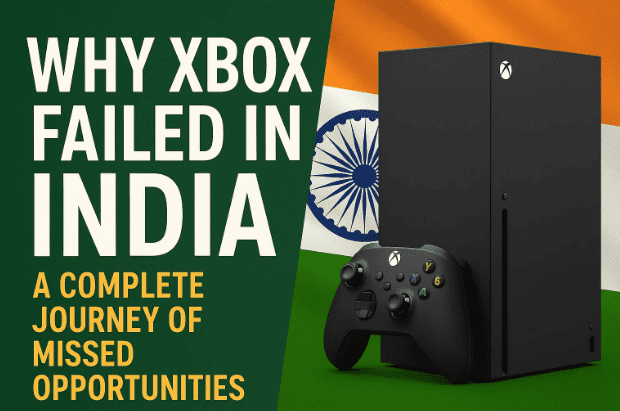
Today, let’s take a deep dive into the journey of Xbox in India. From its first appearance to its current situation, we’ll explore why the console never found respect here and what lessons can be learned.
📺 Marketing: The First and Biggest Mistake
When it comes to consumer electronics in India, there’s a golden rule: “Jo dikhta hai, voh bikta hai” (what is visible is what sells). And in this game, Sony’s PlayStation has been leagues ahead of Xbox.
Think about it—many of us grew up watching ads for PlayStation on TV. Bundles with games like Street Cricket, Ravana, or even motion controllers with PS3 were advertised daily. Celebrities casually owning a PlayStation added to the hype. Even today, before the release of big titles like Ghost of Tsushima or Gran Turismo, Indian metros like Delhi and Mumbai are plastered with PlayStation ads on metros, banners, and even giant 3D displays.
Meanwhile, Xbox remained invisible. Very few remember seeing a proper Xbox campaign in India, and that absence alone pushed it out of public memory.
🎤 Early Days: Xbox 360 and Unrealistic Expectations
Microsoft didn’t bring the original Xbox to India. Their entry started with the Xbox 360 in the mid-2000s. And this was where the cracks began.
Believing that even if 1% of India’s 100 crore population at the time bought a console, they’d sell 1 crore units, Microsoft set overly ambitious targets. They hired Akshay Kumar and Yuvraj Singh as brand ambassadors. But instead of showcasing games, the ads came off as awkward, cringe-worthy, and far from what gamers wanted to see.
Microsoft even distributed 1200 free demo units to retailers and spent millions on print, online, and TV ads. Yet, sales from 2006–2013 reached only 1.5 lakh Xbox 360 units—barely 1.5% of their target. For comparison, Sony’s PS3 sold more than 3.5 lakh units in the same period.
The result? Microsoft burned money on marketing that didn’t connect with Indian gamers, while Sony silently strengthened its brand.
💻 The Xbox One Era: Digital-Only Miscalculation
After the poor showing of Xbox 360, Microsoft decided to cut costs for the Xbox One. Instead of celebrity campaigns, they collaborated with online creators like AIB (All India Bakchod). Instead of offline retail, they went Amazon-exclusive.







Here’s the problem: in 2014, India was still heavily dependent on offline retail for big purchases. Parents, who usually foot the bill for expensive gadgets, wanted to see the product in stores, negotiate prices, and trust warranties. Skipping retail meant cutting out the majority of potential buyers.
Unsurprisingly, Xbox One had only 300 pre-orders before launch. In the first four months, just 1500 units were sold, compared to 4500 PS4s sold in just two weeks.
And the ads? They promoted features like video calling through Kinect instead of showing blockbuster games. Indian gamers weren’t looking to attend virtual meetings—they wanted to play.
💰 Pricing Problems and the Grey Market
Another nail in the coffin was pricing. The Xbox One launched at ₹40,000 in India—the same as the PS4. But where PS4 bundles in the US included multiple games and extras, India’s Xbox offered just one game.
Gamers quickly turned to the grey market, where imported Xbox units sold for ₹27,000. Microsoft tried discounts, but couldn’t match those prices. Add to this the fact that Xbox games in India were more expensive than in the US—sometimes costing as much as ₹4700 each, compared to the $60 global standard.
Meanwhile, PlayStation games were not only priced better but also widely available in physical disc format. For India, where sharing, reselling, and exchanging discs is part of gaming culture, this mattered a lot.
🏬 Retail Confusion: The Xbox One S and One X
Learning from past mistakes, Microsoft eventually pushed Xbox into offline stores with the Xbox One S and One X. But they failed again—this time in execution.
- Launch announcements were weak or nonexistent.
- Promised games like Scalebound were already cancelled by the time of launch.
- Many Xbox exclusives like Dead Rising 4 never saw an Indian release because executives assumed they wouldn’t compete with titles like Battlefield or Call of Duty.
And here’s the kicker: physical discs for many Xbox titles weren’t released in India. Without discs, Indian gamers couldn’t share or resell games, which was a major cultural barrier.
Retailers also got frustrated. Online stores like Amazon offered Xbox consoles with heavy discounts, but offline retailers had to sell at MRP. As a result, many physical stores simply stopped stocking Xbox altogether.
📉 The Current Generation: Xbox Series X/S vs PS5
The pandemic made this generation tough for both PlayStation and Xbox. Supply shortages hit globally, but the difference in handling made all the difference.
Sony carefully announced restocks, partnered with multiple retailers, and even banned stores involved in scalping. Xbox, on the other hand, partnered with only a few select retailers, leading to limited availability and rampant scalping.
A ₹50,000 Xbox Series X was being sold for ₹70,000 in bundles, often forcing buyers to purchase unwanted accessories or games. For Indian gamers, this was frustrating and unfair.
The worst part? When GTA V relaunched in 2022 for new consoles, the PS5 got its disc release in India—but the Xbox version never arrived. The message was clear: even publishers didn’t trust Xbox’s Indian presence anymore.
By 2021, the sales ratio of PS5 to Xbox Series in India had widened to 10:1, cementing India as a PlayStation nation.
🔎 Why Xbox Failed in India: The Core Reasons
Let’s summarize the recurring mistakes that doomed Xbox in India:
- Poor, irrelevant marketing that failed to showcase games.
- Overpriced consoles and games compared to competitors and grey market options.
- Ignoring offline retail presence when Indian buyers depended on it.
- Lack of physical game discs, which alienated Indian gaming culture.
- Weak after-sales support and inconsistent availability.
- No dedicated Indian Xbox team with gaming expertise.
- Publishers losing trust and skipping Indian releases.
💡 What Xbox Can Do to Recover
While Xbox’s situation in India looks grim, recovery isn’t impossible. Here’s what Microsoft could do:
- Hire the right leadership – People who understand Indian gamers and play games themselves.
- Strengthen offline retail presence – Make Series X/S consoles easily available at Croma, Reliance Digital, and local retailers with proper warranties and demos.
- Control pricing – Prevent scalping by fixing distributor-level issues and ensuring fair prices.
- Support physical discs – Make sure major titles come with disc options in India.
- Market effectively – Focus ads on games and experiences, not gimmicks.
- Leverage Game Pass smartly – Highlight how Indian gamers can access hundreds of games at affordable monthly prices.
- Cultural localization – Partner with Indian developers or bundle regionally popular games.
❓ Frequently Asked Questions (FAQs)
Q1. Is Xbox completely dead in India?
Not dead, but extremely niche. Enthusiasts who value Game Pass still buy it, but mainstream adoption is minimal compared to PlayStation.
Q2. Why are Xbox games more expensive in India?
Because of import duties, smaller distribution networks, and Microsoft’s pricing strategy. PlayStation managed better localization and bundling, which kept its prices relatively attractive.
Q3. Is Xbox Game Pass available in India?
Yes, and it’s one of Xbox’s strongest selling points here. You can even buy subscriptions using UPI.
Q4. Can Microsoft turn things around?
Yes, but only with long-term commitment—better pricing, stronger marketing, more retail presence, and building trust with both gamers and publishers.
⚖️ Final Thoughts: Why Competition Matters
At the end of the day, a strong Xbox presence in India is not just good for Xbox fans—it’s good for everyone. Healthy competition forces PlayStation to innovate, offer better deals, and keep pricing in check.
The lack of strong competition is one reason we’re seeing ultra-expensive hardware like the PS5 Pro coming into the market. For Indian gamers, the dream is simple: affordable, accessible, and fun gaming. And for that, we need Xbox to step up.
So tell me in the comments—have you ever owned an Xbox in India? If yes, what was your experience? And if not, what stopped you from buying one?
Tags
xbox india, xbox vs playstation, why xbox failed in india, xbox 360 india, xbox one india, xbox series x india, xbox game pass india, playstation india, console gaming india, gaming consoles india
Hashtags
#Xbox #PlayStation #GamingInIndia #ConsoleWars #GamePass #XboxSeriesX #PS5 #IndianGamers