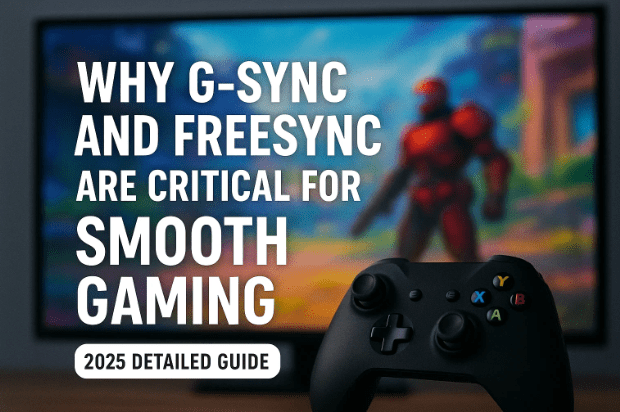
If you’ve ever been deep into a fast-paced game — maybe chasing down enemies or racing through futuristic cities — only to see your screen suddenly tear in half or your motion become choppy, you know how frustrating that moment feels.
That stutter or tear isn’t just an eyesore; it breaks immersion and can even affect performance during critical gameplay moments. Fortunately, modern display technologies like NVIDIA G-Sync and AMD FreeSync were created to solve exactly these problems.
In this article, we’ll explore how these technologies work, what makes them different, how to choose between them, and why they’re essential for a seamless gaming experience in 2025 and beyond.
1️⃣ Understanding the Problem: Why Tearing and Stuttering Occur
Before we talk about how G-Sync and FreeSync fix your display, it’s important to understand what causes the issue in the first place.
Your graphics card (GPU) renders frames — basically, images — and sends them to your monitor, which refreshes the screen at a set rate (like 60Hz, 120Hz, or 144Hz).
Here’s where the problem starts:
- The GPU’s frame rate can fluctuate depending on the game’s load.
- The monitor refreshes at a fixed pace.
- When those two rates don’t line up, you get screen tearing or stuttering.
💥 Screen Tearing
This happens when your monitor starts drawing a new frame before finishing the previous one. You’ll see a visible horizontal split, with the top and bottom halves of the screen showing different frames. It’s especially noticeable in fast games like Call of Duty, Forza Horizon, or Valorant.
⚙️ Stuttering
Stuttering occurs when your GPU can’t maintain a consistent frame rate — often when the FPS drops below the monitor’s refresh rate. The result? Jerky, uneven motion that can ruin the smooth flow of gameplay.
To fix this mismatch, you need a system that keeps your monitor’s refresh rate and your GPU’s frame rate in perfect harmony. That’s exactly what G-Sync and FreeSync do.
2️⃣ How G-Sync Works
G-Sync is NVIDIA’s proprietary variable refresh rate (VRR) technology. It introduces a dedicated hardware module inside the monitor itself that directly communicates with NVIDIA GPUs.
🧠 The Core Idea
G-Sync dynamically adjusts the monitor’s refresh rate to match the exact output of the graphics card. So, if your GPU is producing 95 frames per second (FPS), the monitor refreshes exactly 95 times per second — not 60, not 144, but whatever your GPU is producing at that moment.


This dynamic synchronization removes screen tearing completely and makes frame pacing ultra-smooth.
⚙️ Features That Make G-Sync Stand Out
- Hardware Module: Unlike software-based solutions, G-Sync uses a custom chip inside the monitor to handle VRR. This ensures low latency and minimal input lag.
- Variable Overdrive: Reduces motion blur by adjusting response times dynamically.
- Backlight Strobing: Improves clarity in fast motion, making it ideal for FPS or racing games.
- Seamless Adaptation: Even if your FPS drops below the monitor’s base refresh rate, G-Sync minimizes the jarring stutter that usually follows.
The result is incredibly fluid gameplay, even in demanding titles where frame rates fluctuate constantly.
3️⃣ How FreeSync Works
Developed by AMD, FreeSync takes a more open and flexible approach. Instead of requiring special hardware, it uses the Adaptive Sync feature built into modern DisplayPort and HDMI standards.
🧩 The Key Difference
FreeSync achieves the same end goal — matching your monitor’s refresh rate to your GPU’s frame rate — but it does it without the expensive proprietary G-Sync module.
This makes FreeSync monitors generally more affordable while still delivering excellent performance.
🧭 How It Works
- Your AMD GPU (or a compatible NVIDIA GPU) sends frame data using Adaptive Sync.
- The monitor refreshes dynamically in sync with that signal.
- The result is smooth motion without tearing or stutter, just like G-Sync.
🔍 FreeSync Compatibility
Initially, FreeSync was exclusive to AMD graphics cards. But in recent years, NVIDIA has opened partial compatibility for many FreeSync monitors through its “G-Sync Compatible” certification. That means even NVIDIA users can enjoy adaptive refresh on select FreeSync monitors.
4️⃣ G-Sync vs FreeSync: The Key Differences
While both technologies aim to solve the same problem, there are notable distinctions.
| Feature | G-Sync | FreeSync |
|---|---|---|
| Developer | NVIDIA | AMD |
| Hardware Requirement | Dedicated G-Sync module inside the monitor | Uses Adaptive Sync (no special hardware) |
| Cost | Higher (premium monitors) | More affordable |
| GPU Compatibility | NVIDIA GPUs only | AMD GPUs (and some NVIDIA GPUs) |
| Performance | Consistent, hardware-level control | Depends on monitor and driver quality |
| Additional Features | Variable overdrive, backlight strobing | Premium tiers add HDR, LFC, and higher refresh rates |
Both deliver smooth, tear-free gameplay — the difference mainly comes down to budget and ecosystem preference.
5️⃣ Hardware and Compatibility Requirements
Let’s move to the next section — ensuring your setup actually supports these technologies.
✅ For G-Sync:
- You’ll need an NVIDIA GPU (GTX 10-series or newer).
- A G-Sync or G-Sync Compatible Monitor (check the list on NVIDIA’s official site).
- A DisplayPort connection (HDMI is limited for G-Sync in most models).
✅ For FreeSync:
- Works with AMD GPUs (Radeon R5 series or newer).
- Many NVIDIA GPUs (GTX 10-series and newer) now also support FreeSync through G-Sync Compatible mode.
- A FreeSync-certified monitor and either DisplayPort 1.2a+ or HDMI 2.1+ connection.
For best performance, pair a G-Sync monitor with an NVIDIA GPU or a FreeSync monitor with an AMD GPU. That ensures native communication and lowest latency.
6️⃣ FreeSync and G-Sync Tiers Explained
Both technologies have evolved over the years, introducing tiers that define the level of performance and features.
🟢 FreeSync Tiers
- FreeSync (Standard): Basic adaptive sync to eliminate tearing.
- FreeSync Premium: Adds support for higher refresh rates (120Hz+) and low frame compensation (LFC).
- FreeSync Premium Pro: Includes HDR (High Dynamic Range) support, reducing input latency and improving color vibrancy.
🔵 G-Sync Variants
- G-Sync Ultimate: Highest-end monitors with HDR, advanced color accuracy, and ultra-low latency.
- G-Sync: Standard version using a hardware module inside the display.
- G-Sync Compatible: Certified FreeSync monitors that meet NVIDIA’s quality standards without the hardware module.
These tiers help gamers choose the right level of visual performance and price for their needs.
7️⃣ Benefits of Variable Refresh Rate (VRR) Gaming
Now that you understand how these technologies work, let’s highlight why VRR is considered one of the biggest innovations in modern gaming.
🎯 Major Benefits:
- Tear-Free Visuals: Eliminates those distracting horizontal splits.
- Smooth Frame Delivery: Even during FPS drops, motion remains fluid.
- Reduced Input Lag: Direct communication between GPU and monitor cuts delay.
- Better Visual Clarity: Features like variable overdrive and HDR enhance image quality.
- More Immersive Gameplay: The experience feels cinematic yet responsive.
If you’re into open-world adventures or competitive shooters, these benefits can significantly improve both enjoyment and performance.
8️⃣ How to Enable G-Sync or FreeSync on Your PC
Once you’ve confirmed your hardware supports either technology, enabling it is simple.
For NVIDIA G-Sync:
- Right-click on your desktop → NVIDIA Control Panel.
- Navigate to Display → Set up G-Sync.
- Check Enable G-Sync, G-Sync Compatible.
- Select Enable for full-screen mode (or windowed, depending on your use).
- Apply settings.
For AMD FreeSync:
- Open AMD Radeon Software (Adrenalin Edition) → Display Tab.
- Toggle Adaptive Sync or FreeSync to ON.
- Ensure your monitor’s OSD menu also has FreeSync enabled.
That’s it! You’ve just unlocked smoother gameplay without tearing or stutter.
9️⃣ Troubleshooting Common Sync Problems
Even with the right setup, some users encounter minor hiccups. Here are a few quick fixes:
- FreeSync not showing up: Check your cable type — use DisplayPort or HDMI 2.1.
- G-Sync flickering: Disable V-Sync in games, but keep it ON in NVIDIA Control Panel.
- HDR conflict: On some setups, HDR and VRR don’t work together smoothly. Try toggling HDR off if you notice flickering.
- Inconsistent FPS: Enable frame limiters (like RTSS or in-game caps) to stabilize performance within your monitor’s range.
These small adjustments can make a big difference in maintaining consistent frame pacing.
💬 Frequently Asked Questions
Q1. Do G-Sync and FreeSync improve FPS?
No — they don’t increase frame rate. Instead, they synchronize the frames to display more smoothly, reducing visible tearing or judder.
Q2. Can I use FreeSync with an NVIDIA card?
Yes, many FreeSync monitors are certified as G-Sync Compatible. You can enable this in the NVIDIA Control Panel.
Q3. Is G-Sync worth the extra cost?
If you’re a competitive gamer or use high-refresh monitors (165Hz+), yes — the hardware-based G-Sync offers unmatched stability and minimal input lag.
Q4. Does FreeSync work over HDMI?
Yes, FreeSync can work over HDMI (2.1 or later), though DisplayPort generally provides better stability.
Q5. Do I need special cables?
Not necessarily, but make sure you’re using DisplayPort 1.2a+ or HDMI 2.1-certified cables for best performance.
🏁 Final Thoughts
So far, we’ve learned how both G-Sync and FreeSync revolutionize gaming visuals by synchronizing your GPU and monitor to eliminate tearing and stuttering.
If you’re investing in a new display in 2025, choosing one with either G-Sync or FreeSync support should be a top priority. These technologies don’t just make games look better — they make them feel better to play.
For NVIDIA users, G-Sync remains the gold standard in precision and fluidity. For AMD users or budget-conscious gamers, FreeSync offers a fantastic experience with broad compatibility. Either way, you’ll be stepping into a world of smoother, sharper, and more immersive gameplay.
Enjoy the difference — once you experience truly tear-free gaming, you’ll never want to go back.
#GamingMonitors #GSync #FreeSync #PCGaming #Nvidia #AMD #TechGuide #SmoothGameplay #VariableRefreshRate