Buying a graphics card often feels like trying to decode a secret alphabet. GT, GTX, RTX — for newcomers it’s confusing, and for veterans it’s a nostalgic trip through years of GPU history. Nvidia, the company behind these cards, has shaped PC gaming for decades, moving from budget-friendly entry cards to today’s monster GPUs like the RTX 4090 and the upcoming RTX 5090.
In this guide, we’ll take a deep dive into every Nvidia GT, GTX, and RTX card generation. You’ll not only learn what each lineup offered but also how they shaped gaming history. And don’t worry, we’ll avoid drowning you in jargon — everything will be explained clearly, with some fun comparisons along the way.
1. 🧩 Why Nvidia’s Naming Matters
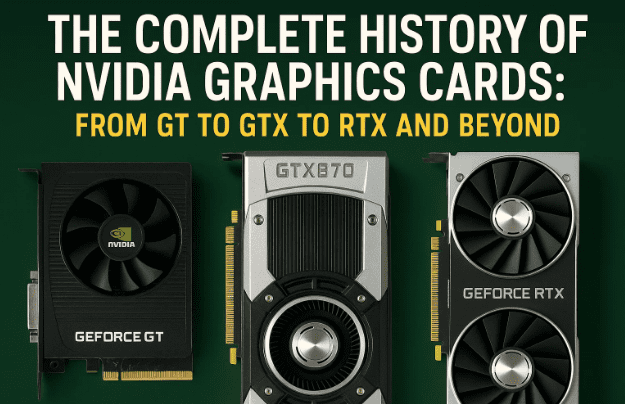
Nvidia doesn’t just throw random letters around. Each name indicates a product tier:
- GT → Entry-level, mainly for light graphics tasks.
- GTX → High-performance gaming cards before ray tracing became mainstream.
- RTX → The current generation, with ray tracing and DLSS (AI-powered performance boosts).
Understanding this progression helps buyers avoid overspending or ending up with outdated cards.
2. 🟢 The GT Era: Budget Heroes of the Past
The GT cards were Nvidia’s budget and mid-range offerings. While they often got roasted by gamers for being weak compared to GTX, they served a purpose: bringing basic gaming and multimedia performance to affordable PCs.
- 8800 GT (2007) → Mid-range but powerful for its time. If you had one, you were the king of LAN parties.
- GT 210 → Absolute bare minimum. Good for office work, YouTube, and ancient games. Buying this was like wearing sneakers only to walk to the fridge.
- GT 220 & GT 240 → Entry cards for light gaming like Counter-Strike and World of Warcraft. Attempting Crysis? Forget it — instant meltdown.
- GT 420 & GT 430 → Targeted at home theater PCs. Great for Netflix, not so great for gaming.
- GT 520 / 530 / 545 → Budget upgrades, just barely better than integrated graphics.
- GT 610 → GT 640 → Low-end gaming at best. GTX was already far stronger.
- GT 710 → GT 740 → Widely sold in cheap builds. GT 710 bizarrely kept being sold new even in 2023.
- GT 1030 (2017) → The final GT card, based on Pascal. Efficient, decent for esports like League of Legends and CSGO. A respectable farewell for the GT lineup.
👉 Verdict: GT cards were the “training wheels” of GPUs. They weren’t flashy but gave millions of users an affordable way into PC gaming.
3. 🔥 The Rise of GTX: Serious Gaming Power
This is where Nvidia became a household name among gamers.
- GTX 260 / GTX 280 (2008) → The first true GTX cards. High-end, expensive, and powerful. Owning one made you a PC god.
- GTX 460 → GTX 480 (Fermi era) → Huge leap in performance, but they ran extremely hot — like gaming on a portable heater.
- GTX 560 / 570 / 580 → Balanced power and popularity. The GTX 580 became a legendary benchmark card.
These GPUs cemented Nvidia’s lead in gaming performance, even if AMD occasionally caught up.
4. 🌟 The Legendary GTX Generations
The GTX name peaked with several unforgettable lineups.
- GTX 660 → GTX 690 (Kepler) → Efficient, powerful, and the GTX 690 was a dual-GPU beast.
- GTX 760 → GTX 780 Ti → A refresh of Kepler. The 780 Ti especially became iconic, dominating its era.
- GTX 750 / 750 Ti (Maxwell) → Efficient entry-level cards. Perfect for budget 1080p gaming.
- GTX 960 / 970 / 980 / 980 Ti (Maxwell) → The 980 Ti rivaled Titan-class performance at a cheaper price. The GTX 970 was infamous for its 3.5GB VRAM controversy but still loved.
- Titan X → Nvidia’s “show-off” card. Designed for enthusiasts who wanted the absolute best.
👉 These generations showed how GTX evolved from “just gaming cards” into a cultural badge of honor for gamers.
5. 🚀 The Pascal Breakthrough (GTX 10 Series)
If you talk about the golden age of GPUs, many will point here.












- GTX 1050 / 1050 Ti → Entry-level champions, super efficient, perfect for budget builds.
- GTX 1060 → The most popular GPU on Steam for years. Affordable and powerful enough for most gamers.
- GTX 1070 / 1080 / 1080 Ti → High-end monsters. The 1080 Ti, in particular, is still in use today, a testament to its incredible performance per dollar.
Pascal hit the sweet spot: efficiency, performance, and price balance.
6. 📦 The Last GTX Lineup (GTX 16 Series)
The GTX 16 series marked the end of the GTX era, launching alongside RTX.
- GTX 1650 / 1650 Super → Budget entry cards.
- GTX 1660 / 1660 Ti / 1660 Super → Strong 1080p cards that skipped ray tracing but kept performance solid.
👉 These were like the iPhone SE of GPUs — no fancy features, but they worked reliably at a good price.
7. 💡 The RTX 20 Series: Enter Ray Tracing
Nvidia flipped the game with ray tracing and DLSS (Deep Learning Super Sampling).
- RTX 2060 / 2060 Super → Entry-level RTX. Brought ray tracing to mid-range PCs.
- RTX 2070 / 2070 Super → Mainstream powerhouse, great for 1440p.
- RTX 2080 / 2080 Super → High-end, strong 4K with DLSS. Criticized for high launch prices.
- RTX 2080 Ti → The flagship that truly showed off ray tracing. Hugely expensive, but unmatched at 4K.
8. ⚡ The RTX 30 Series: Power Meets Scarcity
The Ampere generation was iconic but also infamous for shortages and scalpers.
- RTX 3050 / 3060 / 3060 Ti → Entry to mid-range. The 3060 Ti was hailed as one of the best value GPUs ever.
- RTX 3070 / 3070 Ti → Marketed as “2080 Ti performance for half the price.” Incredible on paper, hard to find at launch.
- RTX 3080 / 3080 Ti → Gaming icons, delivering huge jumps in performance.
- RTX 3090 / 3090 Ti → Workstation-class, with 24GB VRAM. Overkill for most, but loved by creators.
9. ⚙️ The RTX 40 Series: Efficiency and DLSS 3
Built on Ada Lovelace architecture, these cards focused on AI performance.
- RTX 4060 / 4060 Ti → Entry-level with DLSS 3 saving the day. Great for compact builds.
- RTX 4070 / 4070 Ti → Mid-range 1440p beasts. The 4070 Ti was controversial due to naming, but performed well.
- RTX 4080 → Powerful but overpriced. Best when paired with DLSS 3.
- RTX 4090 → The undisputed king. Crushed 4K, flirted with 8K, and became every gamer’s dream card.
10. 🔮 The Future RTX 50 Series: Blackwell Architecture
The next generation is already hyped, though not fully released. Expectations are sky-high.
- RTX 5050 / 5060 / 5060 Ti → Budget-friendly entry cards with efficiency upgrades.
- RTX 5070 / 5070 Ti → Predicted to dominate 1440p and deliver solid 4K.
- RTX 5080 → Balanced high-end card, expected to be a favorite among enthusiasts.
- RTX 5090 → The next supercard, rumored to double the RTX 4090’s power. Aimed at extreme gamers and creators.
📊 Nvidia GTX vs RTX Generations: A Quick Comparison
| Generation / Series | Launch Year | Tier | Key Features | Typical Use Case |
|---|---|---|---|---|
| GT (210 → 1030) | 2008–2017 | Entry-level | Basic graphics, media playback, light esports (last card: GT 1030) | Office PCs, HTPCs, budget esports |
| GTX 200 (260, 280) | 2008 | High-end | First true GTX lineup, powerful for its era | Enthusiast gaming |
| GTX 400 (460 → 480) | 2010 | Mid → High | Strong but ran hot (Fermi architecture) | Gamers wanting raw power |
| GTX 500 (560 → 580) | 2011 | Mid → High | More stable, GTX 580 became iconic | 1080p gaming standard |
| GTX 600 (660 → 690) | 2012 | Mid → High | Kepler architecture, dual-GPU GTX 690 | Balance of efficiency & power |
| GTX 700 (760 → 780 Ti) | 2013 | Mid → High | Refined Kepler, 780 Ti stood tall | Long-lasting enthusiast builds |
| GTX 700 (750 / 750 Ti) | 2014 | Entry → Mid | First Maxwell cards, efficient budget GPUs | Affordable 1080p gaming |
| GTX 900 (960 → 980 Ti, Titan X) | 2014–2015 | Mid → Enthusiast | Maxwell architecture, GTX 970 (popular), GTX 980 Ti near-Titan | 1080p → 1440p premium builds |
| GTX 10 Series (1050 → 1080 Ti) | 2016–2017 | Entry → High | Pascal architecture, GTX 1060 most used GPU for years, 1080 Ti legendary | 1080p → 4K gaming |
| GTX 16 Series (1650 → 1660 Ti) | 2019 | Entry → Mid | Turing without ray tracing, efficient and budget-friendly | Affordable modern gaming |
| RTX 20 Series (2060 → 2080 Ti) | 2018–2019 | Entry → Flagship | First RTX cards with ray tracing + DLSS 1.0, 2080 Ti led the pack | Ray tracing at 1080p → 4K |
| RTX 30 Series (3050 → 3090 Ti) | 2020–2022 | Entry → Extreme | Ampere architecture, DLSS 2.0, massive performance gains, GPU shortage era | 1080p → 8K, creators & gamers |
| RTX 40 Series (4060 → 4090) | 2022–2023 | Entry → Extreme | Ada Lovelace, DLSS 3 & Frame Generation, RTX 4090 crushed all benchmarks | Efficient high-FPS gaming |
| RTX 50 Series (expected: 5050 → 5090) | 2025 (upcoming) | Entry → Extreme | Blackwell architecture, rumored double 4090 performance, improved AI & ray tracing | The future of PC gaming |
11. ❓ Frequently Asked Questions
Q1: Should I still buy a GTX card in 2025?
Only if it’s very cheap. GTX cards are outdated for modern games with ray tracing.
Q2: What’s the difference between GTX and RTX?
GTX focuses purely on rasterized graphics. RTX adds ray tracing and AI-powered DLSS, making it far superior for modern gaming.
Q3: Do GT cards still exist?
No, the GT line ended with the GT 1030. Modern entry-level options are RTX 3050 or 4060.
Q4: Why are Nvidia GPUs so expensive?
Partly due to performance, but also brand dominance, high demand, and supply chain challenges.
12. 🏁 Final Thoughts
From the humble GT cards to today’s RTX monsters, Nvidia has defined PC gaming for nearly two decades. GTX brought performance to the masses, Pascal set a golden standard, and RTX introduced a future powered by ray tracing and AI.
As we step into the RTX 50 series, one thing is clear: Nvidia will continue pushing the boundaries of gaming and computing performance. Whether you’re a casual gamer or an enthusiast building a dream rig, knowing this history helps you appreciate where GPUs have been — and where they’re going.
⚠️ Disclaimer
Specs and performance comparisons are based on historical benchmarks and public information. Always check the official Nvidia website and your card manufacturer for the latest specifications and firmware updates before purchase. Also this article contains affiliate links from Amazon.
Tags
nvidia gt cards, nvidia gtx cards, nvidia rtx cards, gpu buying guide, history of nvidia gpus, pc gaming graphics cards, pascal gpus, ampere gpus, blackwell architecture
Hashtags
#Nvidia #GTX #RTX #GamingPC #GraphicsCards #TechHistory