When was the last time you truly enjoyed a video game — not just played it, but lost yourself in it completely?
Think about it. Maybe it was last week. But do you remember when that game was released? Chances are, it wasn’t very recent. Because somewhere along the way, games stopped being short bursts of joy and started to feel like full-time jobs that you pay to do.
Modern gaming isn’t just entertainment anymore — it’s an obligation. Daily logins, endless side missions, repetitive grinding, and artificial progress barriers have turned once-relaxing pastimes into emotionally draining loops.
Let’s explore how we reached this point — from the compact brilliance of Portal and Bioshock to the bloated design of modern open-worlds and “battle passes.” And most importantly, we’ll look at why we still play them, even when we no longer enjoy them.
🕹️ 1. When Games Were Short but Memorable
Let’s start with a simpler era — when finishing a game meant something.
Games weren’t measured in hours; they were measured in impact. Titles like Portal, Half-Life 2, Bioshock, Uncharted 2, and the early God of War entries could be completed in just a few evenings — yet they stayed with you for years.
They didn’t waste your time with meaningless collectibles or forced replay loops. Every level, every puzzle, every boss had a purpose. You were rewarded not with digital currency, but with emotional satisfaction.
Studios back then weren’t chasing “engagement metrics” or “player retention curves.” They cared about a single, honest goal:
“Make a game so good that it sells itself through word of mouth.”
And it worked. People remembered how they felt, not how many hours they logged.
But then, one unexpected game changed everything.











🔥 2. The Turning Point: How Far Cry 2 Accidentally Redefined Gaming
It wasn’t a blockbuster, nor did it become a global cult hit. Yet Far Cry 2 quietly altered the DNA of game design forever.
Released by Ubisoft in 2008, it was an ambitious attempt at realism — a simulation of chaos rather than a typical shooter.
Here’s what made it groundbreaking at the time:
- Dynamic fire physics — flames spread through dry grass and trees naturally.
- Weapons degraded — guns jammed mid-fight.
- Bullets embedded in the body — forcing the player to manually extract them.
- An open African wilderness that felt hostile, alive, and uncaring.
It was immersive — maybe too immersive. Players felt drained rather than entertained. It was slow, dark, and punishing. Many found it “boring” compared to the colorful shooters of that era.
And that’s where the industry took its fateful turn.
Ubisoft decided: if realism doesn’t keep players happy, content will.
🏝️ 3. Far Cry 3 — The Blueprint for Endless Grind
Then came Far Cry 3 in 2012 — a game that completely flipped the formula. It gave players everything Far Cry 2 didn’t:
- Colorful islands and lush graphics.
- Dozens of map icons and outposts.
- Tower climbing to unlock new areas.
- Weapon upgrades, crafting, and skill trees.
And yes, it worked. The game was great — charismatic villains, smooth gameplay, and dopamine at every corner. But that’s also when the “content addiction loop” was born.
Instead of making games you could finish, studios began making games you could never leave.
Developers misread Far Cry 3’s success, assuming the reason people loved it was because of the sheer number of activities — not the emotional storytelling or design freedom.
From there, Ubisoft began replicating itself.
Every major franchise — Assassin’s Creed, Watch Dogs, Ghost Recon — inherited the same formula: large maps, repetitive objectives, incremental rewards, and time-sucking side content.
Games became larger in size, but smaller in soul.
🌍 4. When the Open World Became the New Prison
What started as a creative design choice became an industry template.
Soon, every studio wanted a piece of the “open-world” pie.
Instead of depth, they built area. Instead of tension, they built towers.
Players were given massive maps filled with hundreds of markers — “collect this,” “hunt that,” “clear that camp.” It gave the illusion of freedom, but in reality, it was a structured treadmill.
Even beloved franchises like Mafia fell victim.
The first two Mafia games were tight, cinematic narratives — memorable characters, short campaigns, and emotional payoffs.
Mafia III, however, turned into a checklist simulator of outposts and repetitive missions.
Developers began to confuse content with value — and gamers mistook duration for depth.
⏳ 5. The Industry Realization: If You Can’t Entertain Them, Enslave Them
The next evolution wasn’t about maps anymore — it was about control.
When publishers realized players could be kept inside their games indefinitely, the real business model was born.
Companies like Activision, EA, and Blizzard understood something fundamental:
You don’t need to make a better game.
You just need to make a harder one to leave.
This gave birth to the modern “live-service” and “battle pass” era — an economy built on habit instead of fun.
The Formula:
- Introduce daily missions and limited-time events.
- Create ranks, skins, and small dopamine rewards for repetitive play.
- Punish players who skip days (falling behind in ranks or unlocks).
Games like Fortnite, Call of Duty: Warzone, Apex Legends, Valorant, and Overwatch don’t just want your money — they want your time.
They’re not designed for you to win. They’re designed to keep you chasing the next match, next skin, next victory — forever.
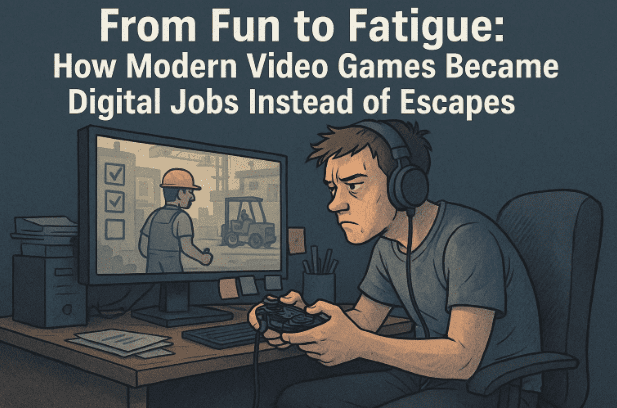
💼 6. When Entertainment Became a Second Job
Let’s be honest — games today feel like unpaid labor.
The endless “battle passes,” seasonal resets, and ranking systems are digital timecards.
If you miss a few days, you lose progress.
Miss a week, and you might as well start over.
The industry found a way to monetize fear of missing out (FOMO) — a psychological trap that keeps players grinding even when they’re exhausted.
Every victory gives a micro-dose of dopamine — a temporary rush that fades within minutes.
So you play again. And again. And again.
But the emotional toll is real:
- Burnout replaces relaxation.
- Anxiety replaces joy.
- Winning becomes mandatory, not rewarding.
Games once meant to free us from daily stress now mirror it.
🧠 7. The Psychology of “Retention Games”
Let’s move to the next crucial question — why do we keep playing, even when we know we’re not having fun anymore?
The answer lies in how the human brain reacts to reward schedules.
Psychologists call it variable reinforcement — the same principle used in casinos.
- You don’t get a reward every time.
- You get it sometimes, at unpredictable intervals.
- That unpredictability hooks you even deeper.
Each kill streak, loot drop, or rank-up feels “earned,” even though it’s part of an algorithmic loop.
Developers know exactly when to trigger these micro-rewards — just enough to keep you hungry.
This transforms games into what behavioral experts call “compulsion loops.”
You’re not chasing enjoyment — you’re chasing the memory of enjoyment.
🧩 8. Streamers and Esports: The New Pressure Cookers
The explosion of streaming platforms like Twitch and YouTube Gaming added another layer to the problem.
Now, gaming isn’t just personal — it’s performative.
We watch others play to learn, to compete, or to compare — and in doing so, we internalize their pressure.
If you’re not climbing ranks, pulling off 360 headshots, or unlocking rare skins, you feel inadequate.
The joy of playing “just for yourself” has disappeared.
Even casual gaming is now benchmarked by global leaderboards and online validation.
It’s no wonder gamers today face burnout, anger, and anxiety from what used to be their favorite hobby.
🌨️ 9. A Memory of Simpler Joy
Let’s pause for a moment.
Think back to your own childhood — those quiet evenings when you’d sit in front of a glowing CRT monitor, playing Mafia II or Need for Speed: Most Wanted.
Snow falling outside, jazz crackling through the speakers, and the yellow warmth of a monitor lighting the room.
There were no battle passes, no rank resets, no microtransactions.
You didn’t play to unlock.
You played because it felt good.
Those games weren’t escapes from reality — they were small alternate lives.
Today, that innocence is gone. The systems are smarter, but the souls inside them are missing.
And maybe that’s why we look back so fondly — because nostalgia is often just authentic joy we’re no longer allowed to feel.
❓ 10. FAQs — Why Modern Gaming Feels Exhausting
Q1: Why are modern games so much longer?
Because engagement time equals profit. The longer you play, the more likely you are to buy skins, DLCs, or season passes. Duration has replaced quality as the main performance metric.
Q2: What’s wrong with open worlds?
Nothing inherently. The problem is filler — repetitive side missions, collectibles, and procedural content that inflate playtime without adding emotional depth.
Q3: Why do I keep playing even when I’m not having fun?
Games are built around psychological retention loops — small unpredictable rewards that mimic gambling mechanisms. You’re wired to chase the “next hit” of achievement.
Q4: Is multiplayer gaming the problem?
Not entirely. It’s the design philosophy behind it — where progression systems are built to reward daily play and punish absence.
Q5: Can smaller studios break this cycle?
Yes. Indie developers are already focusing on compact, meaningful experiences (Hollow Knight, Inside, Hades, Celeste). They remind us that satisfaction doesn’t require 200 hours of repetition.
🧭 11. Finding Balance: How to Reclaim the Fun
It’s not too late to enjoy games again — but it requires breaking free from the loop.
Here are a few mindful steps:
- Play story-driven games again — Linear experiences like A Plague Tale: Requiem, Alan Wake 2, or Resident Evil 4 Remake deliver high emotion in limited time.
- Avoid “daily obligation” games — If a game punishes you for not logging in, it’s not entertainment; it’s exploitation.
- Replay old favorites — Nostalgia often hides design brilliance. Mafia II, Max Payne 2, Bioshock, or Portal can rekindle genuine fun.
- Stop chasing meta progress — You don’t need a rare skin or leaderboard rank to feel accomplished.
- Support indie developers — They still design with heart, not spreadsheets.
Sometimes, fun means stopping before you’re told to.
🕰️ 12. Conclusion: When Did Play Become Work?
Somewhere between outpost #43 and battle pass level 87, we forgot why we played at all.
What was once an art of imagination became a factory of engagement.
Developers stopped asking, “Is it fun?”
They started asking, “How long can we keep them here?”
Maybe it’s time for players to take the power back — to play less, but better.
Because real gaming isn’t about hours logged or ranks earned. It’s about the quiet joy of existing in another world, if only for a little while.
⚠️ Disclaimer
This article reflects general observations about the gaming industry and is not intended to criticize any single studio or title.
Game development is complex, and player enjoyment varies. The focus here is on industry trends affecting overall game design and player psychology.
🏷 Tags & Hashtags
Tags: modern gaming, Ubisoft design, Far Cry 3, open-world fatigue, battle pass, video game psychology, game addiction, game retention systems, nostalgia in gaming, esports burnout
Hashtags: #ModernGaming #GameDesign #FarCry3 #OpenWorldGames #GamingAddiction #BattlePass #VideoGameCulture #GameIndustry #PlayerBurnout #DTPtips