Social media has become the oxygen of our digital lives. For many Indians, WhatsApp isn’t just a chatting app anymore — it’s a lifeline for business, health, and communication. Teachers send assignments, doctors consult patients, farmers share updates, and small entrepreneurs run entire ventures using it.
But what happens if one day your WhatsApp account is suddenly banned or blocked without warning? Can you go to court? Can you claim that your right to communicate or earn a livelihood has been violated?
That’s exactly what happened in the case of Dr. Raman Kundra vs WhatsApp LLC, Meta Platforms, and Others, which reached the Supreme Court of India.
This article breaks down that real-life case, the court’s reasoning, and what it means for millions of Indian users. We’ll also explore how WhatsApp’s terms of service, Meta’s global policies, and Indian legal frameworks interact — and what you can do to stay safe from account bans in the future.
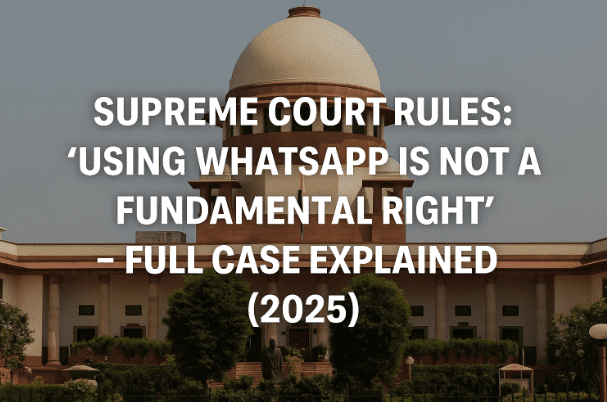
1. Background: The Dr. Raman Kundra vs WhatsApp Case
The case that sparked national discussion was Dr. Raman Kundra & Another vs WhatsApp LLC, Meta Platforms & Others.
Dr. Raman Kundra and another petitioner — both medical professionals — used WhatsApp for years to communicate with patients and manage consultations. Suddenly, their WhatsApp accounts were blocked by the company without prior notice.
Feeling helpless, they approached the Supreme Court of India under Article 32, claiming that their Fundamental Rights had been violated.
They argued that:
- Their right to livelihood was being disrupted, since their work relied heavily on WhatsApp communication.
- Their freedom of expression was being curtailed.
- And that blocking them without a clear reason amounted to digital injustice.
2. What Exactly Happened?
The petitioners, two practicing doctors, used WhatsApp for over a decade to interact with their patients.
From consultations to appointment scheduling, WhatsApp had become their digital clinic.
Then one morning, both discovered they were locked out — their WhatsApp numbers were permanently banned.
No detailed explanation came, just an automated message:








“Your account activity has violated our Terms of Service. This account has been banned.”
They contacted support, but received no satisfactory response.
So they did what most people wouldn’t dare — they filed a petition directly before the Supreme Court of India.
3. Why the Doctors Went to the Supreme Court
The petitioners used Article 32 of the Indian Constitution, which allows citizens to approach the Supreme Court directly if a Fundamental Right has been violated.
They argued that:
- Their daily income depended on WhatsApp communication with patients.
- Losing access effectively harmed their right to livelihood, which flows from Article 21 (Right to Life).
- Hence, they sought a Writ Petition directing WhatsApp and Meta to restore their accounts.
But this argument hit a crucial legal wall.
4. Article 32 and Fundamental Rights Explained
To understand the court’s response, let’s briefly revisit Article 32.
It gives every Indian the power to approach the Supreme Court for enforcement of Fundamental Rights. The Court can issue five types of writs:
- Habeas Corpus – against unlawful detention
- Mandamus – to compel a public authority to perform its duty
- Prohibition – to prevent an inferior court from exceeding jurisdiction
- Certiorari – to quash an order
- Quo Warranto – to challenge the legality of an appointment
But here’s the key point:
These writs can only be issued against the “State” or public authorities, not private companies.
So the question became — Is WhatsApp a State?
5. The Supreme Court’s Decision
The Supreme Court heard the matter and made its position crystal clear.
It ruled that:
“WhatsApp, Meta, and similar social media platforms are private entities, not part of the Indian State. Therefore, no writ under Article 32 can be issued against them.”
In other words, using WhatsApp is not a Fundamental Right, and its suspension does not qualify as a violation of the Constitution.
If WhatsApp bans you, you cannot directly seek relief under Article 32 in the Supreme Court.
6. Why the Court Dismissed the Petition
The bench noted several important reasons for dismissing the petition:
- Private Ownership: WhatsApp is owned by Meta Platforms (a private company), not the Indian government.
- No Constitutional Duty: Fundamental Rights apply only against the State, not against private corporations.
- Voluntary Usage: WhatsApp is a voluntary service. No one is forced to use it.
- Existing Remedies: Users can approach civil courts or consumer forums if they feel wronged.
The Supreme Court also stated that since WhatsApp provides a private communication service under its own Terms and Conditions, any dispute must be governed by contract law, not constitutional law.
In short, you agree to WhatsApp’s rules the moment you start using it — whether you read them or not.
7. How WhatsApp’s Terms and Conditions Affect You
Every user clicks “Agree and Continue” while installing WhatsApp — but few actually read what they agree to.
Here’s what those Terms of Service include:
- WhatsApp reserves the right to suspend or terminate accounts that violate its policies.
- Content involving nudity, hate speech, misinformation, violence, or illegal activities can trigger permanent bans.
- WhatsApp can also block your device ID (not just your account), meaning reinstalling won’t help.
These rules are part of WhatsApp’s Code of Conduct, aligned with Meta’s global content guidelines.
Let’s understand how this plays out with real-world examples.
8. Examples from Instagram and Snapchat Bans
One of the most relatable examples came from a user named Manoj, who shared how his Snapchat account was permanently banned.
He had posted a story related to a tragic incident — a news screenshot showing a victim’s image from a sensitive case. Though his intention was to condemn the act, Snapchat’s algorithm flagged it as nudity and sexual content, leading to a device-level ban.
This shows that automated moderation doesn’t interpret context — it simply enforces guidelines strictly.
Similarly, on Instagram, users have been banned for:
- Sharing violent protest videos
- Posting fake medical claims
- Using copyright music without permission
WhatsApp, Telegram, and Meta platforms all apply similar algorithms to identify and remove content that violates global standards.
So while it might feel unfair, the platforms are legally protected because you consented to those conditions while signing up.
9. Key Lessons for Every Social Media User
So far, we’ve understood what happened in court and why. Now let’s turn this into practical advice.
If you rely on WhatsApp or other platforms for business or personal use, here are crucial lessons to keep in mind:
- Read the Terms of Service: Take five minutes to understand what is prohibited.
- Avoid forwarding unverified news: Spreading false or violent information can trigger automated bans.
- Do not share sensitive visuals or explicit content, even in protest — AI filters can misinterpret your intent.
- Keep backups of critical business contacts or chats using WhatsApp’s export feature.
- Don’t depend on one platform: Always maintain an alternate channel (email, Telegram, or Zoho Cliq).
Remember: social media platforms enforce global rules, not Indian court exceptions.
10. What Are Your Legal Options if Your Account Is Blocked?
While the Supreme Court dismissed the Article 32 petition, it did offer alternative remedies.
If your WhatsApp or social media account gets blocked:
- Contact Support: Use the in-app “Contact Us” option.
- Check Violation Email: WhatsApp usually sends a brief reason for the ban.
- File a Complaint in Civil Court: You can challenge wrongful suspension under contract law.
- Approach Consumer Forum: If the service caused measurable loss or distress.
But remember — courts will only intervene if you can prove that the platform violated its own stated terms, not because it hurt your feelings or convenience.
11. Government and Indian Alternatives (Zoho, Jio, etc.)
The discussion also highlighted a larger concern — India’s dependence on foreign digital platforms.
The speaker in the original discussion recommended exploring Indian or self-hosted alternatives, such as:
- Zoho Cliq / Arattai – an Indian-made messaging and collaboration platform by Zoho Corporation (https://www.zoho.com/cliq).
- JioChat – a voice, video, and messaging app developed by Reliance Jio.
- Bharat Messenger (in development) – proposed under the Digital India mission for secure domestic communication.
Even the Government of India has begun migrating official communication to Indian-made platforms. Ministers like Amit Shah and Ashwini Vaishnaw have publicly endorsed the move to homegrown apps for security and sovereignty.
In a world of digital conflicts and data control, the message is clear — be aware of where your data lives.
12. Frequently Asked Questions (FAQs)
Q1. Can the government control or regulate WhatsApp?
Not directly. WhatsApp is a private company governed by Indian IT rules but not under constitutional control. However, the government can regulate it through IT Act Section 69A and Intermediary Guidelines 2021.
Q2. If my WhatsApp is banned, can I restore it by reinstalling the app?
No. If your number or device ID is banned, reinstalling won’t help. You must contact WhatsApp support and request a review.
Q3. Why does WhatsApp ban accounts without warning?
Because AI moderation detects suspicious patterns — mass messaging, spam, or violating content — and auto-flags accounts to maintain community safety.
Q4. Is using WhatsApp a Fundamental Right?
No. The Supreme Court clarified that it’s a private service, not a government function. Hence, banning or blocking an account does not violate Fundamental Rights.
Q5. What’s the safest way to protect my account?
Avoid sharing unverified or sensitive content, read the Terms of Service, and use Indian alternatives for critical communications.
13. Final Thoughts
The Raman Kundra vs WhatsApp case is a wake-up call for every digital citizen. It reminds us that while technology empowers us, it doesn’t exempt us from responsibility or corporate terms.
Your WhatsApp, Instagram, or Snapchat account isn’t your property — it’s a licensed service governed by company policies.
The Supreme Court’s verdict wasn’t against users — it was a reminder of digital literacy and self-accountability.
As India moves towards building its own tech ecosystem, the call for “Swadeshi Social Media” grows louder. But until then, awareness is your best protection.
So next time you click “Agree and Continue,” pause for a moment — because those few lines decide your digital rights.
14. Disclaimer
This article is for educational and informational purposes only.
It does not provide legal advice and should not be interpreted as legal counsel.
The explanations of Article 32, Fundamental Rights, and Supreme Court rulings are simplified for public understanding.
For legal action, always consult a qualified lawyer.
All brand names and trademarks belong to their respective owners.
Official sources for platforms mentioned:
- WhatsApp: https://www.whatsapp.com/legal
- Zoho Cliq: https://www.zoho.com/cliq
- JioChat: https://www.jiochat.com
Tags: WhatsApp ban Supreme Court case, Dr Raman Kundra vs WhatsApp LLC, Article 32 fundamental rights, social media blocking, WhatsApp terms of service, Supreme Court 2025 ruling, Indian digital laws, WhatsApp account ban solution, Zoho Cliq, Indian alternatives to WhatsApp
Hashtags: #SupremeCourt #WhatsAppBan #DigitalRights #MetaPlatforms #Article32 #SocialMediaLaws #IndianApps #ZohoCliq #DataPrivacy #WhatsAppNews