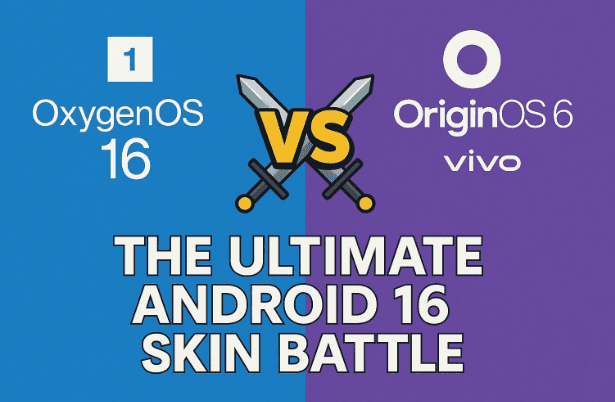
The Android ecosystem has always thrived on diversity — each brand adds its own flavor to Google’s foundation. In 2025, two manufacturers stand out for their unique takes on Android 16: OnePlus with OxygenOS 16, and Vivo with OriginOS 6.
Both systems are fast, fluid, and beautiful, yet they represent opposite philosophies:
- OxygenOS 16 focuses on precision and practicality, bringing clean visuals, responsive animations, and Gemini-powered AI integration.
- OriginOS 6, on the other hand, is all about creativity and emotional design — an artistic reimagining of Android that feels alive and customizable.
So which one truly wins the crown in 2025? Let’s break down their differences across design, performance, customization, AI integration, and real usability.
🕐 Always-On Display and Lock Screen: Function vs Flair
Before we compare deep system behavior, let’s start with what you see first — the lock screen and always-on display (AOD).
OxygenOS 16: AOD with Elegance
OxygenOS 16 introduces a full-screen Always-On Display, which beautifully blends into the lock screen. The transition from AOD to lock screen feels seamless, almost cinematic. Clock styles, depth transitions, and color tones now match the wallpaper perfectly.
The full-screen animation feels premium and cohesive, giving OxygenOS that minimalist yet dynamic OnePlus vibe users love.
OriginOS 6: Morphing Magic and Magazine Aesthetics
Vivo went in the opposite direction with design flair. OriginOS 6 brings morphing animations, glass textures, and magazine-style lock screens that evolve every time you unlock your phone.
There’s even a Combination Locker, allowing you to mix design elements from different templates — clocks from one style, wallpapers from another, and icons from a third — creating a uniquely personal lock screen experience.
Verdict
- OxygenOS 16: Cleaner, professional, and refined transitions.
- OriginOS 6: Creative, expressive, and full of character.
If you love sleek simplicity, OxygenOS wins. But if you want your lock screen to tell a story, OriginOS takes the edge.
🎨 Home Screen and App Drawer Customization
So far, we’ve seen aesthetics. Now let’s explore usability — where you spend most of your time: the home screen and app drawer.
OriginOS 6: Adaptive Folders and Color Themes
Vivo’s OriginOS 6 introduces scalable folders, a clever concept that lets you resize folder icons into small, medium, or large grids. Each folder can display multiple apps directly — eliminating extra taps.


You can also color-code folders, adding visual separation for categories like work, entertainment, or tools. The new widget library now includes dedicated categories like Health, Recorder, Notes, and Device Management.
It’s a creative and flexible approach that feels designed for visual thinkers.
OxygenOS 16: Organized and Accessible
OxygenOS takes a more practical approach. It merges home screen and lock screen settings into one place for better control. You can now choose from multiple icon shapes, add custom icon packs, and even use rounded or minimal styles to fit your theme.
The app drawer has also evolved.
- A new Categories tab automatically groups apps like iOS.
- The search bar has been moved to the bottom — making it easier to reach with one hand.
Verdict
- OxygenOS 16: Prioritizes accessibility and efficiency.
- OriginOS 6: Prioritizes creativity and personalization.
Both are great — but if you want one-tap usability, OxygenOS wins. If you enjoy customizing every detail of your layout, OriginOS offers more freedom.
🔔 Control Center and Notifications
Let’s move to the area you interact with dozens of times a day — the notification shade and control center.
OxygenOS 16: Functionally Refined
OnePlus continues to focus on smooth transitions and customizable quick toggles. The swipe-down animation is silky smooth, and you can now have two large cards at the top (e.g., brightness and data usage) with four smaller buttons below.
You can choose which toggles to highlight and arrange them however you want. The interface feels closer to Google’s stock Android but with extra polish.
OriginOS 6: Artistic Split-View
OriginOS also uses a split notification and control layout, but with more cinematic motion. Its morphing blur effects give it a glossy, glassy appeal.
The downside? You can’t fully customize the top blocks like in OxygenOS. But Vivo makes up for it with small design touches like water-ripple charging animations and elegant fingerprint scan effects.
Verdict
Both are fluid and responsive, but OxygenOS offers more functional control, while OriginOS provides visual delight.
🧠 Dynamic Island Features: Live Alerts vs Origin Island
Almost every Android brand has adopted its own version of Apple’s Dynamic Island — and both OnePlus and Vivo have done interesting work here.
OxygenOS 16: Live Alerts
OxygenOS 16 continues to evolve its Live Alerts feature, allowing multiple activities (like music playback, delivery tracking, and recording) to stack as cards. It’s neat, efficient, and blends well with the OS.
OriginOS 6: Origin Island
Vivo reimagines the concept entirely with Origin Island, a feature that doesn’t just display information — it lets you interact with it.
You can drag text or images into the island, and it intelligently shows apps you can share or paste to. For example, dragging a photo from your gallery into the island might bring up Instagram, Telegram, or Notes.
That’s an innovative use of space — both aesthetic and functional.
Verdict
If you want stability and familiarity, OxygenOS 16 wins. If you want innovation and creativity, Origin Island is a glimpse into the future.
⚡ Speed, Smoothness, and Performance
Now comes the big question — how fast are these systems in real use?
Both operating systems are based on Android 16, optimized for flagship processors like the Snapdragon 8 Gen 3. Both feel incredibly fluid, but their philosophies differ slightly.
OxygenOS 16: Parallel Animations 2.0
OnePlus has introduced the Parallel Animations Engine 2.0, refining micro-transitions across the entire OS. Opening apps, pulling down the notification panel, or accessing the global search feels effortlessly smooth.
Animations are consistent system-wide — you’ll notice transitions between screens feel natural, not abrupt.
OriginOS 6: Catching Up Gracefully
Vivo has massively improved its performance engine, matching OxygenOS in real-world speed. When stress-tested by rapidly opening and minimizing 20 apps, OriginOS 6 kept up almost frame-for-frame with OxygenOS 16.
That’s a big leap forward, considering earlier FunTouch versions struggled here.
Verdict
- OxygenOS 16 feels slightly more optimized, especially under load.
- OriginOS 6 is nearly as smooth, with gorgeous animation consistency.
🧩 AI and Smart Integration
Let’s talk about the brain behind the beauty — the AI ecosystem.
OxygenOS 16: Deep Google Gemini Integration
OxygenOS 16 integrates Google Gemini deeply within the system. Gemini is available in Gemini Live, and you can use features like Circle to Search directly on your screen.
OnePlus also introduced MindSpace integration — meaning you can ask Gemini to pull context from your notes, tasks, or documents stored locally. It feels similar to how Google Workspace tools (Docs, Sheets) interact with Gemini.
There’s also an AI Writer that works system-wide — you can use it to rewrite WhatsApp messages, emails, or social media captions with natural-sounding suggestions.
OriginOS 6: Office Kit and AI Utilities
Vivo’s OriginOS focuses on cross-device integration through its Office Kit. It allows:
- Screen mirroring between Windows/Mac and phone.
- Drag-and-drop file transfers.
- Cross-device notifications.
- Remote PC access.
This means your phone becomes an extension of your desktop — perfect for professionals.
AI also powers smart features like image-to-text recognition, contextual sharing, and handwriting optimization in Notes.
Verdict
- OxygenOS 16 is stronger in Google AI and writing tools.
- OriginOS 6 shines in cross-device ecosystem and PC connectivity.
🔋 Battery and Everyday Enhancements
A great interface means nothing without good endurance. Vivo and OnePlus both focus heavily on battery intelligence in this iteration.
OriginOS 6
Vivo introduces Battery Extender — a feature that adjusts background processes when your battery drops below critical levels. It also includes Bypass Charging, which lets your phone run on direct power while gaming, reducing heat and preserving battery health.
OxygenOS 16
OnePlus doesn’t fall behind. It optimizes charging curves intelligently, learning your routine. The new AI Smart Charging adapts charging speed overnight to reach 100% right when you wake up.
Additionally, both systems include granular privacy dashboards, redesigned weather and notes apps, and enhanced file managers with better categorization.
🧱 Quality-of-Life Improvements
Beyond major features, both OSes bring subtle upgrades that make everyday life smoother.
- Vivo’s redesigned Notes and Weather apps now use fluid layouts with realistic animations.
- Album app pinch gestures allow quick layout changes.
- New Data Visualization: Both systems rework the “About” and “Battery” pages to show detailed charts.
- Private Space (Vivo) lets you hide personal apps securely.
- Smart Sidebar (OxygenOS) is faster and smoother than before.
These details show how far Android skins have evolved — they’re no longer just themes, but full experiences.
⚖️ Feature-by-Feature Comparison Table
Here’s a quick side-by-side look at where each operating system stands:
| Category | OxygenOS 16 (OnePlus) | OriginOS 6 (Vivo) |
|---|---|---|
| Base System | Android 16 | Android 16 |
| UI Philosophy | Clean, functional, productivity-driven | Artistic, expressive, visually dynamic |
| Always-On Display | Full-screen AOD with depth transitions | Standard AOD with morphing blur |
| Lock Screen Customization | Flux Theme 2.0 with new clocks | Combination Locker + magazine templates |
| Home Screen Folders | Static folders, icon packs supported | Scalable folders, color-coded |
| Widgets | Minimal, functional | Animated, interactive widgets |
| App Drawer | Categories tab, bottom search bar | Traditional layout, widget tab |
| Control Center | Highly customizable toggles | Limited customization, better visuals |
| Dynamic Island | Live Alerts (multi-card stack) | Origin Island (drag-and-share AI) |
| Animation Engine | Parallel Animations 2.0 | New Morphing Engine |
| AI Integration | Google Gemini + MindSpace + AI Writer | Office Kit + cross-device sync |
| Cross-Device Link | Opus Connect for iPhone/Windows | Office Kit for Windows/Mac |
| Battery Features | AI Smart Charging, Thermal Optimizer | Battery Extender, Bypass Charging |
| Private Mode | App Locker, Hidden Space | Private Space 2.0 |
| Performance Tuning | Faster under heavy load | Close to Oxygen, improved stability |
| Customization Depth | Moderate – focused on efficiency | Extensive – focused on creativity |
| Best For Users Who… | Want reliability, speed, Google AI power | Love design, animation, and ecosystem fluidity |
🤔 OxygenOS 16 vs OriginOS 6: Which Should You Choose?
After spending time with both, here’s the honest conclusion:
- OxygenOS 16 is about refinement. It’s minimal, fast, and deeply integrated with Google’s AI ecosystem. Perfect for professionals and power users.
- OriginOS 6 is about expression. It’s visually stunning, artistic, and imaginative — perfect for users who love customization and design fluidity.
In short:
OxygenOS 16 makes your phone work for you.
OriginOS 6 makes your phone delight you.
If you prefer efficiency and precision — go with OxygenOS 16.
If you love personality, flexibility, and creativity — choose OriginOS 6.
💬 Frequently Asked Questions (FAQs)
Q1. Does OriginOS 6 replace FunTouch OS globally?
As of 2025, OriginOS 6 is rolling out gradually in global markets, replacing FunTouch OS on flagship Vivo and iQOO devices.
Q2. Which OS is faster in gaming?
OxygenOS 16 slightly edges out due to better animation optimization and heat management.
Q3. Which is better for PC connectivity?
OriginOS 6 wins with its Office Kit allowing full file drag-and-drop and remote PC access.
Q4. Can both systems use Google Gemini AI?
Yes. Both integrate Gemini and Circle to Search, though OnePlus has deeper integration via MindSpace.
Q5. Which one supports iPhone syncing or Apple Watch connection?
Both promise partial support globally, but as of now, Apple Watch sync isn’t fully functional outside China.
⚙️ Final Verdict
Comparing OxygenOS 16 and OriginOS 6 feels like comparing two artists from different schools — one paints with clean precision, the other with emotional strokes.
OxygenOS 16 continues to represent efficiency, stability, and smart integration, while OriginOS 6 reflects artistry, imagination, and design ambition.
If I had to pick one, I’d go with OxygenOS 16 for its polished execution — but Vivo deserves credit for pushing Android’s design boundaries in ways no other brand dares to.
The Android world is richer because both exist.
⚠️ Disclaimer
All features discussed are based on Android 16 builds of OxygenOS 16 and OriginOS 6 as of October 2025. Features may vary by device model and region. Always back up your data before performing OS updates.
For official details, visit:
#OxygenOS16 #OriginOS6 #Android16 #OnePlus #Vivo #SmartphoneOS #MobileTech #AndroidUI #TechComparison #OxygenOSvsOriginOS