Smartwatches were once seen as the next big thing after smartphones — a wrist-sized companion that could track your health, display notifications, and even make calls.
But as the years passed, something went wrong. The smartwatch hype slowed, many brands backed out, and users quietly returned to traditional wristwatches.
So what really happened?
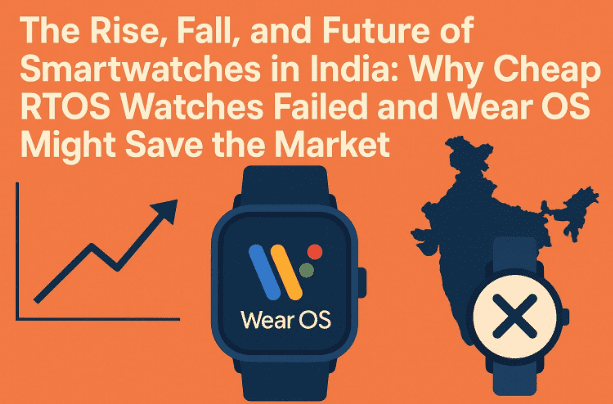
Why did Android-powered and RTOS-based watches fail, and what makes Google’s Wear OS the only hope for the future of smartwatches?
Let’s dive deep into this fascinating evolution of the smartwatch industry, especially in India, and understand what’s next.
The Smartwatch Boom: From Fitness Bands to Mini Phones
Just a few years ago, everyone wanted a smartwatch.
The trend started not with watches, but with fitness bands — simple, sleek devices designed to track your steps, heart rate, and sleep.
When the COVID-19 pandemic began in 2020, demand skyrocketed for health-related features like SPO2 sensors and heart-rate monitoring.
Brands quickly realized there was a huge market waiting — and thus began the transition from fitness bands to smartwatches.
Soon, the market was flooded with colorful circular or square displays that looked premium but were essentially fitness bands disguised as watches.
But this rapid growth came with a big problem — quality.
RTOS Smartwatches: The Budget Temptation and Its Downfall
If you’ve ever bought a smartwatch under ₹5000, chances are it runs on RTOS (Real-Time Operating System).
RTOS watches became the default choice for Indian consumers because of their low cost and simple interface.
They offered:
- Step tracking
- Heart rate and SPO2 monitoring
- Watch faces
- Bluetooth calling and notifications
At first glance, these seemed perfect. But here’s the catch — RTOS isn’t a real smartwatch operating system.
Let’s understand this in a little more detail.






What is RTOS?
RTOS is a lightweight system that can perform limited functions, but you can’t install or update apps.
It’s more like firmware for fitness tracking, not a full-fledged OS like Android or iOS.
Why RTOS Watches Failed
Despite flashy displays, most RTOS watches failed because:
- They can’t install third-party apps.
- The performance is extremely limited.
- They depend on your smartphone for everything — even AI chat or weather updates.
- Most importantly, their build quality and sensors are unreliable.
Some brands even advertised features like ChatGPT integration — but the reality was disappointing.
These watches didn’t actually run AI locally; they simply sent your request to your phone’s app, which then responded via Bluetooth.
In short, the “smart” part of these watches existed only on paper.
Android Smartwatches: Ambitious but Broken
Before Wear OS became popular, several brands launched Android-based smartwatches — mini versions of smartphones strapped to your wrist.
They often included:
- SIM card slots
- Direct app installation
- YouTube, Maps, and WhatsApp access
It sounded futuristic — until people started using them.
These Android watches faced major problems:
- Laggy performance due to weak processors
- Overheating during simple tasks
- Poor battery life (barely lasting a day)
- Faulty sensors and cheap materials
In short, they were too ambitious for their hardware.
Running Android on tiny watch hardware drained power and made the user experience miserable.
By 2022, most of these “Android watches” disappeared from the market entirely.
The Rise of Wear OS: Google’s True Watch Operating System
So far, we’ve seen two extremes — limited RTOS watches and underpowered Android watches.
But Google had another plan: Wear OS.
Wear OS (formerly Android Wear) is a specialized version of Android built specifically for smartwatches.
It includes:
- A dedicated Google Play Store for watch apps
- Optimized animations and UI for small displays
- Voice assistant integration
- Compatibility with Android phones (and partial support for iPhones)
This OS made smartwatch experiences smoother and more meaningful.
Unlike RTOS, you can install apps, sync calendars, reply to messages, and even use Google Maps navigation.
However, there’s a reason you don’t see Wear OS watches everywhere.
Why Most Indian Smartwatches Use RTOS Instead of Wear OS
You might wonder — if Wear OS is better, why don’t Indian brands use it?
Here’s why:
- Licensing Restrictions:
Google doesn’t allow every brand to use Wear OS. The company verifies quality and hardware before granting licenses. - Hardware Requirements:
Wear OS requires strong chipsets (like Qualcomm Snapdragon W5+) and more memory — both of which increase cost. - Development Complexity:
Building a Wear OS watch needs dedicated engineering and long-term updates — not quick assembly.
This is why only global brands like Samsung, Fossil, TicWatch, and Pixel watches use Wear OS officially.
The Price Game: Quality vs Quantity
Let’s move to the next issue — price.
The smartwatch market in India thrives on one principle: “more features, less price.”
Companies compete to sell watches at ₹999, ₹1499, or ₹1999 — promising everything from blood pressure monitoring to AI chat.
But with such aggressive pricing:
- There’s no budget left for good sensors or displays.
- Most watches use cheap components that fail within months.
- Brands skip quality testing to keep costs low.
The result?
Attractive designs, but poor internals.
The product looks great in your hand — but starts malfunctioning in 6–8 months.
Many users, frustrated by repeated failures, eventually stopped buying smartwatches altogether.
Performance Problems: Battery, Sensors, and Heat
When people first used budget smartwatches, they were excited by the sleek interface and colorful dials.
But after a few days, the flaws became clear.
Common complaints included:
- Battery draining within a day
- Step counts showing random numbers
- Sensors giving inaccurate SPO2 or heart rate readings
- Laggy Bluetooth calling
- Heating during charging
In short, the watches looked smart — but didn’t act smart.
A product’s real strength lies in its performance, not its advertisement — and that’s where many brands lost trust.
How Samsung Saved Wear OS (and Google)
While small brands struggled, one major player — Samsung — changed the game.
Samsung partnered directly with Google to merge its Tizen OS (used in older Galaxy watches) with Wear OS 3.
The result was a new generation of Galaxy Watch models offering:
- Smooth performance
- LTE calling support
- Advanced sensors (ECG, body temperature, stress tracking)
- Regular software updates
Even better, these watches support third-party apps from the Play Store — something RTOS devices can never do.
Samsung proved that when hardware and software align, smartwatches can be truly useful.
The Shrinking Smartwatch Market in India
Despite global progress, India’s smartwatch market has started to shrink.
Why? Because customers are tired of poor-quality products.
Data shows that even leading local brands that once dominated sales have seen a sharp drop in shipments.
Earlier, Realme, Xiaomi, and Noise led the race.
Today, even they are facing declining demand because users realized that cheap watches don’t last.
The result — fewer sales, reduced competition, and more caution from buyers.
🔙 Return of Classic Watches: Why People Switched Back
Interestingly, as disappointment grew with budget smartwatches, people started returning to traditional wristwatches — analog or digital models from Casio, Titan, and Timex.
Why? Because:
- They last for years.
- No charging required every night.
- No app crashes or connection drops.
It’s a classic case of “old is gold.”
People realized that reliability sometimes matters more than gimmicks.
Can the Market Recover? The Future of Wear OS Watches
So what lies ahead?
The future of smartwatches depends on quality and ecosystem integration.
Here’s what could change the game:
- Affordable Wear OS Devices:
If brands like Xiaomi or Realme launch Wear OS models under ₹10,000, it could revive interest. - Improved Chipsets:
Qualcomm’s new Snapdragon W5+ platform offers up to 50% better battery life and faster performance. - AI-Powered Features:
Future Wear OS watches could use Gemini or Google Assistant 2.0 for real-time translation, voice control, and image recognition. - Health Accuracy:
With advanced biosensors, heart and sleep data will become more reliable — closer to medical-grade accuracy.
If brands focus on making fewer but better watches, the category can thrive again.
🕶️ The Next Phase: AI Smart Glasses and Beyond
While the smartwatch trend cools, a new wave is emerging — AI-powered smart glasses.
Companies like Meta (Ray-Ban Stories) and Fire-Boltt (Fire Lens) are experimenting with wearable AI assistants built directly into eyewear.
However, cheaper clones can’t match the hardware or audio quality of Meta’s version — and we may see the same pattern repeating: too many features, too little refinement.
The lesson remains simple — quality wins.
No matter the form — watch or glasses — users now want reliable, long-lasting tech.
❓ Frequently Asked Questions (FAQs)
Q1. What is the difference between RTOS and Wear OS?
RTOS is a closed, limited system used in low-cost watches. Wear OS, developed by Google, is a full operating system that supports apps, updates, and smooth integration with Android phones.
Q2. Can I install apps on an RTOS smartwatch?
No. RTOS watches can’t install third-party apps — you can only use preloaded ones.
Q3. Why are Wear OS watches expensive?
They use powerful hardware, licensed software from Google, and premium materials — making them costlier but much better in performance.
Q4. Are Android watches still available?
Most Android-based watches have vanished because of poor battery life and outdated performance. Only Wear OS-based models remain practical.
Q5. Which brands still make good quality watches?
Brands like Samsung, Fossil, Amazfit, and Pixel continue to offer reliable options with balanced pricing and strong ecosystems.
⚠️ Disclaimer
This article is for educational and informational purposes only.
All trademarks like Android, Wear OS, and Apple Watch belong to their respective owners.
Pricing, features, and availability may vary depending on region and time.
Always verify compatibility before purchasing any smartwatch or wearable device.
Official Wear OS info: https://wearos.google.com
🏷️ Tags & Hashtags
Tags: smartwatch industry, Wear OS, RTOS, Android watches, Samsung Galaxy Watch, Google smartwatch, smartwatch future, Indian tech market, wearable technology, smartwatch comparison
Hashtags: #WearOS #Smartwatch #AndroidWatch #Gadgets #TechTrends #Google #Samsung #Amazfit #Wearables #Technology