Artificial Intelligence (AI) has become the backbone of many platforms we use daily — from recommending videos to moderating content. But as AI takes on more responsibility, it also raises bigger questions about accuracy, fairness, and transparency.
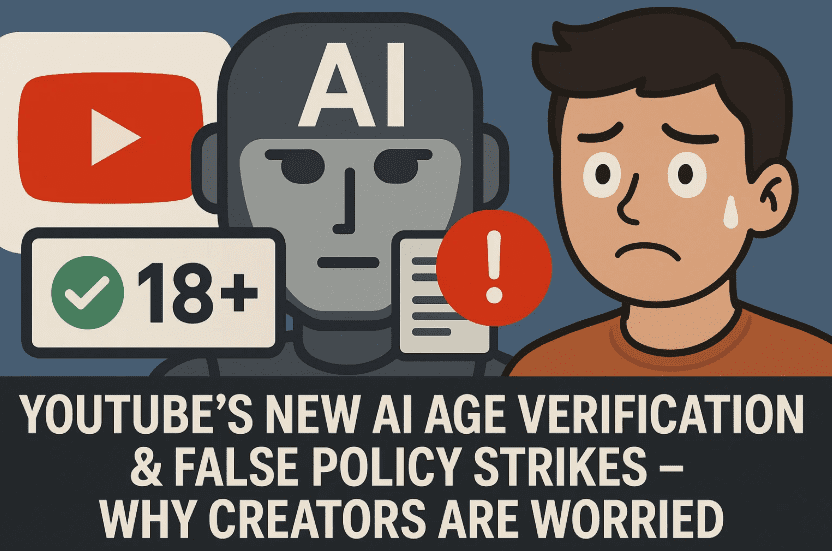
One of the most alarming developments in this space is YouTube’s recent move toward AI-based age verification that goes live on August 13. The system will decide whether you’re over 18 using automated detection methods, and if there’s a mismatch, you’ll be asked to verify with government-issued ID or video-based verification.
On paper, this might sound like a necessary step for protecting minors. But many creators are already raising the alarm — because the same AI systems handling this age verification are making serious mistakes in other areas, such as falsely flagging videos for “Child Safety” violations.
In this article, we’ll unpack:
- How YouTube’s current AI moderation is impacting creators.
- The upcoming age verification process and its potential pitfalls.
- Real-world examples of false strikes and shadowbanning.
- Why this issue goes beyond just creators — and affects every user.
- Practical steps you can take as a viewer or creator.
1. The Growing Role of AI in YouTube Moderation
YouTube’s AI is not just recommending videos anymore — it’s moderating, flagging, age-rating, and in some cases, removing them entirely without human review at the initial stage.
This AI scans videos for:
- Violations of Community Guidelines (like hate speech, harassment, or child safety issues).
- Monetization eligibility (detecting advertiser-friendly or unsuitable content).
- Copyright claims.
- Policy violations that can result in strikes or channel removal.
The system’s reach will expand on August 13, when it begins actively determining user age for content access. That means the same algorithms currently flagging videos will now decide if you need to submit ID or a video of your face to continue using certain features.
2. A False Strike for Child Safety – Case Study
Imagine uploading a video nine months ago. It’s reviewed, allowed on the platform, and stays up without issue. Then, out of nowhere, YouTube flags it for “child endangerment” — a serious violation under their Community Guidelines. That’s exactly what happened to one creator.
How it happened:
- Video title/context: A commentary about an argument on Twitter. No child-related content.
- Time gap: 9 months after upload, the AI system flagged it.
- Immediate impact: Community Guidelines warning issued.
- Appeal process: Rejected within about 12 hours, without clear explanation.
This kind of retroactive enforcement is worrying because it undermines creator confidence. If a video passes all automated and human checks at upload, it should not suddenly become a violation unless policies change and creators are given a fair chance to adapt.
3. Why This Matters for Upcoming Age Verification
If AI can misinterpret a harmless video as a serious child safety violation, how reliable will it be at determining your age?
Mistakes here could mean:
- Being wrongly classified as under 18.
- Losing access to certain videos or features.
- Having to provide personal documents to prove your age.
When it comes to age verification, an AI’s judgment could have personal data consequences, not just content removal.
4. Government ID and Video Verification – How It Works
YouTube’s documentation states that for “Advanced Features” or in age disputes, you may be asked for:






- A valid government-issued ID (passport, driver’s license, etc.).
- Video verification, where you follow prompts on your phone (look up/down, turn your head).
Some sources earlier mentioned credit card verification, but this doesn’t appear in the latest on-platform instructions.
YouTube claims that:
- These verification files will be automatically deleted after review.
- They will not use them for other purposes.
But here’s the concern: users have no way to verify that deletion actually happened. It’s purely a matter of trust.
5. The Privacy & Trust Problem
Platforms like YouTube have had data breaches in the past, and other big companies have been caught mishandling “confidential” data. That makes it hard for users to simply take these promises at face value.
Questions many are asking:
- How secure is the storage during the review process?
- Who has access to this sensitive information?
- Will it be shared with third parties?
- What happens if a government agency requests access?
Without independent audits or proof of deletion, these assurances feel fragile.
6. Other Creators Facing the Same Issue
This isn’t an isolated incident. Another creator, “Bang Snap,” was banned for four months over a supposed child safety violation.
The reason?
- The AI flagged the last 4 seconds of her video where she accidentally knocked over her microphone.
- Obviously, that’s not a child safety risk — but the system treated it as one.
When cases like this stack up, the narrative becomes clear: YouTube’s AI moderation has a false positive problem.
7. Shadowbanning & Auto-Unsubscribes
Beyond strikes, some creators report a decline in reach after policy disputes — a phenomenon often called “shadowbanning.”
Signs include:
- Sudden drops in views despite regular uploads.
- Subscribers saying they’re not seeing videos in their feed.
- Automatic unsubscribes without user action.
Some viewers even report seeing warnings like:
“This channel is under review. Some content may not be available.”
If true, this means the AI isn’t just moderating — it’s also quietly limiting channel visibility.
8. Community Feedback and Evidence
Here are some real comments from viewers:
- “In 10 years of using YouTube, this is the first time I’ve been randomly unsubscribed.”
- “I’ve been auto-unsubscribed 25+ times.”
- “I didn’t believe creators when they said this happened, but today I saw I was unsubscribed.”
- “My parents think this age verification is unnecessary and doesn’t benefit anyone.”
This feedback suggests the issue is systemic and not just a glitch affecting a handful of channels.
9. Potential Risks if Left Unchecked
If the same flawed AI is used for age verification, possible risks include:
- Loss of access to legitimate content.
- Privacy breaches if sensitive documents are mishandled.
- Suppression of dissent if policy critics are disproportionately flagged.
- Erosion of trust between creators, viewers, and the platform.
And perhaps most worrying — once an AI model is deployed at scale, rolling back mistakes becomes incredibly hard.
10. What Creators and Viewers Can Do
While the system is controlled by YouTube, users can still take steps:
For creators:
- Keep archival backups of all videos.
- Document strikes and appeal responses.
- Use alternative platforms for backup publishing.
- Encourage viewers to bookmark your channel directly.
For viewers:
- Check subscriptions regularly.
- Engage with content you value (likes, comments, shares help algorithmic visibility).
- Stay informed about YouTube policy updates.
11. Questions & Answers
Q: Will the age verification affect everyone?
A: It will apply to users accessing age-restricted content. If the AI thinks you might be under 18, you’ll be asked to verify.
Q: What if I refuse to give my ID or do video verification?
A: You won’t be able to access restricted content or certain features.
Q: Can false strikes be removed?
A: Yes, if you win an appeal — but many creators report instant rejections.
Q: Is YouTube legally allowed to store my ID?
A: Policies claim storage is temporary, but enforcement is based on trust.
12. Final Thoughts
This is more than just a “creator issue.” It’s about how much trust we can place in AI systems that control access, visibility, and even personal data requirements. When mistakes can lead to bans, strikes, or loss of income — and when those mistakes are hard to overturn — the balance of power shifts dangerously toward the platform.
YouTube’s age verification rollout will be a major test. If they can’t ensure accuracy in moderation, they risk locking out legitimate users and further eroding trust.
Disclaimer: This article discusses policy enforcement and AI moderation. It is not legal advice. Always refer to YouTube’s official Community Guidelines and Age Verification Help Page for the latest information.
Tags: youtube ai moderation, youtube age verification, false community guideline strike, youtube privacy concerns, creator policy issues, ai bias in moderation, youtube id verification process
Hashtags: #YouTubeAI #AgeVerification #CreatorRights #DigitalPrivacy #YouTubePolicies #ContentModeration #AIBias #OnlineSafety #YouTubeNews #PlatformAccountability