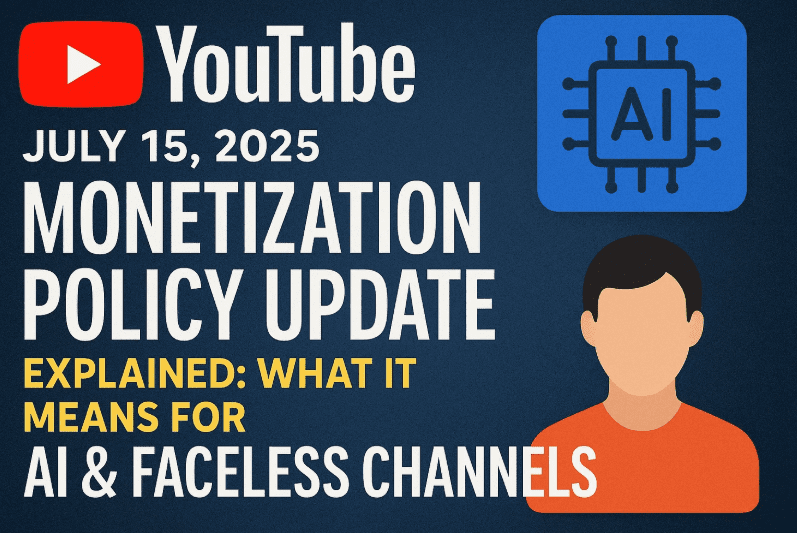
The internet is buzzing with panic about YouTube’s upcoming monetization policy update on July 15, 2025, with many creators wondering — Is this the end of YouTube automation? Will AI content and faceless channels get demonetized?
Let’s break it all down — clearly, calmly, and without the clickbait.
📢 What’s Actually Happening?
Starting July 15, 2025, YouTube is updating its monetization guidelines under the YouTube Partner Program (YPP). According to YouTube:
“We’re updating our guidelines to better identify mass-produced and repetitious content. This update better reflects what inauthentic content looks like today.”
At first glance, this sounds threatening to creators using AI-generated content, faceless video formats, or automated production tools. But in reality, it’s not a radical shift — it’s a modernization of existing rules that have been around for over a decade.
🧠 Why Is YouTube Updating This Policy?
The simple reason: AI has changed the game.
Previously, YouTube’s monetization policy flagged:
- Slideshows with scrolling text
- Reused compilations
- Slightly altered re-uploads (like pitch-shifted music)
But now in 2025, AI tools can mass-produce videos in seconds — from text prompts to entire narrated videos using tools like Google’s V3 (which adds realistic voice and sound design). So, YouTube needs updated language and enforcement strategies to distinguish original from automated spam.
🎯 What Does “Mass-Produced and Repetitious” Mean in 2025?
YouTube is focusing on:
- Videos made entirely by AI with minimal human input
- Cloned content that follows the same template across hundreds of uploads
- AI spam channels that post 20+ low-effort Shorts daily
- Recycled, unoriginal content that adds no transformation or commentary
However, there’s a gray area:
- AI-assisted content that includes editing, scripting, narration, or personalization may still be considered original.
- Content created using YouTube’s own AI tools (like the upcoming V3-powered Shorts editor) also seems to contradict these concerns — if YouTube is offering these tools, how can it punish creators for using them?
💡 Interpretation: It’s less about what tools you use, and more about how you use them.







🧑💻 Does This Affect Your Faceless or AI Channel?
Not unless you’re breaking existing rules.
YouTube has clarified:
“This is a minor update to our long-standing YPP policies to better identify when content is mass-produced or repetitive. This type of content has already been ineligible for monetization for years.”
So, if you:
- Already follow YouTube’s reuse policies
- Create videos with added value, transformation, commentary, or editing
- Don’t rely purely on auto-generated videos without review
Then you’re probably safe.
🔍 What About Shorts Made with AI?
YouTube’s own tools (like V3) will allow creators to generate Shorts with voiceovers, music, and AI visuals. But can you monetize them?
We don’t know for sure yet. It’s possible:
- YouTube sees them as engagement tools, not revenue drivers
- YouTube wants to flood the Shorts feed to grow user time-on-site, regardless of monetization
In either case, if you’re producing low-effort AI Shorts just for views, you may not be eligible for monetization — but you may still gain subscribers and traffic.
🧑💻 Useful Resources
- How to Find Viral YouTube Keywords Using SEMrush (And Rank Long-Term)
- How YouTube Studio May Be Killing Your Motivation – And How to Take Back Control as a New Creator
- How to Increase YouTube Views and Subscribers Using Google Ads
❓ Common Questions
Q1: Will all AI content be demonetized?
No. If your content is creative, transformative, or manually edited — even if AI-assisted — you’re still within the safe zone.
Q2: Will faceless channels be affected?
Only if they rely on repetitive templates or unoriginal bulk uploads. Faceless content with effort and originality (animation, narration, storytelling) is still valid.
Q3: Is this the end of YouTube automation?
No — but it may be the end of low-effort, mass-published AI spam channels trying to game the system.
Q4: Should I panic?
Not at all. Most of what YouTube plans to enforce is already outlined in the current monetization guidelines.
🔎 Pro Tip: Read These Sections Before July 15
To prepare, visit the official YouTube Monetization Policies – Reuse & Repetitious Content page and read:
- What counts as reused content?
- What is repetitious content?
- What content is NOT eligible for monetization?
You’ll likely find that 90% of the policy remains unchanged — only the definitions are evolving to suit the AI era.
🎬 The Real Threat: Vague Enforcement
The challenge with this update isn’t the policy itself — it’s how it’s enforced. YouTube uploads over 500 million videos per month. It needs flexibility, which is why the language is often vague. Expect enforcement to be:
- Gradual
- Case-by-case
- Automated via AI detection
But that also means inconsistent decisions might happen. That’s the risk — not the policy.
💡 Final Thoughts: What Should Creators Do?
- Continue creating authentic, engaging, and original content
- Use AI as a tool, not a replacement for creativity
- Avoid mass publishing templated videos with no added value
- Prepare for a stricter review process if applying for monetization
“This update might only affect 0.5% of creators — but that’s still over 15,000 creators. If you’re reading this, make sure you’re not one of them.”
Stay informed. Stay original. Keep creating.
🛍️ Suggested Tools for Authentic Video Creation
🎤 Need a quality voiceover mic for YouTube Shorts? https://amzn.to/4kppxid
🎬 4K Digital Camera for Photography- 48MP Autofocus Camera with 64GB SD for YouTube, Travel, Beginners
🏷️ Tags:
youtube monetization update 2025, ai content youtube, youtube automation, faceless youtube channel, reused content youtube, repetitious content policy, v3 ai tool youtube, youtube ai shorts, monetization eligibility, youtube partner program
📢 Hashtags:
#YouTubeUpdate2025 #AIVideos #FacelessChannels #YTPartnerProgram #YouTubeMonetization #YouTubeAI #ContentPolicyUpdate #OriginalContent #ShortsMonetization #AIContentCreation