Welcome back to the second part of our detailed roadmap to mastering AI in 2025. In Part 1, we explored the core concepts, essential tools, and lifelong AI skills that form the foundation of working smartly with artificial intelligence.
You are still Early – Complete AI Roadmap Part 1: Core Concepts, Tools, and Skills
If you haven’t read that yet, check it out first before diving into this part. Now, let’s move ahead and level up.
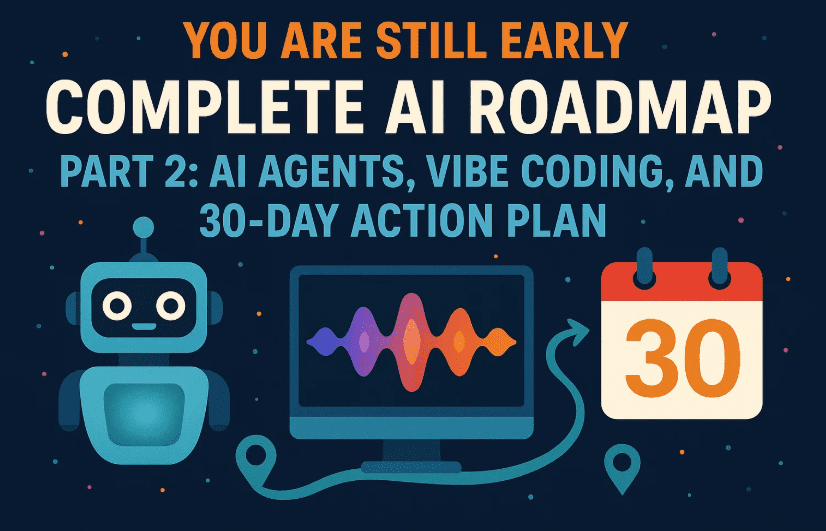
In this post, we’ll take you through the exciting world of AI agents, automations, vibe coding, and help you build your own personalized 30-day AI learning plan.
Let’s Begin with AI Agents: What They Are and Why They Matter
You might have heard the term “AI agent” being thrown around a lot recently. But what does it actually mean?
AI Agent vs Automation
- Automation is fixed. It follows predefined steps: A → B → C. Tools like Zapier or Make help you build these.
- AI Agents are dynamic. They can reason, make decisions, and select actions based on context. They think like a human assistant, not a robot.
Every AI Agent Needs 3 Core Parts:
- Brain: Usually a Large Language Model (LLM) like ChatGPT or Claude
- Memory: Stores context, history, or internal knowledge
- Tools: Capabilities like sending emails, updating sheets, fetching data, running API calls
Agents can:
- Summarize your day from your calendar
- Reschedule meetings based on your needs
- Read your inbox and reply
- Write content based on templates
- Execute complex decisions for you
Example Use Case
Start simple: A Telegram bot that:
- Reads your daily schedule
- Summarizes high-priority tasks
- Lets you reschedule with a single message
Over time, you can add:
- Email summaries
- Custom GPT prompts
- Integration with Notion or Google Docs
You don’t need to code. You just need the right tools and a mindset to experiment.
Recommended No-Code Tools to Build AI Agents
Let’s take a look at the best tools available today for non-coders to create powerful automations and agents:
1. N8N
- Open-source workflow automation
- Visual editor with logic, APIs, and now AI agent nodes
- Agents can now reason and act based on triggers and context
- Monetization: Users can sell workflow templates
2. Make (formerly Integromat)
- Cloud-based automation platform
- Excellent for connecting apps like Google Sheets, Gmail, Slack, Discord
3. Zapier
- The most popular automation tool
- Simple and great for beginners
- Now includes AI integrations
4. Cursor
- AI-first coding IDE
- Great for builders with some technical skill
- Can run code + AI side-by-side for agent creation
5. AI Studio (Google)
- Offers multi-modal agents
- Can process your screen and voice in real-time
- Think of it as a co-pilot for learning and working
What Is Vibe Coding? A Beginner-Friendly Way to Build Tools
Vibe coding is a term used for a new way of building apps or tools using plain language. You don’t start with lines of code, you start with an idea or request.




Here’s How Vibe Coding Works:
- You describe what you want in voice or text
- AI builds a working version (UI + logic)
- You test and give feedback
- AI makes changes based on your instructions
This loop continues until you get what you want. No coding needed.
Example:
“Build a small tool where I can enter YouTube titles and it scores them for emotional impact.”
The AI will build the interface, add logic, and iterate with you. In a few rounds, you have a working product.
This is perfect for:
- Solo creators
- Marketers
- Indie developers
- Educators
Tools That Support Vibe Coding
1. Windsurf
- Ideal for MVPs or internal productivity tools
- Polished output with zero code
2. Lovable
- Built for indie creators
- Great UX, guided process for building apps
3. Replit
- AI-powered browser IDE
- Best for technical folks who want a fast prototyping setup
4. Cursor
- Desktop IDE with full coding + AI pairing
- Steeper learning curve, but excellent for developers
Building a Personal AI Assistant (Highly Recommended)
This is the perfect starter project.
Start with:
- Calendar summarizer
- Email overview tool
- Reminder generator
Then add:
- Task prioritization
- Scheduling with voice commands
- Notion integration to check goals or templates
Eventually:
- Your agent will run workflows end-to-end
- You just give it a command like “Update my AI course outline”
Core Skill: Workflow Thinking (Break Down & Automate)
You don’t need to automate everything at once. Start small.
Identify a Friction Point:
- Repeating tasks (scheduling, copy/paste, replies)
- Things that drain your energy
Create a Basic Workflow:
- Input (calendar/email/form)
- LLM (decision-making or summarizing)
- Output (email/slack/notification)
Set it to run automatically. Now you have a working AI system.
Core Skill: Creative Remixing
Don’t be afraid to combine tools in unusual ways.
- Midjourney for visuals + ChatGPT for storyboarding = pitch deck
- Runway video + Eleven Labs voice = YouTube ad
- NotebookLM notes + Perplexity = course outline
You’ll find some of your best creations by simply following what the AI gives you and building from there.
The 30-Day AI Learning Plan (Simple, Practical, Effective)
Don’t rush. You’ll learn better by doing small actions consistently.
Week 1: Explore LLMs
- Sign up for ChatGPT, Gemini, and Claude
- Ask them the same prompt and compare responses
- Practice basic prompting with: summarizing, rewriting, brainstorming
Week 2: Visual + Audio Tools
- Try Midjourney or DALL-E: make 5 different types of images
- Use Eleven Labs or Suno to generate audio
- Create a small content piece using AI voice + image
Week 3: Start Automating
- Pick one repetitive task (e.g., summarizing articles)
- Use Make or N8N to automate it
- Build a small workflow with 2+ steps
Week 4: Build Your First Agent
- Use AI Studio or N8N to build a task assistant
- Add memory or context (e.g., last command, goal)
- Refine it by testing daily
Optional: Try Vibe Coding to build a micro-app or assistant interface
Key Takeaways
- You don’t need to be technical to start with AI
- The real magic happens when you combine tools and iterate
- Agents and automation will reshape how we work
- Vibe coding makes software creation accessible to everyone
And most importantly: Start with a real problem. Then solve it with AI.
Even if you only apply 10% of what you learned across this blog series, you’ll already be ahead of 99% of people who are still waiting.
Tags: AI agents, AI automation, vibe coding, N8N workflows, no-code AI, personal AI assistant, learn AI 2025, AI roadmap, Replit, Google AI Studio, ChatGPT agents, AI productivity, indie hacking with AI
Hashtags: #AI2025 #AIWorkflow #VibeCoding #AIAutomation #BuildWithAI #NoCodeTools #AIProductivity #LearnAI #AIBuilder #PersonalAI
Disclaimer: This guide is based on tools and platforms available as of 2025. Functionality, pricing, or access may vary in future versions. Always test AI outputs before critical use.