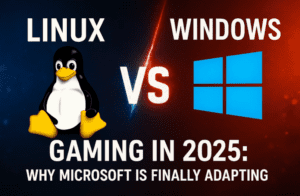
When it comes to operating systems, the debate between Windows and Linux has been ongoing for decades. While Linux has made significant advancements in performance, security, and flexibility, Windows continues to dominate, especially in the general user space. But why is that the case? Why do most people still prefer Windows, even with the many benefits Linux offers?
Let’s dive into the practical reasons behind Windows’ continued popularity and the real-world challenges users face when switching to Linux.

1. Familiarity from Childhood
Most users in countries like India are introduced to Windows at a young age. Whether in school computer labs or home PCs, Windows is often the first operating system people use. This early exposure builds familiarity and comfort. So even if the interface evolves — from Windows XP to 7, 10, or 11 — the core elements like the Start Menu, Control Panel, My Computer, etc., remain familiar.
Even when new versions are released, the overall layout and interaction style remain largely unchanged. This means people don’t have to relearn how to use their computers every time there’s an update.
✅ Takeaway: Windows provides a consistent experience across versions, making it user-friendly for all age groups.
2. Learning Curve in Linux
Linux is powerful — there’s no doubt about that. But with that power comes a learning curve. Unlike Windows, which is GUI-based and intuitive for most tasks, Linux often requires users to interact with the command line interface (CLI) for system-level changes and installations.
For example, changing hardware settings, installing drivers, or configuring software may require terminal commands. While many modern Linux distributions offer user-friendly interfaces, deep customizations and troubleshooting usually require technical knowledge.
✅ Takeaway: Linux can be intimidating for non-technical users, especially those used to GUI-driven interfaces.
3. Hardware and Driver Compatibility
A major challenge with Linux is hardware compatibility. Many manufacturers develop drivers only for Windows. Whether it’s a webcam, printer, or barcode scanner — if it’s a budget or older device, chances are it has Windows drivers but no official Linux support.
This can create frustration when a user installs Linux, only to find that certain devices won’t work unless they manually configure open-source drivers — and even then, success isn’t guaranteed.
✅ Takeaway: Windows has broader hardware and driver support out of the box.










4. Legacy Software and Compatibility
One of the strongest reasons people still use older versions of Windows — like Windows 7 — is because of legacy software compatibility. Some companies have internal software built specifically for certain versions of Windows. These applications may not work well (or at all) on newer versions or on Linux.
You’ll often see this in retail environments, where billing systems or stock management software is built for Windows 7 or XP. Upgrading the OS would require changing or replacing the software, which is often costly and time-consuming.
✅ Takeaway: Windows maintains backward compatibility, which is crucial for businesses running legacy applications.
5. Accountability and Support
If something goes wrong on Windows, users can reach out to Microsoft or use various support channels — from forums to official customer service. There’s a clear accountability model in place.
In contrast, Linux is community-driven. While there’s an incredible amount of support available online, users often have to rely on forums or GitHub threads for help. For beginners, especially those with no technical background, this can feel overwhelming.
✅ Takeaway: Windows provides a sense of reliability with dedicated support structures.
6. Personal Needs and Preferences
Ultimately, the choice between Windows and Linux comes down to individual needs. A tech-savvy person or someone interested in programming, cybersecurity, or ethical hacking might prefer Linux. But someone who just wants to browse the web, use office software, or run general-purpose applications will find Windows easier and more convenient.
There’s no universal “best” — it depends on what you need from your computer.
✅ Takeaway: The “best” OS varies from person to person. Choose what aligns with your workflow.
Conclusion
While Linux is an incredibly capable and flexible platform, Windows continues to reign as the preferred OS for most users due to its simplicity, familiarity, compatibility, and support structure. That said, Linux isn’t going anywhere. It’s growing rapidly, especially in the developer, server, and cybersecurity communities.
If you’re curious, you don’t have to switch entirely. You can try dual-booting Windows and Linux or run Linux in a virtual machine to explore it without giving up your current setup.
This article is meant to help you understand the real-world differences between the two platforms. Now that you know the pros and cons, you can decide which one works best for you.
Tags:
windows vs linux, linux learning curve, linux compatibility, windows legacy software, windows hardware support, linux drivers, windows 11 features, linux operating system, beginner friendly OS, linux vs windows, linux for developers, windows for general users
Hashtags:
#windowsvslinux #windows11 #linuxos #techcomparison #operatingsystems #linuxlearningcurve #windowsusers #opensource #softwarecompatibility #linuxcommunity