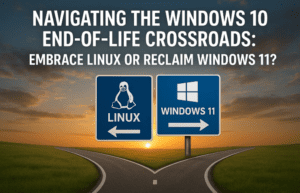
With Windows 10’s end of support looming in October 2025, users are left wondering what to do next. Should you pay Microsoft’s new annual “Extended Security Updates” fee to stay on Windows 10? Should you upgrade to Windows 11 with its heavy TPM and AI integrations? Or is there a middle ground — something faster, lighter, and more private?
That’s where Windows 10 LTSC 2021 comes in. It’s a streamlined, long-term version of Windows designed for stability and speed — without Microsoft’s extra bloat or forced updates. In this in-depth article, we’ll explore exactly what LTSC is, what you lose (and gain) by switching, how it performs compared to standard Windows 10/11, and whether it’s worth using in 2025 and beyond.
🧩 1. Understanding Windows 10 LTSC
LTSC stands for Long-Term Servicing Channel — a special branch of Windows designed for medical systems, industrial PCs, kiosks, and businesses that need rock-solid stability instead of constant new features.
Unlike Windows 10 Pro or Home, LTSC does not receive major feature updates. It only gets:
- Monthly security patches
- Occasional bug fixes
- No UI or feature changes
Essentially, LTSC freezes Windows in time — the way it was released in 2021 — and only keeps it secure.
🏢 2. Why LTSC Exists and Who It’s For
Microsoft designed LTSC for environments where updates can’t break things — think hospitals, factories, labs, and ATMs. But many power users have adopted it because of its benefits:
- No Microsoft Store or bloatware
- No Cortana, AI assistants, or telemetry-heavy apps
- No forced feature updates
- Lower system requirements (no TPM needed)
- Better performance on older or mid-range hardware
In short, it’s perfect for users who want a classic Windows experience — simple, fast, and distraction-free.
🚫 3. What You Lose When You Switch to LTSC
Of course, the trade-off is that LTSC comes without many of the built-in conveniences (and annoyances) of newer Windows versions.
Here’s a detailed breakdown of what’s missing:
🏪 Microsoft Store
There’s no Microsoft Store in LTSC. You can’t download apps like Spotify, Netflix, or Edge extensions from the Store. However, you can manually install traditional .exe or .msi programs — and even sideload Store apps via PowerShell if needed.
🧮 Modern Apps
LTSC reverts to the classic versions of several built-in apps:


- Old Calculator instead of the modern one
- Paint as the default image viewer
- No Photos app or Sticky Notes
- No Mail or Calendar app
☁️ Cloud & Timeline
- Cloud Clipboard and Timeline features are gone.
- If you rely on cross-device copy/paste, you’ll need third-party tools.
- Cortana and the new Windows Recall AI tools are completely absent.
🗞️ Widgets and News Feed
The “News and Interests” widget and weather panel from Windows 10 are also missing — leaving your taskbar clean and distraction-free.
⚙️ 4. What Still Works — and What’s Even Better
Now, just because LTSC removes features doesn’t mean it’s crippled. Many essential tools work perfectly — and often run faster.
✅ OneDrive still installs and works (though you can easily remove it).
✅ Windows Defender and security updates are supported.
✅ Windows Update works for monthly patches.
✅ Classic Control Panel, File Explorer, and Task Manager are unchanged.
✅ All standard drivers (NVIDIA, AMD, Intel, Realtek) install normally.
✅ Bluetooth, Wi-Fi, and Ethernet behave just like regular Windows 10.
For users who prefer old-school simplicity, LTSC feels like Windows used to be — fast, focused, and uncluttered.
🤖 5. AI, Cloud, and Privacy: What You’re Not Getting (and Why That’s Good)
If you’ve been wary of Microsoft’s increasing focus on AI, LTSC is a breath of fresh air.
- No Copilot integration
- No data-hungry Recall or timeline tracking
- No telemetry-based recommendations
That means less background processing, less data collection, and fewer pop-ups asking you to “sign in with your Microsoft account.”
Many privacy-focused users actually consider LTSC the last real version of Windows before the company’s shift toward AI and cloud dependency.
🎮 6. Gaming on LTSC: What Works and What Doesn’t
Let’s talk about something crucial — gaming.
You might assume LTSC is not gamer-friendly, but that’s not true. Here’s what you can expect:
- Game Mode: Fully available and works the same as Windows 10 Pro.
- Hardware-Accelerated GPU Scheduling: Supported (just enable it in Settings → Graphics).
- FreeSync, G-Sync, and V-Sync: Work perfectly.
- DirectX 12: Fully supported (including Vulkan).
However, there are a few limitations:
❌ No Auto HDR: A Windows 11-only feature.
❌ No Dynamic Refresh Rate (DRR): You’ll need to manually set refresh rates.
❌ No DirectStorage: The new game-loading optimization is exclusive to Windows 11.
That said, these differences only impact a small set of modern games. For 95% of titles, you won’t notice any performance difference between LTSC and Windows 11.
⚡ 7. DirectStorage, HDR, and Performance Explained
Microsoft’s DirectStorage and Auto HDR have been heavily marketed, but they’re not game-changers — at least not yet.
DirectStorage improves how games handle lots of tiny texture files by optimizing I/O calls, but it still involves the CPU. Only a few games (like Forspoken or Ratchet & Clank) support it today.
For most users, the difference in load times between Windows 10 LTSC and Windows 11 is minimal — often less than 2–3 seconds.
As for HDR, you can manually enable it in your display settings if your monitor supports it:
Settings → System → Display → Use HDR → On
Dynamic refresh rates are absent, but you can still use your GPU driver panel (NVIDIA/AMD) to manage adaptive sync or frame caps.
💻 8. App Installation and Microsoft Store Alternatives
LTSC doesn’t include the Microsoft Store — but that doesn’t mean you’re stuck.
Here are the main ways to install apps:
- Use .EXE or .MSI installers directly from the publisher.
- Use PowerShell commands to sideload modern app packages (
.appxor.msix). - Use winget, Microsoft’s command-line package manager, to install apps like VLC, 7-Zip, or Steam:
winget install vlc winget install steam - Use third-party stores like Chocolatey or Ninite for bulk installs.
If you absolutely need the Microsoft Store, you can install it manually via PowerShell scripts — though most LTSC users prefer not to.
🧠 9. Driver and Hardware Compatibility Tips
Driver installation works much like standard Windows 10, but it’s wise to prepare in advance.
Before installing LTSC:
- Download your motherboard, GPU, and network drivers from the manufacturer’s website.
- Save them on a USB stick.
- Install Windows 10 LTSC, then run your driver setup files manually.
💡 Tip: Some older systems might not automatically detect Ethernet adapters, so having network drivers ready avoids the dreaded “no internet” issue.
Once installed, LTSC handles Windows Update–delivered drivers the same as any other edition.
🧭 10. Should You Switch to LTSC?
Here’s the bottom line:
| Use Case | LTSC Recommended? | Why |
|---|---|---|
| Everyday personal use | ✅ Yes | Lightweight, stable, no bloat |
| Older PCs or laptops | ✅ Yes | Lower system requirements |
| Gamers | ⚠️ Mixed | Works fine but lacks DirectStorage |
| AI or Copilot users | ❌ No | AI integrations unavailable |
| Enterprise or kiosk setups | ✅ Yes | Long-term stability |
| Creative professionals | ✅ Yes | Fewer interruptions, reliable environment |
If you want speed, control, and privacy, LTSC is a smart choice.
If you rely on the Microsoft ecosystem (Teams, Store, Copilot), it’s better to stay with Windows 11.
❓ 11. Frequently Asked Questions
Q1. Is Windows 10 LTSC free?
No. It requires a valid license, usually sold to enterprises. However, it can be purchased through authorized resellers.
Q2. Does LTSC require TPM?
No. LTSC runs perfectly on older PCs that don’t meet Windows 11’s hardware requirements.
Q3. Will LTSC receive updates after 2025?
Yes — LTSC 2021 is supported until January 2032 with security patches.
Q4. Can I install Microsoft Teams or Office?
Yes. You can download the standalone installers for Office 2019/2021 and Teams (classic) without the Microsoft Store.
Q5. Can I upgrade from LTSC to Windows 11 later?
Not directly. You’ll need to perform a clean installation of Windows 11.
⚠️ 12. Disclaimer
Windows 10 LTSC is officially licensed for enterprise use under Microsoft’s terms. While it can be installed on personal PCs, always ensure you’re using a legitimate license key and comply with local software laws. This guide is for educational purposes only.
#Windows10 #LTSC #Microsoft #OperatingSystem #TechGuide #WindowsTips #Windows11 #Performance #Privacy #PCOptimization