When was the last time you turned off your smartphone? For most of us, the honest answer is “almost never.” Modern phones are designed to stay on for days, weeks, or even months without interruption. But while that may seem convenient, never rebooting your device could actually be harming its performance and security.
Rebooting — or simply turning your phone off and back on again — is one of the simplest yet most effective habits you can adopt. It can make your device safer, faster, and more reliable. In this article, we’ll explore why restarting is essential, how it benefits your phone, and how you can even schedule automatic reboots so you don’t have to remember.
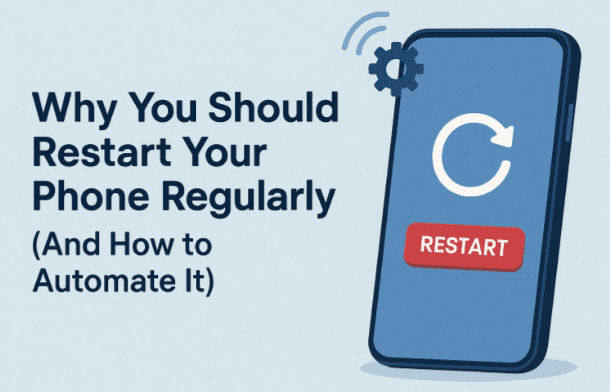
1. Why Restarting Your Phone Matters
Smartphones today are powerful mini-computers, constantly running dozens of background processes. From social media notifications to location tracking and messaging apps, your phone rarely gets a break.
But over time, these processes create temporary files and consume system resources. Just like a computer, your phone can become sluggish, overheat, or even crash. Restarting gives your device a clean slate.
Think of it like cleaning your desk. If you never clear away papers, coffee cups, and old notes, eventually there’s no room left to work efficiently. Restarting your phone is the digital equivalent of tidying up.
2. Rebooting for Better Security
One of the most overlooked benefits of restarting your phone is malware protection.
- Many malicious programs rely on temporary processes or cached files.
- When you reboot, all running apps and background processes are forced to close.
- Temporary files — including malicious ones — are wiped from memory.
Most smartphone malware doesn’t have a strong auto-run mechanism. That means if your phone was infected, a simple reboot can stop the malware from relaunching.
Of course, this doesn’t replace having good antivirus software or safe browsing habits, but it’s an easy first step in protecting yourself.
3. How Restarting Improves Performance
Now let’s talk about everyday usability. Have you ever noticed your phone:
- Getting unusually hot?
- Freezing or lagging when opening apps?
- Showing glitches, like apps not responding or functions failing to load?
These issues often come from resource buildup. Over time, background apps consume memory and processing power. Restarting clears all of this, giving your phone a “fresh start.”
That’s why many technical support agents recommend restarting your phone as the first troubleshooting step. In fact, in about 95% of cases, rebooting fixes minor glitches instantly.











4. How Often Should You Reboot Your Phone?
So, how frequently should you restart your device?
- Recommended: Once a week.
- At minimum: Once every two weeks.
- If you notice problems: Immediately (lag, overheating, crashes).
Restarting too often isn’t necessary, but neglecting it for months can lead to accumulated problems. A weekly reboot strikes the right balance between convenience and performance.
5. How to Check for Malware on Android and iPhone
While restarting helps, you should also regularly check your phone for malware. Here’s how:
On Android
- Open the Google Play Store.
- Tap your profile picture in the top-right corner.
- Select Play Protect.
- Tap Scan.
If malware is detected, you’ll receive a prompt asking whether you want to remove it.
On iPhone
- Open Settings.
- Use the Search bar at the top and type “VPN.”
- Tap VPN & Device Management.
- Look for any unknown profiles and delete them.
Unlike Android, iOS doesn’t allow direct malware scans, but shady configuration profiles can act as a security risk. Removing them is essential.
6. Why Regular Security Updates Are Equally Important
Even the best rebooting habit won’t help if your phone is running outdated software. Hackers constantly discover new vulnerabilities, and manufacturers release security patches to fix them.
- On Android:
- Open Settings.
- Use the search bar and type Update.
- Select System update or Security update.
- Apply any pending updates.
- On iPhone:
- Open Settings.
- Tap General.
- Select Software Update.
- Install any available updates.
Combining regular reboots with up-to-date security patches makes your device much harder to exploit.
7. How to Schedule Automatic Reboots on Android
Restarting weekly is easy to forget. Luckily, many Android devices include scheduled reboot features.
Here are two examples:
Method 1: Restart on Schedule (Samsung and similar)
- Open Settings.
- Use the Search bar and type “Restart.”
- Select Auto Restart or Restart on Schedule.
- Turn the feature on.
- Choose a day and time (e.g., 3 a.m. on Sundays when you’re asleep).
Your phone will quietly reboot once a week, and you’ll barely notice.
Method 2: Schedule Power On/Off (some other Android models)
- Open Settings.
- Use the Search bar and type “Power.”
- Select Scheduled Power On/Off.
- Enable both Power Off and Power On.
- Choose a day and time (e.g., Power Off at 3:00 a.m., Power On at 3:02 a.m.).
This achieves the same effect: a fresh reboot once a week.
8. What iPhone Users Can Do Instead
Unfortunately, Apple doesn’t currently offer a built-in scheduled reboot feature. That means iPhone owners need to restart manually.
Here’s what you can do:
- Pick a day of the week (e.g., Sunday night) and make it a routine.
- Set a calendar reminder or alarm to restart your phone before bed.
While it takes a little discipline, the benefits are just as important for iPhone users as for Android owners.
9. Frequently Asked Questions
Q1. Does restarting delete my photos or apps?
No. Restarting only clears temporary files and processes. Your data and apps remain untouched.
Q2. Can malware survive a reboot?
Most simple malware cannot. However, advanced malware with root access can. In such cases, a factory reset or professional help may be required.
Q3. Does iPhone really need restarting?
Yes. While iOS is optimized for efficiency, restarting still helps clear memory leaks and temporary processes.
Q4. Will scheduled reboots interrupt alarms?
If the reboot happens while an alarm is set, the phone may not ring. That’s why it’s best to schedule reboots at times when no alarms are active, such as 3 a.m.
Q5. Does restarting save battery life?
Indirectly, yes. By closing resource-hogging background apps, your phone may run cooler and consume less battery.
10. Conclusion
Restarting your phone might sound old-fashioned, but it’s a simple trick that delivers big benefits:
- It enhances security by killing malicious processes.
- It improves performance by freeing system resources.
- It prevents overheating and lag by clearing background buildup.
For Android users, the automatic reboot feature is a game-changer, ensuring your phone stays fresh without effort. For iPhone users, a quick manual restart once a week is all it takes.
In a world where we rely on our smartphones for everything, taking just a minute to reboot is one of the smartest digital hygiene habits you can adopt.
Disclaimer
Restarting improves security and performance in most cases, but it does not replace proper antivirus protection, software updates, or safe browsing practices. Always keep your device updated and avoid downloading apps from untrusted sources.
Tags: smartphone reboot, phone restart benefits, Android scheduled reboot, iPhone restart, smartphone malware protection, phone troubleshooting
Hashtags: #SmartphoneTips #Android #iPhone #MobileSecurity #PhoneHacks #TechGuide