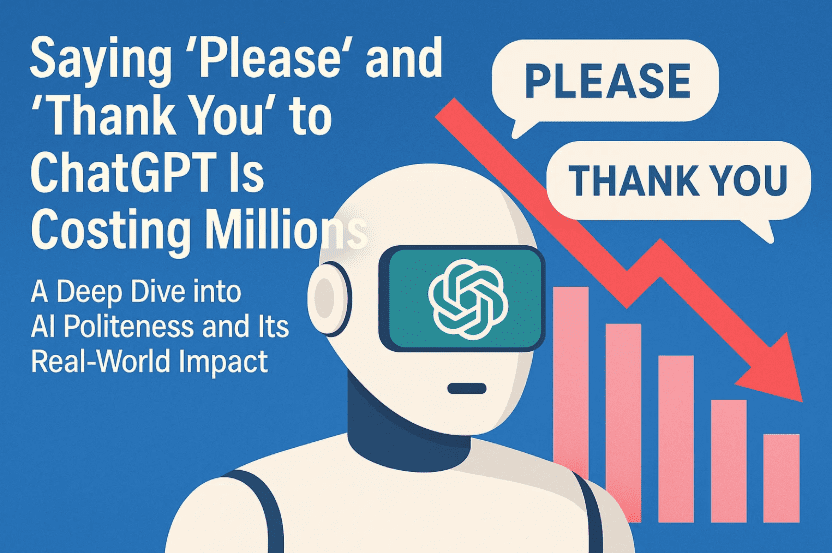
In the world of artificial intelligence, where logic reigns supreme, there’s something unexpectedly human happening—users are being polite to their chatbots. You read that right. People across the globe are saying “please” and “thank you” to ChatGPT and similar AI tools. While this might seem like a harmless show of good manners, it turns out that these small gestures of politeness are costing OpenAI millions of dollars every year.
Yes, the cost of being nice is real. And it’s far more fascinating than you might think.
Let’s explore the full story behind how polite words trigger massive computation, why OpenAI CEO Sam Altman considers it a “good expense,” and what this tells us about the evolving relationship between humans and AI. This isn’t just a quirky tech anecdote—it’s a reflection of how deeply AI has embedded itself into our daily behavior.
Human Politeness in a Machine World: The Surprising Revelation
Let’s begin with the heart of the story.
Recently, OpenAI CEO Sam Altman responded to a post on social media platform X (formerly Twitter), where a user jokingly asked:
“Does saying ‘please’ to ChatGPT cost the company extra?”
Altman’s answer?
“Dozens of millions of dollars.”
And no, he wasn’t kidding.
He went on to clarify that while it’s an expensive habit, it’s also a good expense. This short yet powerful response sparked a flood of discussions online. Why does saying “please” or “thank you” cause such an enormous financial load? Let’s break it down.
So, Why Does Politeness Cost So Much?
At first glance, adding an extra word like “please” to your ChatGPT prompt doesn’t seem like a big deal. But the cost isn’t in the word itself—it’s in the computational load that every single word triggers behind the scenes.












Before we get into the technical details, let’s talk about how ChatGPT processes your inputs.
What Happens When You Type a Message into ChatGPT?
Every time you enter a message—no matter how short or polite—here’s what happens:
- Tokenization: Your input is broken down into tokens. One token is roughly equivalent to 0.75 words. So a sentence like “Thank you so much for your help” might become 6–8 tokens.
- Model Processing: These tokens are then passed to a massive transformer-based model (like GPT-4 or GPT-4o), which uses billions of parameters to understand the context and generate a coherent reply.
- Computation Load: The longer your prompt, the more tokens, the more compute cycles required. These computations happen in large-scale data centers with thousands of high-end GPUs.
- Energy and Cooling: These GPUs consume vast amounts of power and generate significant heat. Cooling systems—sometimes even liquid cooling or AI-optimized HVAC systems—are needed to keep operations stable.
❄️ So yes, your small “thank you” is triggering entire cooling systems and GPUs to stay online just a little bit longer.
Why Sam Altman Called It a “Good Expense”
When Altman said it’s a “good expense,” he wasn’t just trying to be polite himself. There’s a deeper meaning behind this.
Let’s unpack what this reveals:
- Human-AI Relationship: People are increasingly treating AI not like a tool but like a conversational partner. Saying “please” and “thank you” is a reflection of social norms and empathy—even when there’s no human on the other end.
- Behavioral Shift: The fact that users are instinctively being polite to a machine shows how integrated AI has become in our everyday lives.
- Positive Culture Signal: Politeness, even when directed at an AI, reflects respect and humility—qualities that are essential in human society. Altman recognizes this as something worth supporting, even if it’s expensive.
Behind the Scenes: The Real Cost of a Simple Chat
Let’s take a moment to understand the infrastructure that makes AI conversations possible and why it’s so costly.
1. High-Performance GPUs
ChatGPT relies on NVIDIA A100 or H100 GPUs, which are incredibly powerful and equally power-hungry. These GPUs are stacked in clusters to run inference tasks at scale.
- Each GPU consumes up to 700 watts under full load.
- A data center might have tens of thousands of such units.
2. Cooling Infrastructure
The heat produced by so many GPUs requires industrial-grade cooling systems. These include:
- Liquid cooling loops
- Precision air conditioning
- Thermal management sensors
- Backup generators to keep things going 24/7
3. Electricity Bills
Running a single large language model instance at scale could result in millions of dollars in power bills annually. The cost increases linearly with more users, more prompts, and—yes—more tokens.
So, a global user base typing extra words like “thank you very much, ChatGPT” adds up significantly over time.
The Token Economy: How Every Word Matters
Let’s discuss the role of tokens a bit more clearly.
If you’re using ChatGPT’s free version, you may not be fully aware of the concept of tokens. But for premium users (like those on GPT-4), every word is part of a metered token limit.
Example:
- Saying “OK” = 1 token
- Saying “Thank you so much, I appreciate your kind help” = 10–12 tokens
Now imagine:
- 10 million users per day
- Average 5 extra tokens of politeness
- Total = 50 million tokens/day of just pleasantries
At scale, this becomes a real financial and computing burden.
User Reactions: From Memes to Philosophical Takes
Altman’s post caused a storm of reactions across X and Reddit. Some were hilarious. Others were thought-provoking.
Here are some popular ones:
- “Skynet will remember that we said please.”
- “If AI takes over the world, only the polite ones will survive.”
- “Future AI court: Your Honor, this user always said ‘thanks’ after asking for help.”
Humor aside, these reactions point to a very real shift: AI is not just a tool anymore. It’s part of our social and moral imagination.
FAQs: Everything You Need to Know About This Politeness Cost
Q1. Does being polite to AI really increase electricity usage?
Yes. Every additional word increases the number of tokens processed, which directly increases compute cycles, energy consumption, and cooling needs.
Q2. Is it wrong to be polite to AI?
Not at all. In fact, it reflects the evolving human tendency to apply social behavior to machines. It’s not harmful from a societal standpoint, but it does have resource implications.
Q3. Should I stop saying “please” or “thank you” to ChatGPT?
That’s your choice. It depends on whether you value efficiency or courtesy. If you’re using a paid tier, keep in mind you’re being charged for every token. But if you believe politeness should never be sacrificed—even to machines—go ahead.
Q4. Will this affect my usage limit on GPT-4 or GPT-4o?
Yes. Every token is counted. So longer polite phrasing may consume your quota slightly faster.
A Final Thought: The Human Cost of Humane AI
So far, we’ve taken a detailed journey into how a simple act of politeness has real-world consequences in the AI world. From massive electricity bills to philosophical memes, it’s fascinating to see how humanity seeps into technology.
What makes this story special isn’t just the cost—it’s the meaning behind it. In a world where AI often feels cold and mechanical, the fact that we still say “thank you” shows we haven’t lost our human touch.
And maybe, just maybe, that’s worth paying for.
Tags: AI cost, ChatGPT electricity usage, OpenAI CEO, token billing, ChatGPT behavior, AI data centers, GPU power, ChatGPT politeness, token economy, social AI interaction
Hashtags: #ChatGPT #OpenAI #AIPowerConsumption #GPT4 #TokenEconomy #PoliteAI #SamAltman #AITechnology #ChatbotBehavior #EnergyCostAI