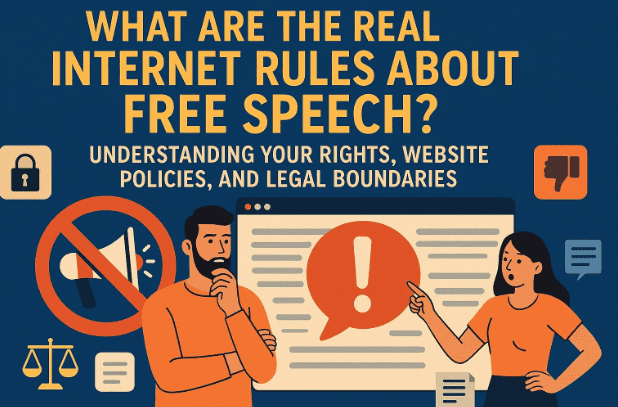
Free speech — it’s one of the most debated, misunderstood, and emotionally charged topics in the digital age. With billions of people expressing opinions daily across social media, forums, and websites, it’s no surprise that conflicts arise when a comment is deleted or a user gets banned.
A question many users ask is:
“If my comment gets deleted by a website owner, isn’t that a violation of my free speech?”
The short answer: no, it’s not.
Let’s explore this issue deeply — what free speech really means on the internet, why private platforms can moderate or delete content, how laws differ across countries, and where your actual rights begin and end.
First, a Disclaimer
Before diving in, it’s important to clarify that this article is not legal advice. I am not a lawyer, and laws about speech, expression, and the internet vary drastically from one country to another.
If you’re facing a real legal issue — such as being accused of libel, defamation, or being censored by a government — you should always seek professional legal counsel.
This article reflects a well-informed understanding of the general principles surrounding free speech online and aims to clarify some common misconceptions.
What Exactly Is the Internet?
Let’s start with the basics — something most people overlook when debating “internet rights.”
The internet is not a single entity. It’s not owned or governed by one body. It’s a massive global network of interconnected computers and servers that communicate through shared standards and protocols.
That means there’s no single universal rulebook for how speech works online. There’s no global constitution of the internet.




Each website, country, and service provider has its own rules, terms of service, and local laws that determine what can or cannot be said.
Even the very communication standards that let websites function — like HTTP, HTML, or DNS — aren’t technically “laws.” They’re conventions agreed upon by developers and companies for interoperability.
So when we talk about “internet rules,” we’re really talking about a complex mix of national laws, platform policies, and private decisions that vary depending on where you live and where the website is hosted.
There’s No Global “Free Speech Law”
This is where things get tricky.
Different countries have different legal limits on speech. For example:
- In the United States, citizens are broadly protected under the First Amendment, which limits the government’s ability to restrict expression.
- In the United Kingdom, laws exist to curb hate speech, defamation, and “incitement to violence.”
- In Germany, Holocaust denial and Nazi symbolism are illegal.
- In Saudi Arabia or China, speech against the monarchy or government can lead to imprisonment.
This means what’s “free” in one country could be criminal in another.
If your favorite social media company is based in a country with specific speech laws, those laws affect what the company allows globally — even if you personally live elsewhere.
In other words, there’s no single global rule that defines free speech on the internet.
The Internet’s Legal Reality: Layers of Control
Think of the internet as layers:
- Governments — set national laws and can order takedowns, surveillance, or censorship.
- Hosting Providers — own the servers and networks that store websites; they often enforce acceptable use policies (AUPs).
- Website Owners — control what’s allowed on their specific sites through moderation and community guidelines.
- Users — post and interact under those rules.
So, if your comment disappears or your account is banned, it’s not a constitutional issue — it’s usually a platform policy decision.
What Free Speech Actually Means
Now, let’s get to the heart of the confusion.
When people talk about “free speech,” they often imagine it means “I can say whatever I want, wherever I want, and nobody can stop me.”
But that’s not how it works.
Free speech — in a constitutional sense — only applies to government restrictions.
For example, in the U.S., the First Amendment begins with:
“Congress shall make no law … abridging the freedom of speech.”
That means:
- The government can’t silence you for expressing an opinion (within legal limits).
- But private individuals and companies can choose not to host or publish your words.
If you post a comment on someone’s blog or social media post, and the owner deletes it, that’s not censorship in the legal sense — it’s moderation.
They’re managing their own platform. You still have the right to say whatever you want, but you need your own space to say it.
A Practical Example
Imagine you visit someone’s personal blog — say, a technology site that allows public comments.
You write a response criticizing the author’s point of view. The author deletes your comment.
You might feel angry, maybe even censored. But legally speaking:
- The author owns the website.
- The hosting account is in their name.
- They decide what content stays or goes.
They are not obligated to publish your comment or give you a platform for your views.
That’s not a violation of free speech — it’s their right of control over their own property.
If you still want to share your opinion, you’re absolutely free to:
- Start your own website or blog.
- Post your critique on social media.
- Write a response elsewhere online.
That’s where your freedom of speech truly exists — in your ability to create your own venue, not in the right to use someone else’s.
Free Speech Does Not Guarantee an Audience
Another crucial point: you have the right to speak — not the right to be heard.
The internet is crowded. Billions of voices compete for attention daily.
Just because a platform removes your post or nobody reads it doesn’t mean your free speech rights are violated. It just means others aren’t obligated to listen.
Freedom of speech is the freedom to express yourself, not the freedom to force others to host or amplify your message.
The Role of Terms of Service and Moderation
Let’s move to something most users skip — the Terms of Service (ToS).
Every website, from Facebook to Reddit to your local community forum, has a ToS or community guidelines.
When you post on that platform, you implicitly agree to follow those rules.
That means:
- If a comment violates the ToS — for example, using hate speech, harassment, spam, or off-topic content — moderators can remove it.
- If you break multiple rules, they can suspend or ban your account.
And they’re legally within their rights to do so.
If you don’t like those terms, you can always choose another platform. That’s the internet’s built-in freedom of choice — you control where you speak, but not how someone else runs their space.
Acceptable Use Policies (AUPs): The Hidden Layer
If you decide to start your own blog or website, you’ll likely host it through a provider like Bluehost, Hetzner, or Hostinger.
Even then, you’re still bound by their Acceptable Use Policy (AUP).
These policies define what content is allowed on their servers — and yes, they can suspend or remove your site if you violate them.
For example, hosting malware, pirated content, or explicit hate material usually violates the AUP, even if you own the domain.
So even “owning your website” doesn’t make you immune from all restrictions. You’re still part of a broader system governed by overlapping rules.
Free Speech Isn’t Absolute — Legally or Morally
Even in countries that protect free speech, there are limits.
Classic examples include:
- Inciting violence or panic, such as yelling “Fire!” in a crowded theater.
- Defamation or libel, where you knowingly publish false information that harms someone’s reputation.
- Threats, harassment, or hate speech, depending on local laws.
Freedom of speech doesn’t protect language that causes harm or danger to others.
And even beyond legality, there’s an ethical dimension. The right to speak freely doesn’t erase the responsibility to speak truthfully or respectfully.
But What If I’m Being Targeted Unfairly?
It happens. Many people are banned or censored by overzealous moderators, algorithms, or biased platforms.
So what can you do?
- Read the platform’s terms carefully. Check if your post truly violated their rules.
- Appeal the decision. Many platforms provide a review process for mistaken bans.
- Move elsewhere. The internet is vast — if one platform doesn’t welcome your content, start your own site or join an alternative that aligns with your views.
- If defamatory content is posted about you, consult a lawyer. Slander and libel laws may apply, depending on jurisdiction.
Remember: not every removal is censorship — sometimes, it’s simply moderation.
Why Website Owners’ Rights Also Matter
Here’s a thought experiment: what if site owners were legally required to publish every comment, no matter how offensive or irrelevant?
That would lead to chaos. Hate speech, misinformation, and spam would flood every comment section.
In fact, most platforms would simply stop offering comment features altogether to avoid that liability.
That’s why the ability for site owners to delete or filter posts is actually a form of their own freedom of speech — the right to decide what content they associate with their platform.
As frustrating as it can feel, this balance is what keeps the internet functional.
Common Questions About Free Speech Online
Q1: Isn’t deleting my comment censorship?
Not legally. Censorship applies when a government restricts your speech, not when a private website moderates its own content.
Q2: Can I sue a website for removing my post?
Usually no. When you use their service, you agree to their terms, including their right to moderate or remove posts.
Q3: What if a platform claims to support “free speech” but still bans users?
That’s hypocrisy, not illegality. They may promise openness but still have boundaries. It’s poor ethics, not a legal violation.
Q4: Are there exceptions where deletion violates the law?
Only if it involves government interference, defamation, or breach of contract. For most websites, moderation is fully allowed.
The Bottom Line
Free speech online is not as absolute or simple as many think.
The internet is not one unified public space — it’s a vast collection of privately owned platforms, each with its own rules, moderators, and responsibilities.
Your right to free speech gives you the freedom to express your ideas, but it doesn’t guarantee:
- A platform to say them, or
- An audience to listen.
And that’s okay. It’s what allows both individuals and communities to create safe, structured spaces for discussion without chaos.
The true essence of free speech on the internet isn’t forcing others to host your words — it’s the freedom to build your own platform and say what you believe, responsibly.
Disclaimer:
This article is for educational purposes only and does not constitute legal advice. Laws regarding speech, expression, and online conduct vary by country. Consult a qualified attorney for legal concerns about censorship, defamation, or online moderation.
#FreeSpeech #InternetLaw #OnlineCensorship #DigitalRights #CommentModeration #WebsiteRules #AskLeo #FreedomOfExpression