Education is evolving rapidly, and artificial intelligence is at the forefront of that transformation. But AI isn’t just about quick answers anymore—it’s about helping learners truly understand complex ideas through interaction, curiosity, and personalized explanations. Google’s Guided Learning feature in Gemini is a bold step in that direction, offering something far more valuable than simple search results: the ability to learn with AI, not just from it.
In this article, we’ll take a detailed look at how Guided Learning inside Google Gemini works, how it enhances comprehension across different subjects, and why it’s one of the most promising tools for students, teachers, and lifelong learners alike.
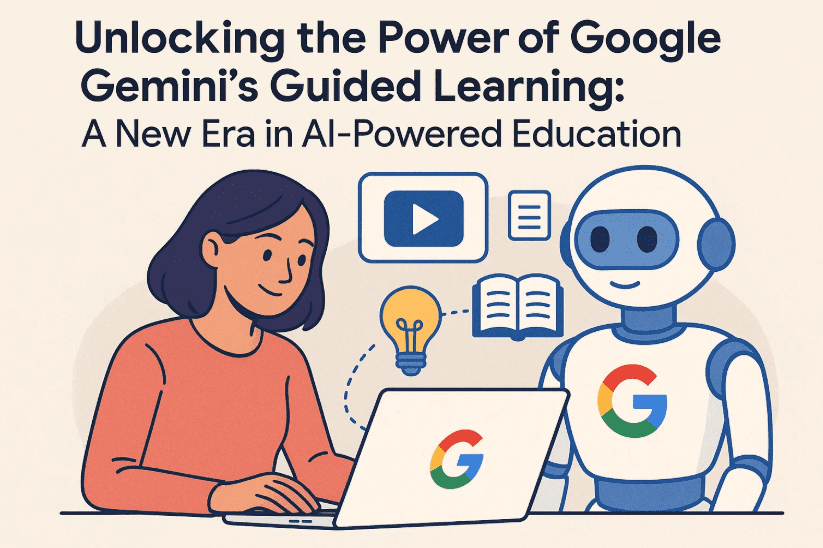
What Is Guided Learning in Google Gemini?
Before diving into examples, let’s first understand what Guided Learning actually is.
Unlike traditional chatbots or AI models that simply provide answers, Guided Learning in Google Gemini functions like a personal tutor. It doesn’t just dump information on you—it walks you through the topic, checks your understanding, uses analogies and visuals, and even adapts based on how much you already know. In short, it teaches you step-by-step.
According to Google’s official blog, Guided Learning is designed to:
- Help you understand concepts deeply, not just memorize facts.
- Engage your critical thinking by asking follow-up questions.
- Offer step-by-step breakdowns that build your knowledge gradually.
- Provide visual aids and analogies to support understanding.
You can access this feature through the Gemini web app, either in the Flashcards section or under the Gemini Advanced (Pro) plan. For the best experience, it is recommended to use the Pro version.
Why This Is a Game-Changer for Learning
Let’s face it—AI giving you an instant answer is helpful, but real learning is more than that. True education involves grappling with difficult ideas, making connections, asking “why?”, and sometimes getting things wrong before finally getting them right.
Guided Learning embraces that philosophy. Think of it as an AI-powered Socratic method, where instead of simply teaching, the system asks you to think, nudging you in the right direction.
Real-World Examples: Guided Learning in Action
To truly appreciate Guided Learning, let’s walk through three subject-based use cases—science, writing, and photography—and see how this feature adapts in each scenario.
🧬 Example 1: Understanding Enzymes in Biology
Biology can be a tough subject, especially when abstract concepts like enzymes and molecular reactions are involved.
Let’s say you’re struggling to understand why the shape of an enzyme is important. Here’s how Gemini’s Guided Learning helps:








Step-by-step breakdown:
- It begins by affirming your basic understanding: enzymes are biological catalysts.
- Then it introduces the “lock and key” analogy—a well-known model to explain how enzymes work with substrates.
- Gemini provides diagrams and illustrations showing how the enzyme’s 3D shape forms a “pocket” where the substrate fits.
- It then asks you questions like:
“What happens if the substrate doesn’t fit the enzyme’s shape?”
Your answer is checked, and if it’s correct, it provides positive reinforcement. If not, Gemini explains it again in a different way—just like a patient tutor would.
Learning benefits:
- Immediate feedback reinforces comprehension.
- Visual explanations support abstract thinking.
- You can ask further questions at any point.
This is miles ahead of just Googling “how enzymes work” and reading a dry paragraph.
🧠 Example 2: Writing a Research Paper on Teen Mental Health & Exercise
Switching to a humanities context—let’s say you’re a high school student assigned to write a research paper on “the connection between physical activity and teen mental health.”
Instead of writing the paper for you (which would defeat the purpose), Guided Learning coaches you through the process.
Here’s what happens:
- Gemini first breaks down the topic into three possible angles:
- Scientific explanations
- Specific mental/physical benefits
- Real-world challenges and solutions
- You pick one—say, real-world challenges.
- It then helps you structure your outline:
“Do you want to start with the barriers or the solutions?” - Based on your choice, Gemini further breaks down the structure and helps you brainstorm examples—like access to sports facilities or social stigmas—and how schools or communities can address them.
Again, this interaction builds your thinking, instead of giving you a generic essay. It turns AI into a real-time research assistant and writing coach.
📸 Example 3: Mastering Photography Concepts — The Exposure Triangle
Let’s move into a more creative territory.
Suppose you’re an aspiring photographer and want to understand the exposure triangle—the core technical concept that controls how bright or dark a photo is. It involves three interrelated components: aperture, shutter speed, and ISO.
Here’s how Guided Learning helps:
- You ask: “I want to understand the exposure triangle in photography. Illustrations really help me learn.”
- Gemini delivers a clean diagram showing the triangle with labeled parts.
- It explains each component one by one:
- Aperture controls how much light enters the camera and affects depth of field.
- Shutter speed affects motion blur.
- ISO impacts image brightness and grain.
- It checks your understanding through questions like:
“What else does aperture affect besides light?” - You answer, and based on your response, it either reinforces or clarifies the concept.
This approach is far more engaging than reading a manual or watching a tutorial that may move too fast or too slow for your learning pace.
Comparing Regular Gemini vs. Guided Learning
What if you asked the same question—say, about enzymes—but without Guided Learning?
In that case, Gemini would just return a detailed answer in paragraph form. It might include:
- Diagrams or videos
- Scientific terminology
- Factual correctness
But the difference is: it won’t ask for your input. It won’t adjust its teaching style based on your level. You’ll get all the info at once, which can be overwhelming—especially if you’re a beginner.
With Guided Learning, it:
- Starts at your level.
- Checks your understanding.
- Encourages questions.
- Builds concepts gradually.
- Reinforces correct responses and explains incorrect ones.
Who Can Benefit from Guided Learning?
This isn’t just for students. Here’s who might find Guided Learning incredibly helpful:
- Middle school and high school students preparing for exams or writing papers.
- College students exploring difficult subjects like physics, chemistry, or history.
- Teachers who want to supplement their lessons with interactive AI explanations.
- Self-learners and hobbyists exploring topics like programming, art, music theory, or astronomy.
- ESL learners who need simplified explanations and visuals.
Frequently Asked Questions (FAQs)
Q1: Do I need a paid Gemini subscription to access Guided Learning?
A: The Guided Learning feature is available in the Pro version of Gemini (Gemini Advanced). While some elements may be available in the free tier, the best experience is unlocked through Pro.
Q2: Can Guided Learning write my homework or essays for me?
A: No, and that’s by design. Instead of doing the work for you, it coaches you to think critically, structure ideas, and build arguments. It’s a learning assistant, not a shortcut.
Q3: Is there support for visual learners?
A: Yes! Gemini often includes illustrations, diagrams, and analogies to help you understand visually complex concepts. If it doesn’t, you can request one mid-conversation.
Q4: Can teachers use it in classrooms?
A: Absolutely. It’s perfect for individualized learning, helping each student progress at their own pace. It encourages participation and understanding over rote memorization.
Q5: What happens if I give a wrong answer?
A: Guided Learning will break the concept down further and try a different way of explaining it—just like a patient teacher would.
Final Thoughts: AI That Teaches, Not Just Tells
So far, we’ve seen how Google Gemini’s Guided Learning can:
- Help you understand difficult science concepts with analogies and questions.
- Coach you through writing essays with clear structure and guidance.
- Assist in mastering creative skills like photography with diagrams and interactivity.
This is the future of AI in education—not just acting as a search engine or cheat sheet, but as a judgment-free, responsive tutor that meets you where you are and grows with you.
With thoughtful design and a clear focus on learning science, Guided Learning bridges the gap between knowing the answer and understanding the concept—and that’s what real education is all about.
Disclaimer:
This article is intended for educational purposes only. All examples, features, and descriptions are based on the current implementation of Google Gemini’s Guided Learning as of the time of writing. Features may evolve in future updates. Visit the official Google Gemini site for the most accurate and updated information.
Tags:
AI in education, guided learning, Google Gemini Pro, student tools, learning with AI, study assistant, interactive AI learning, exposure triangle photography, biology learning tools, writing assistant AI
Hashtags:
#GoogleGemini #GuidedLearning #AIinEducation #LearningWithAI #GeminiPro #StudyTools #PhotograpyTips #BiologyHelp #EssayWriting #EdTech #StudentSuccess #InteractiveLearning