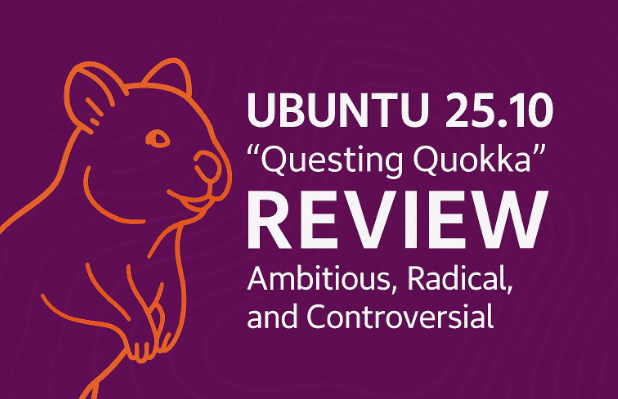
Ubuntu’s latest release — Ubuntu 25.10 “Questing Quokka”, launched on October 9, 2025 — is one of the boldest moves Canonical has made in recent years. Supported until July 2026, this version introduces sweeping technical shifts that signal both innovation and ideological departure from the traditional Linux spirit.
While many in the Linux community hold mixed feelings about Ubuntu’s direction, there’s no denying that this release marks a major milestone in system modernization. It pushes the boundaries of what a mainstream Linux distribution can become, while simultaneously igniting debate about how far one can go before leaving behind the open-source essence.
Let’s unpack what makes Ubuntu 25.10 both revolutionary and divisive — feature by feature, layer by layer.
1. A Quick Overview of Ubuntu 25.10
Ubuntu 25.10, codenamed “Questing Quokka,” represents the culmination of Canonical’s long-term vision to merge innovation, enterprise usability, and commercial polish into one coherent Linux experience.
From the moment you boot it up, you notice two things:
- It feels sleeker and more integrated than most community-driven distributions.
- It also feels different — almost corporate in its presentation and philosophy.
This release isn’t about incremental polish; it’s about redefining the base of Ubuntu itself. Canonical is rewriting critical Linux tools in Rust, enforcing Wayland-only support, and introducing TPM-backed encryption for improved enterprise security.
For long-time Linux users, this might seem extreme. But for newcomers — especially those transitioning from Windows — Ubuntu 25.10 might be the easiest on-ramp yet.
2. Major System Changes: The End of X11 and the Rise of Wayland
One of the biggest headlines of Ubuntu 25.10 is the complete removal of X11 sessions. Ubuntu now ships as Wayland-only for GNOME, following Fedora’s lead but with an even larger user base in tow.
That means:
- No more Xorg login option in the display manager.
- Legacy apps still function through XWayland, but pure X11 sessions are gone.
This move is bold and risky. Wayland promises smoother rendering, better security isolation, and reduced screen tearing. However, not all applications — especially remote desktop tools and certain older games — are fully compatible yet.
For Ubuntu, making this jump reflects a commitment to the future rather than backward compatibility. The message is clear: the Linux desktop must evolve, and Ubuntu wants to lead that charge.




3. The Rust Revolution: A New Foundation for System Utilities
The second headline change is even more controversial. Ubuntu 25.10 introduces a Rust-based rewrite of critical system components — marking a historic departure from decades of C-based Linux code.
Here’s what changed:
sudo(written in C for 30+ years) is now replaced bysudo-rs, a secure Rust reimplementation.- Core utilities like
ls,cp,mv, andcatnow come from the Rust-based uutils coreutils project instead of the GNU versions.
For context, these tools form the foundation of every Linux system. Rewriting them is no small feat — it’s a philosophical gamble that prioritizes memory safety and modernization over proven legacy stability.
While you can still revert to traditional GNU versions via the update-alternatives system, the default environment is fully Rust-powered.
Let’s pause to consider what this means.
Rust is indeed a safer and more modern programming language, designed to prevent memory leaks and buffer overflows. But as even GNU maintainers like Paul Brady argue, rewriting decades of stable, optimized code for theoretical safety gains may not always be practical.
At this point, Ubuntu is not just adopting Rust — it’s making a statement: the future of Linux tooling will be memory-safe, even if it takes time to reach perfect compatibility.
4. New Default Applications and Tools
Ubuntu 25.10 introduces several application-level replacements as part of its modernization effort:
- Pixus replaces GNOME Terminal as the default command-line interface.
- Pixus offers more configuration options, modern rendering, and smoother scaling on HiDPI displays.
- Loop replaces Eye of GNOME (Image Viewer) for viewing images.
- Loop is lightweight, fast, and integrates better with Wayland.
- Dracut replaces initramfs-tools for generating boot images on fresh installations.
Each of these swaps might sound minor, but collectively they transform how Ubuntu operates under the hood. For the first time, Canonical seems determined to shed legacy components entirely in favor of modern, modular ones.
5. Improved Package Management and Software Distribution
Ubuntu 25.10 still uses APT as its primary package manager, but the ecosystem around it has become far more flexible.
The Ubuntu Software Center now manages:
- APT packages
- Snaps (Canonical’s universal format)
- Flatpaks (for users who enable them manually)
This hybrid system ensures that users can choose how they want software delivered — though Canonical’s preference for Snap remains evident.
A noteworthy improvement is better support for third-party repositories with enhanced signature verification and smarter key management.
For developers, synchronization with Debian has improved dramatically, meaning packages reach Ubuntu faster than in previous cycles. Canonical also included:
- OpenJDK 25 LTS
- .NET 10 RC
- Zig 0.14.1 (preview)
- GCC 15 and LLVM Clang 21 (available, though not default)
In short, Ubuntu 25.10 is one of the most developer-friendly releases to date.
6. Kernel, Performance, and Hardware Support
Ubuntu 25.10 ships with the Linux 6.17 kernel, one of the newest and most forward-looking kernels available.
This kernel brings:
- Expanded hardware support for Intel and AMD GPUs.
- VRR (Variable Refresh Rate) support via Mutter for smoother gaming.
- Optimizations for newer processors and NVMe storage.
However, some critics argue that shipping such a recent kernel in a stable release is risky — as release candidates may still contain unresolved regressions.
Still, Ubuntu’s willingness to stay ahead of the curve reinforces its identity as the mainstream innovator among Linux distributions.
7. Installer Upgrades and Enterprise Features
Canonical’s Ubuntu Installer has been revamped with both security and enterprise in mind.
Key changes include:
- TPM-backed full-disk encryption (experimental)
- Easier recovery key management and PIN support
- Better integration with NVIDIA proprietary drivers
- Improved policy enforcement via Microsoft Entra ID
- Landscape integration for fleet management
For enterprises, these features make Ubuntu a serious competitor to Windows in managed environments.
And visually? The installer remains the most polished in the Linux world — professional, intuitive, and consistent with Canonical’s corporate ambitions.
8. User Experience, Design, and Onboarding
Once installed, Ubuntu 25.10 welcomes you with GNOME 49 on top of a sleek, orange-accented interface. The Wayland-native experience feels smooth, stable, and fluid.
The first-run setup assistant is also among the best across Linux distributions — complete with guided cloud setup, account sync, and helpful tutorials.
The desktop theme, icon set, and dock layout continue Canonical’s refined approach: familiar enough for existing users, friendly enough for newcomers.
Minor issues do exist — such as occasional Bluetooth bugs and a few AppArmor quirks — but overall, it’s a stable and visually cohesive system.
9. Gaming and NVIDIA Improvements
Gamers have reason to celebrate. Ubuntu 25.10 significantly improves NVIDIA driver support on Wayland, especially for the 550+ driver series.
Performance improvements include:
- Lower latency and stutter-free performance for Vulkan games.
- Full support for Variable Refresh Rate (VRR) monitors.
- Smooth compatibility with Steam, Proton, and Steam Deck environments.
While very old X11-dependent games may show minor issues, the majority now run flawlessly through XWayland translation.
For anyone gaming on Linux, Ubuntu remains a reliable out-of-the-box experience, though performance-tuning users might still prefer Fedora or Nobara.
10. Security Enhancements and Rust’s Role
From a security standpoint, Ubuntu 25.10 makes a theoretical leap forward.
The transition to Rust-based tools like sudo-rs and uutils-coreutils minimizes the risk of memory-related vulnerabilities — a common exploit target in older C programs.
The new installer’s TPM-backed encryption adds hardware-level security for sensitive data, and integration with Microsoft Entra ID introduces enterprise-grade access policies.
However, Ubuntu still lacks some proactive defaults:
- The firewall (ufw) is not enabled by default.
- AppArmor profiles exist but aren’t fully optimized.
This means users must still manually tighten defenses to achieve a hardened setup — an area where Fedora’s defaults remain stronger.
11. Enterprise Integration and RISC-V Future Readiness
Ubuntu 25.10 isn’t just about the desktop — it’s about preparing for the next decade of computing.
The release introduces experimental RISC-V desktop support (RVA23 baseline) — primarily through QEMU emulation for now.
Additionally:
- AB-boot layout for Raspberry Pi improves boot reliability.
- Landscape and Active Directory/Entra ID integration streamline enterprise fleet management.
Canonical clearly positions Ubuntu as the go-to Linux for corporate deployments, competing directly with Red Hat and SUSE.
12. Bugs, Limitations, and Known Issues
Despite the innovation, Ubuntu 25.10 isn’t perfect. Here are some pain points users might encounter:
- Certain remote desktop clients (like Remmina) still face Wayland compatibility issues.
- Snap apps start slower and consume more disk space than Flatpaks.
- A few legacy pseudo features (like
sudoeditor SELinux integration) are not yet available insudo-rs. - Occasional update freezes and resource spikes during package upgrades.
These are manageable issues, but they remind us that 25.10 is a transitional release — a testing ground for the next LTS (Long-Term Support) version.
13. Ubuntu 25.10 vs Fedora, Debian, and Others
Comparing Ubuntu 25.10 to its main competitors:
| Distribution | Focus | Strengths | Weaknesses |
|---|---|---|---|
| Ubuntu 25.10 | Corporate + Consumer | Polished UI, enterprise tools, Wayland-only modernization | Snap slowness, short support cycle |
| Fedora 41 | Cutting-edge | Faster updates, stronger defaults (SELinux, Firewall) | Slightly rougher UX for newcomers |
| Debian 13 | Stability | Rock-solid and predictable | Older packages |
| Linux Mint | User-friendliness | Beginner-oriented, traditional desktop | Slower updates |
| OpenSUSE Tumbleweed | Rolling release | Advanced tools (YaST, Btrfs) | Requires experienced users |
Ubuntu sits right in the middle — accessible, modern, and enterprise-ready — but sometimes too commercial for open-source purists.
14. Final Verdict: Who Should Use Ubuntu 25.10?
Ubuntu 25.10 is not a casual upgrade — it’s a statement. Canonical wants to reinvent Ubuntu as a secure, modern, enterprise-friendly Linux platform.
You should consider Ubuntu 25.10 if you:
- Want a modern, Wayland-ready desktop with strong hardware support.
- Need enterprise features like Entra ID or TPM encryption.
- Appreciate Canonical’s polish and attention to detail.
You might want to skip it if you:
- Prefer traditional open-source transparency and community-first development.
- Rely heavily on legacy or X11-only applications.
- Want long-term support (in that case, wait for Ubuntu 26.04 LTS).
Ultimately, Ubuntu 25.10 balances innovation with usability, but it also highlights Canonical’s gradual shift toward a closed, enterprise ecosystem.
It’s fast, modern, and works well — but it’s not quite the “Linux for everyone” that Ubuntu once claimed to be.
15. FAQs
Q1: What is the release cycle for Ubuntu 25.10?
Ubuntu 25.10 is a short-term release with 9 months of support, lasting until July 2026.
Q2: Can I revert to X11?
Not officially. Ubuntu 25.10 ships Wayland-only, though some community spins may reintroduce Xorg sessions.
Q3: Is the Rust transition stable?
Yes, for most users. However, system administrators may prefer to manually revert to GNU versions if compatibility issues arise.
Q4: Does Ubuntu 25.10 support gaming?
Yes. Steam, Proton, and NVIDIA drivers perform well under Wayland.
Q5: Should enterprises upgrade now?
For testing environments, yes. For production, wait until the next LTS unless you need the latest kernel or enterprise integrations.
Disclaimer
This article is for informational purposes only. Ubuntu and Canonical trademarks belong to their respective owners. Always back up your data before upgrading your operating system. Visit Ubuntu’s official website for the most accurate technical documentation and download links.
Tags
Ubuntu 25.10, Questing Quokka, Linux distributions, Rust in Linux, Wayland, Ubuntu review, Canonical, Linux kernel 6.17, Ubuntu features, enterprise Linux
Hashtags
#Ubuntu #Linux #QuestingQuokka #Rust #Wayland #Canonical #Ubuntu2510 #OpenSource