This week has been a whirlwind of innovation, competition, and disruption across the tech industry. From Microsoft’s new reinforcement learning framework to OpenAI’s safety-first openweight models, Telegram’s entry into decentralized AI, Adobe’s mind-bending creative tools, and Nvidia’s record-breaking valuation — the future of technology seems to be unfolding faster than ever before.
Let’s explore these major developments one by one and understand why they matter, how they work, and what they mean for the next phase of AI and computing.
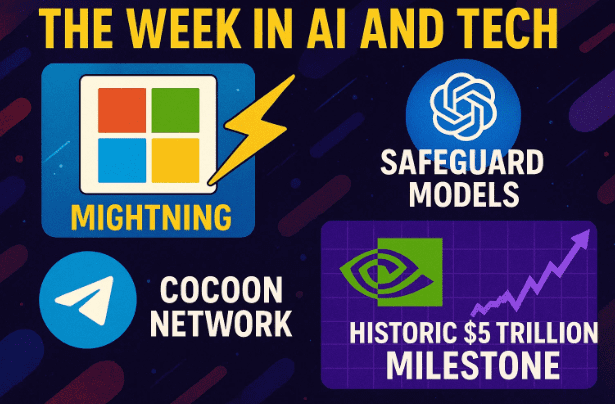
1. Microsoft Introduces Agent Lightning — AI That Learns From Its Own Mistakes
Microsoft’s newest framework, Agent Lightning, marks a major leap in reinforcement learning. Until now, making an AI agent “learn from experience” required rebuilding large parts of its system or retraining it with huge datasets. Agent Lightning changes that completely.
So far, so good — but what exactly does it do?
Agent Lightning gives AI agents the ability to observe their own actions and improve over time, much like humans do through trial and error. It works through two main components:
- Lightning Server – Handles training, reward processing, and experience management.
- Lightning Client – Stays close to your existing AI tools (chatbots, workflows, web agents), collecting real-world data on performance, success rates, and user feedback.
Every time the AI answers a query, fails, or succeeds, that information is quietly sent to the server, which retrains the model’s decision logic.
Microsoft Tested It in Three Key Domains:
Let’s move through each example to understand how powerful this could be.
- Natural Language to SQL Conversion:
Using the Spider dataset of over 10,000 questions, Microsoft trained an AI to convert text queries into database searches. The more it practiced, the fewer syntax and logic errors it made. - Retrieval-Augmented Generation (RAG):
In another experiment, Agent Lightning combed through 21 million Wikipedia-style documents to summarize answers accurately. The system improved its relevance and citation precision over time. - Mathematical Reasoning:
A final test involved connecting the model to a calculator. By breaking down multi-step problems and receiving immediate intermediate feedback, accuracy improved dramatically.
The secret sauce?
A technique called Automatic Intermediate Rewarding, which gives the AI smaller “rewards” during training instead of waiting until the final result. This speeds up learning and prevents the system from overfitting or getting “stuck.”
Agent Lightning is open-source, meaning developers can integrate it into their own apps, chatbots, or productivity tools. In simple terms, Microsoft just made it possible for any AI system to train itself continuously without manual retraining cycles.
2. OpenAI Launches Safeguard Models — AI That Watches Other AI
While Microsoft focused on self-learning, OpenAI turned its attention to safety and moderation. The company released two new “openweight” models — GPOS Safeguard 120B and GPOS Safeguard 20B — both designed to detect and explain harmful or fake online content.
Before we go deeper, it’s worth understanding what openweight means.





Unlike open-source models (where you can edit and redistribute everything), openweight models allow developers to inspect and analyze parameters but not modify the core code. This strikes a balance between transparency and security.
These models were built in partnership with the ROOST initiative (Robust Open Online Safety Tools) and tested by real-world platforms like Discord. They not only flag unsafe content but also explain why it was flagged, offering traceable reasoning — a feature many regulators have demanded.
Both models are freely available for research on Hugging Face, and OpenAI is inviting the broader AI safety community to “stress test” them for robustness.
In short, OpenAI is moving toward accountable AI, where systems don’t just act safely but also justify their decisions.
3. Telegram’s Founder Launches “Cocoon” — Decentralized AI on the TON Blockchain
While tech giants focus on centralization, Pavel Durov, the founder of Telegram, is going the opposite direction. His newly announced project, Cocoon (Confidential Compute Open Network), aims to build a decentralized AI infrastructure running entirely on the TON blockchain.
Let’s unpack what this means.
Cocoon connects two types of users:
- GPU Owners: People or companies with idle graphics cards can plug into the network to process AI tasks and get paid in Toncoin.
- Developers: Those needing computational power can rent it securely without relying on cloud providers like AWS or Azure.
The biggest innovation here is data privacy. Every AI task runs in encrypted form, meaning GPU providers can never see or access user data — even while processing it.
Telegram itself will be Cocoon’s first major customer, integrating it across its massive app ecosystem for tasks like message summarization and AI-assisted replies.
Applications for both developers and GPU providers are already open, with companies like Alphon Capital and Kazakhstan’s AI labs pledging infrastructure support.
Durov described Cocoon as a move to restore digital freedom, which he believes has been eroding under centralized AI monopolies. With over a billion Telegram users and strong crypto backing, Cocoon could become the first mainstream decentralized AI marketplace.
4. Elon Musk Unveils “Grokipedia” — An AI-Powered Encyclopedia
Elon Musk, never one to stay on the sidelines, announced Grokipedia, a new AI-driven encyclopedia powered by his xAI models.
The concept? Think of Wikipedia — but rewritten by AI. Instead of volunteer editors, Grokipedia uses autonomous AI systems to gather, verify, and update information continuously.
Musk’s vision is an “unbiased knowledge platform”, free from the political and social biases that critics have long accused Wikipedia of harboring.
Key Differences Between Grokipedia and Wikipedia:
- Wikipedia: Relies on human consensus and community moderation.
- Grokipedia: Relies on algorithmic objectivity and continuous machine verification.
Critics argue that AI lacks nuance and context awareness, while supporters believe AI-driven verification could drastically reduce misinformation. Either way, it represents a fascinating experiment in how AI could reshape public knowledge — just as search engines once did.
5. Adobe Wows Creators at MAX 2025 with Mind-Bending AI Tools
Adobe’s annual MAX 2025 event in Los Angeles showcased what might be the future of creative work. The company introduced a collection of experimental projects — each one blurring the line between imagination and automation.
Let’s highlight the most impressive ones.
- Project Motion Map: Turn any static Illustrator design into a full animation with simple text prompts. Example: a still burger illustration that automatically animates each layer — buns, lettuce, and cheese — independently.
- Project Clean Take: Edit audio directly from text transcripts. You can replace words, alter tones, or even regenerate background music — all without touching a waveform.
- Project Light Touch: Instantly relight any photo after it’s taken. Toggle virtual light sources, and shadows shift realistically in seconds.
- Project Frame Forward: Edit a single frame of a video, and Adobe’s AI applies those changes to every other frame automatically.
These experiments show how Adobe is blending generative AI with visual reasoning, making creativity feel conversational rather than technical.
6. YouTube Quietly Upgrades Everyone’s Videos with AI
While Adobe focused on creation, YouTube turned to enhancement. The platform has started AI upscaling low-resolution videos — automatically converting 480p and 720p uploads into 1080p or even 4K.
Currently, this feature is limited to smart TVs, with “Super Resolution” appearing in video settings when active.
Other upgrades include:
- Thumbnails up to 50MB (previously 2MB).
- Immersive TV previews for binge browsing.
- Contextual search that prioritizes videos from the channel you’re viewing.
- QR code integration linking directly to products mentioned in videos.
YouTube is positioning itself less as a video site and more as a smart streaming platform, adapting to how people actually consume content today.
7. IBM Shrinks AI Models to Fit in Your Pocket
IBM announced a new family of small yet powerful models — the Granite 4.0 Nano series. These are compact AI systems (ranging from 350 million to 1 billion parameters) designed to run directly on your device — laptops, phones, even browsers.
Why is that a big deal?
Because these models deliver enterprise-grade intelligence without the cloud — no latency, no subscription fees, and no risk of data leaks.
They’re trained on IBM’s 15-trillion-token dataset, the same one used for their large-scale models. The “hybrid” architecture combines transformer and lightweight recurrent designs to use less memory while retaining high reasoning accuracy.
Each model is open-source, ISO-certified, and cryptographically signed, ensuring authenticity and transparency.
In benchmarks, Granite Nano models outperformed competitors like Gemma and Liquid AI on coding, math, and reasoning tasks — proving that small doesn’t mean weak.
8. Nvidia Becomes the First Company to Hit a $5 Trillion Market Cap
Finally, let’s talk about the tech story of the year — Nvidia crossing the $5 trillion mark in market capitalization.
The stock closed at $274, up 3%, officially valuing Nvidia above the GDP of entire nations like Japan and the UK.
Just three months ago, it hit $4 trillion — meaning it added $1 trillion in value in only a quarter.
CEO Jensen Huang credited the growth to massive GPU demand driven by AI model training. Nvidia’s chips, originally designed for gaming, now power nearly every AI product — from OpenAI’s ChatGPT to Google’s Gemini.
Recent announcements include:
- $500 billion in new chip orders.
- $1 billion investment in Nokia for 6G development.
- Partnership with Uber for autonomous vehicles.
- $100 billion investment in OpenAI’s data centers.
Despite concerns from the IMF and Bank of England about an “AI bubble,” Huang insists the growth reflects real-world demand, not speculation.
Whether this pace is sustainable remains to be seen — but one thing is clear: Nvidia is now the backbone of the AI revolution.
9. Frequently Asked Questions (FAQ)
Q1. What is the difference between reinforcement learning and supervised learning?
Reinforcement learning trains AI through trial and error, rewarding good actions and penalizing bad ones. Supervised learning uses pre-labeled data. Microsoft’s Agent Lightning applies reinforcement learning dynamically to live AI systems.
Q2. Why are OpenAI’s models called “openweight”?
Because their parameters are visible for transparency but not editable — balancing accountability and security.
Q3. What makes Cocoon different from AWS or Azure?
Cocoon runs on a decentralized blockchain network, paying GPU providers directly and encrypting all tasks — eliminating data visibility and central control.
Q4. How are Granite Nano models significant for users?
They allow powerful AI tasks to run offline, bringing privacy, speed, and cost efficiency to edge computing.
Q5. Is Nvidia’s valuation sustainable?
Analysts are divided. Some expect a correction, while others see AI hardware as the next industrial infrastructure — like electricity or the internet once were.
10. Final Thoughts
From self-learning AI frameworks and safety-first moderation models to decentralized compute networks and edge AI systems, this week proved one thing: the AI ecosystem isn’t just evolving — it’s diversifying.
Microsoft and OpenAI are redefining training and ethics. Telegram and IBM are decentralizing and miniaturizing intelligence. Adobe and YouTube are transforming creativity. And Nvidia? It’s quietly building the world’s AI foundation.
The pace of innovation is dizzying, but the underlying trend is clear — AI is no longer a single technology. It’s a universe of systems learning, communicating, and improving in parallel.
The question now isn’t if AI will reshape our lives, but how fast — and who controls the infrastructure that makes it possible.
Disclaimer:
This article is for informational purposes only and reflects the state of technology developments as of November 2025. Financial data, product releases, and projections are based on official announcements and may change over time.
#AInews #Microsoft #OpenAI #Telegram #AdobeMAX #YouTubeAI #IBMAI #Nvidia #MachineLearning #dtptips