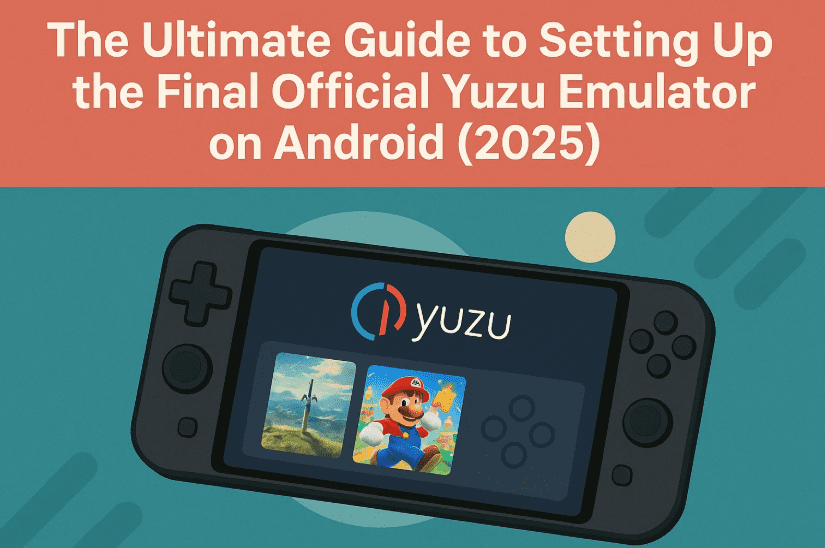
Nintendo Switch emulation has come a long way, and even after its legal shutdown, the final official Yuzu emulator build still holds a special place for many Android gamers. In this guide, we’re going to walk through the full process of setting up Yuzu’s last official build on Android—from installation and configuration to gameplay optimization. No shortcuts. No assumptions. Just pure, step-by-step explanation so anyone can follow along, whether you’re a veteran emulator user or just getting started.
So far, we’ve seen many forks like Eden, Citron, and Nyushu, but despite their development, the original Yuzu still performs better on many devices. Ready to explore this nostalgic and powerful emulator? Let’s get started.
Battle of the Switch Emulators: Ryubing vs. Sudachi vs. Others — Which Is Best in 2025?
⚠️ Disclaimer
This article is meant for educational purposes only. Emulators like Yuzu are legal tools, but using or downloading pirated/copyrighted ROMs is not supported. Please use legally acquired game backups. Always comply with your local laws.
Step 1: Download and Install Yuzu Final Build APK
Since Yuzu’s original website, Discord, and GitHub were shut down following legal issues, it’s difficult to find the APK today. However, trusted emulator communities still circulate this final build.
⚠️ If you don’t have the APK, ask in trusted forums or communities. Do not download from suspicious or ad-filled websites.
Once you have the APK:
- Install the APK file on your Android phone.
- Grant all required permissions, especially storage and notifications.
Upon launching the app, you’ll notice the classic Yuzu interface—familiar to those who’ve used it before, and different from modified forks.
Step 2: Add Product Keys and Game Directory
Before you jump into gameplay, Yuzu needs two things:
- Product Keys
- Games Folder
🔐 Product Keys
Without valid product keys, games won’t load. These are essential files dumped from your own Nintendo Switch. Once added, Yuzu will be able to decrypt and run your games.
📂 Adding Game Directory
- Tap the folder icon and select the directory where your
.NSPor.XCIgames are stored. - Yuzu will automatically scan and display them in your library.
Step 3: Check Game Compatibility
Before loading any game, it’s crucial to know whether it’s supported.






🔗 https://github.com/XForYouX/Yuzu-Android-9/releases/tag/Alpha-V.24
You can use this as the official download page for the final Yuzu Android build.
- Playable (Green)
- In-game (Orange)
- Intro/Crash (Red)
Yuzu supports both .NSP and .XCI formats, giving you flexibility in how you manage your games.
Step 4: Emulator Settings for Optimal Performance
Now comes the most critical part—configuring Yuzu for the best possible gameplay on your Android device. Let’s break this down category by category.
🛠️ Access Settings:
- Tap the gear icon (⚙️) at the bottom-right corner.
- Go to Advanced Settings → System.
🔧 System Settings:
- Limit Speed: Turn off for full performance.
- ⚠️ But in some games, disabling speed limit may cause stuttering.
- Docked Mode: Leave disabled unless your device is high-end.
- Enabling increases resolution but drains performance.
🖼️ Graphics Settings:
- CPU Accuracy: Normal (Best balance)
- Resolution:
- 4x → Flagship devices (SD8 Gen 2+)
- 1x (720p) → Recommended for most users
- 0.5x → Low-end phones
- VSync Mode: Set to Immediate (i.e., off)
- Anti-aliasing: FXAA
- Anisotropic Filtering: 2x
- Aspect Ratio: Stretch to Window
- Force Max Clocks: Only if you have Adreno GPU (Snapdragon)
🧠 Shader Settings:
- Asynchronous Shaders: On (Reduces stutter)
- Reactive Flushing: On (Improves rendering, might affect performance)
🧪 Debug Settings:
- API: Vulkan only (no OpenGL here)
Pro Tip: If something goes wrong, hit “Reset to Default” to restore safe settings.
Step 5: Install Custom GPU Drivers (Snapdragon Only)
One of Yuzu’s most powerful features is support for custom GPU drivers. This can boost FPS significantly, especially on Adreno-based Snapdragon devices.
🧰 How to Do It:
- Use apps like AIDA64 or CPU-Z to check your GPU model.
- Download Adreno drivers like:
- V615
- V630
- V85
- In Yuzu, go to Settings > Install GPU Driver
- Select your downloaded
.sofile and install
📌 Try each version one by one and test in the same game. Stick with the one offering smooth performance without overheating.
❌ Users with MediaTek, Exynos, or non-Snapdragon chips can’t use custom drivers.
Step 6: Install Firmware and Enable Applet Launcher
To unlock full emulator features like the Q launcher, install official firmware.
Steps:
- Tap on Manage Yuzu Data
- Select Install Firmware
- Navigate to the folder where you stored dumped firmware files
- Tap and install
Once done, test the Applet Launcher. If it opens without errors, the firmware was installed correctly.
Step 7: Game Testing and Benchmarks
Let’s now look at how Yuzu performs with some popular titles. These benchmarks are based on the final build with optimized settings and tested on Snapdragon 870 and Snapdragon 8 Gen 2 devices.
🗡️ The Legend of Zelda: Breath of the Wild
- FPS: 35–40 (drops in populated zones)
- Settings Tips:
- Resolution: 1x or 0.5x
- CPU Accuracy: Normal
- Docked Mode: Off
- API: Vulkan
- Clear shader cache for stutter issues
🥊 Super Smash Bros. Ultimate
- FPS: 20–30 (stable for fights)
- Settings Tips:
- Resolution: 1x–2x
- Enable Async Shaders + FXAA
- Turn off Reactive Flushing if lag occurs
🏹 Prince of Persia: The Lost Crown (Deluxe Edition)
- FPS: 35–45 consistently
- Settings Tips:
- Resolution: 1x
- Enable Force Max Clocks (Snapdragon)
- Disable Docked Mode for better performance
- Close background apps for extra headroom
Frequently Asked Questions (FAQ)
Q1: Is the original Yuzu better than Eden or Citron forks?
A: In many cases, yes. The official Yuzu build tends to have more stable performance and fewer compatibility bugs than newer forks, especially on mid-range Android phones.
Q2: Can I use Yuzu without product keys?
A: No. Product keys are required to decrypt and run Switch games. Dump them legally from your own console.
Q3: My game crashes on launch. What should I do?
A: Try lowering resolution, disable docked mode, clear shader cache, or reinstall firmware.
Q4: Where can I download legal games?
A: You should only use games you’ve legally purchased and dumped from your own Switch console.
Q5: Why can’t I install GPU drivers on my device?
A: Only Snapdragon chipsets with Adreno GPUs support custom driver installation.
Final Thoughts: Is Yuzu Still Worth Using?
Despite the legal storm and shutdown, Yuzu’s final Android build remains a legendary emulator. It still outperforms most modern forks in many real-world tests. For gamers who care about stability, compatibility, and performance—this version remains a strong choice.
Big thanks to the original Yuzu development team for giving Android users a piece of Nintendo magic in our hands. With the right tweaks and device, you can enjoy many of your favorite Switch games smoothly.
Tags:
yuzu emulator, nintendo switch android emulator, yuzu settings, android gaming, switch emulation, yuzu vs eden, yuzu fork, switch emulator 2025
Hashtags:
#YuzuEmulator #AndroidGaming #NintendoSwitchEmulator #YuzuSettings #MobileGaming #SwitchGamesOnAndroid #YuzuGuide #EmulatorSetup