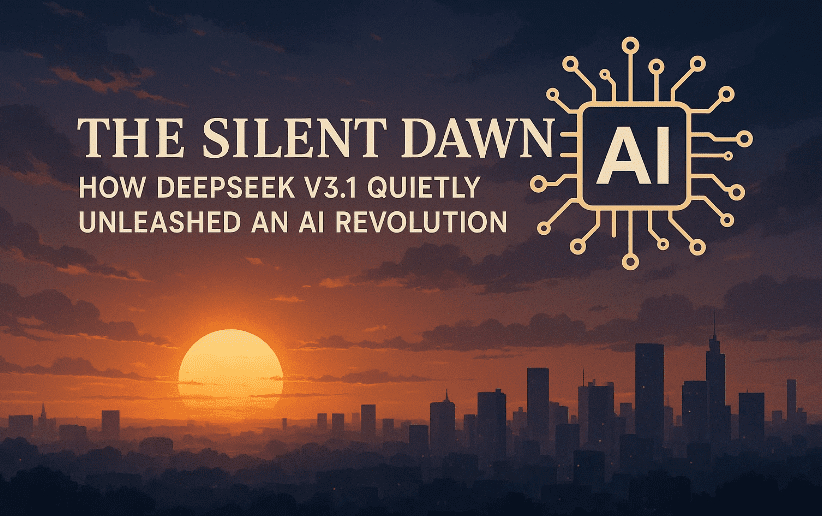
It was 3:47 AM Pacific Time. While Silicon Valley slept, something monumental happened not on a flashy stage or in a corporate boardroom, but in a nearly anonymous repository on Hugging Face. An unexpected file appeared. There were no official press releases, no media leaks, no conferences full of smiling executives. Just a silent upload that, within hours, detonated one of the biggest technological shocks of this century.
That file contained DeepSeek V3.1: a 685-billion-parameter model so powerful it doesn’t just rival GPT-5 and Claude Opus 4—it surpasses them in critical benchmarks. And the most devastating part? It costs 68 times less to run.
The impact was immediate. In less than twelve hours, major U.S. tech companies saw over 600 billion dollars evaporate from their market valuation. That morning marked a definitive before and after in the history of technology. Today, we’re going to dissect why. We’ll explore what makes DeepSeek V3.1 a true game-changer, the technical genius behind it, and what this silent earthquake means for your future.
Beyond the Hype: What Exactly is DeepSeek V3.1?
Before we dive into the technical marvels, let’s establish what we’re talking about. DeepSeek V3.1 is a state-of-the-art large language model (LLM) developed by the Chinese AI research company, DeepSeek. In simple terms, it’s an incredibly advanced AI that can understand and generate human-like text, translate languages, write different kinds of creative content, and, most notably, write and debug complex code.
But calling it “advanced” is a colossal understatement. The key takeaway from its release wasn’t just its performance; it was the staggering efficiency with which it achieved that performance. This isn’t an incremental improvement. This is a complete paradigm shift.
The Heart of the Revolution: Deconstructing DeepSeek V3.1’s Technical Genius
To truly understand what makes DeepSeek V3.1 special, we need to journey into the heart of its technical innovation. This is where the real magic happens and where all the paradigms we thought were immutable are being shattered.
For years, the AI industry operated on a simple premise: more parameters equal better performance, but also equal exponentially higher costs. It was an equation seemingly carved in stone. GPT-4 is rumored to have approximately 1.76 trillion parameters. Claude Opus 4 operates in similar ranges. Both require massive infrastructure—data centers that consume the electricity of entire cities and operational costs that justified premium prices.
DeepSeek V3.1, with its 685 billion parameters, challenged that fundamental equation. It’s not just about having fewer parameters; it’s about what it managed to achieve with them. And this is where the true genius of its design comes in: its hybrid architecture.
Let’s break down the components that make this architecture so revolutionary.
1. The Mixture of Experts (MoE) Model: Efficiency Through Specialization
At its core, V3.1 likely utilizes a Mixture of Experts model. Imagine a large corporation. Instead of having one overwhelmed generalist trying to do everything, you have a team of specialized experts: a legal expert, a finance whiz, a creative director, and a tech guru. When a problem comes in, a smart router (like a manager) decides which expert or combination of experts is best suited to handle the task.











This is what MoE does. The model consists of multiple “expert” networks. For any given input, a gating network activates only the most relevant experts. This means that for each query, only a fraction of the model’s total 685 billion parameters are actually used. The result? Dramatically reduced computational costs and lightning-fast inference speeds without sacrificing the depth and knowledge that a large model provides.
2. Massive Context Window: Remembering Everything
One of V3.1’s most lauded features is its support for a 128K context window. But what does that mean?
The “context window” is the amount of text the model can consider at one time when generating a response. Think of it as the AI’s short-term memory. Older models had limited memory—they might forget the beginning of a long conversation.
A 128K context window is enormous. It allows V3.1 to process and understand the equivalent of an entire long novel, a full software repository, or hours of conversation in a single go. Developers immediately began testing these limits, feeding the model massive texts, complete technical documents, and entire codebases. V3.1 didn’t just process them; it maintained coherence and precision throughout the entire context, something previous models struggled with.
3. Native Web Search: Integrated Reasoning
This might be its most revolutionary feature. While other models require external tools and complex API orchestration to access up-to-date information from the web, V3.1 can do this natively, integrated directly into its thought process.
This isn’t just a tacked-on feature. When V3.1 determines it needs current information to answer a question accurately, it can perform a web search, process the results, evaluate the credibility of sources, and integrate that fresh information directly into its reasoning chain before delivering a final, coherent answer. This seamless integration is a monumental leap forward in creating a truly autonomous and knowledgeable AI assistant.
4. Private “Chain-of-Thought” Reasoning
Building on the concept of chain-of-thought prompting, V3.1 appears to execute this internally. This means the model can literally “think” privately before responding. It processes information, evaluates options, and constructs a reasoned response without the user seeing all that internal work. It’s like having access to the private thoughts of an artificial mind as it works through a problem, resulting in more accurate and well-reasoned final answers.
So far, we’ve covered the how. But the story gets even more incredible when we look at the cost.
The Unthinkable Economics: Training a Titan on a Startup Budget
In January 2024, when DeepSeek published the training details for its original V3 model, they revealed something that shook the industry’s foundations: they had trained a competitive model using only 2,000 slower-tier Nvidia GPUs with a total budget of $5.6 million dollars.
Let that sink in. Five point six million.
To put this in perspective, it is rumored that OpenAI spent over $100 million on computational costs alone for GPT-4. Google and Anthropic likely spent comparable amounts on Gemini and Claude Opus.
But V3.1 goes far beyond that initial revelation. It demonstrates that you can not only build frontier AI more efficiently, but you can openly share it and still maintain a competitive advantage. This flips the entire business model of AI on its head. While U.S. corporations try to recoup massive investments by charging premium prices, DeepSeek’s strategy accelerates global adoption, builds ecosystems around its technology, and forces closed competitors to justify why anyone should pay 68 times more for similar capabilities.
By the Numbers: Benchmarks That Redefined the Game
Benchmarks in artificial intelligence are the Olympic medals of the tech world. They define who is the best, set new records, and determine where investment and attention flow. When DeepSeek V3.1 began demolishing these benchmarks one by one, it wasn’t just winning points on leaderboards; it was rewriting the rules of what we believed was possible.
Let’s start with the one that caused the most stir: a staggering 71.6% on the Ader programming benchmark.
For anyone who doesn’t live and breathe code every day, this number might seem like just another percentage. But for the developer community, it represents something monumental. Ader is brutally difficult. It doesn’t evaluate if you can write a “Hello World” or solve basic algorithm problems. It evaluates whether you can take complex specifications, understand advanced software architectures, debug code with subtle errors, and optimize performance in real-world systems. It’s the kind of work that separates junior from senior programmers, and traditionally, only the most experienced humans and the most expensive models could do it well.
Surpassing Claude Opus 4 on this benchmark while being drastically cheaper isn’t just an improvement; it’s an industry disruption. That programming task that cost you $70 on a closed system? You could now run it for around $1. For a startup executing thousands of queries daily, this isn’t just savings; it’s the difference between economic viability and bankruptcy.
But its prowess isn’t limited to code. V3.1 excels across a broad spectrum of tasks, including complex reasoning, mathematics, and general knowledge, consistently matching or outperforming models orders of magnitude more expensive to operate.
The Ripple Effect: Why the Market Panicked
When the implications of DeepSeek’s efficiency became clear, the market reacted with stunning violence. Nvidia, the company whose high-end GPUs are the gold standard for training and running these massive models, lost $600 billion in market capitalization in a single day.
Why such a dramatic reaction? Because the entire industry had operated for years on the assumption that competing at the frontier of AI required spending hundreds of millions of dollars on the most advanced GPUs. DeepSeek didn’t just challenge that assumption; it completely demolished it. The market suddenly had to price in a future where the hardware requirements for top-tier AI might be significantly lower than previously thought.
This isn’t just a story about one company. It’s a reconfiguration of an entire industry’s power structure and economic model.
A Philosophical Divide: Tool vs. Product
The true genius of V3.1 goes beyond operational efficiency. It’s a model built from the ground up with the philosophy that AI should be a tool, not a controlled product.
This philosophical difference manifests in concrete design choices:
- Closed models are often optimized to maximize API usage (more calls = more revenue), which can sometimes lead to designs that encourage multiple interactions.
- V3.1 seems optimized to solve problems completely in the fewest number of interactions possible. It prefers to give you a complete, useful answer in a single interaction rather than forcing you to ask multiple follow-up questions. It prefers to process long, complex contexts in a single query.
This user-centric design philosophy, combined with its open nature, is empowering a new wave of innovation. Developers, researchers, startups, and even governments are beginning to build their AI infrastructures around open models instead of relying on APIs controlled by foreign corporations. The official DeepSeek community has already surpassed 80,000 members and is growing exponentially.
Frequently Asked Questions (FAQ)
Q: Where can I find and use DeepSeek V3.1?
A: The model is available on the Hugging Face platform. You can also find more information on the official DeepSeek website.
Q: Is DeepSeek V3.1 truly “Open Source”?
A: The term “open weight” is more accurate. This typically means the model weights (the core parameters) are publicly available for download and use, often for research and commercial purposes, but the underlying training code and data might not be fully disclosed. Always check the specific license agreement on its Hugging Face page for details.
Q: Does its native web search pose any risks?
A: Like any tool, it depends on its use. The ability to access live information is powerful but also requires robust safeguards to avoid propagating misinformation from unreliable sources. The model’s ability to evaluate source credibility is a critical part of its design.
Q: What does this mean for the future of AI development?
A: It signals a powerful shift towards democratization. It proves that frontier-level AI is not exclusively the domain of tech giants with near-infinite budgets. This could lead to an explosion of innovation from smaller players and research groups around the world.
Q: How does this affect me as a developer or business owner?
A: It dramatically lowers the barrier to entry for leveraging top-tier AI. The cost of developing AI-powered features has plummeted overnight. It’s now economically feasible to integrate advanced AI capabilities into projects that previously couldn’t afford it.
Conclusion: The Future is Open
DeepSeek V3.1 is more than just a better model; it is living proof that the future of AI does not have to be controlled by a few. It is concrete evidence that the most important innovation of our era can be free, open, and accessible without sacrificing excellence.
This silent upload in the early hours of the morning didn’t just change a market; it changed the trajectory of artificial intelligence itself. It has redefined the limits of efficiency, challenged entrenched business models, and empowered a global community.
The question is no longer if open models will compete with closed ones, but how quickly they will become the new standard. So, how do you think this change will affect your work, your industry, or your life? One thing is certain: the future is open. And it begins now.
Tags:
DeepSeek, DeepSeek V3.1, Artificial Intelligence, AI Revolution, Open Source AI, Mixture of Experts, Large Language Models, AI Benchmarks, AI Economics, Technology Disruption, Hugging Face
Hashtags:
DeepSeek #AI #ArtificialIntelligence #LLM #OpenSource #TechRevolution #MachineLearning #Innovation #BigTech #FutureOfAI
Disclaimer: This article is based on available public information and benchmark results. Performance and cost savings can vary based on specific use cases and implementations. This content is for informational purposes only and does not constitute financial or investment advice.