🌐 Introduction: From Virtual Dreams to Reality Fatigue
Just a few years ago, the entire tech world was obsessed with one buzzword — Metaverse.
Facebook even changed its name to Meta, signaling what many believed was the next digital revolution. Tech giants promised that we’d soon live, work, and socialize in a fully immersive virtual world powered by VR headsets.
During the pandemic, that idea made sense. People were stuck at home, longing for experiences that could replace physical presence. Every major company jumped into the race, imagining a future where heavy headsets would transport us into another dimension — a “better” digital version of our lives.
But five years later, the story turned out differently.
The Metaverse hype has quietly faded, and virtual reality (VR) — once seen as the future — now feels like a niche experiment. So, what went wrong? And more importantly, what technology is now taking its place?
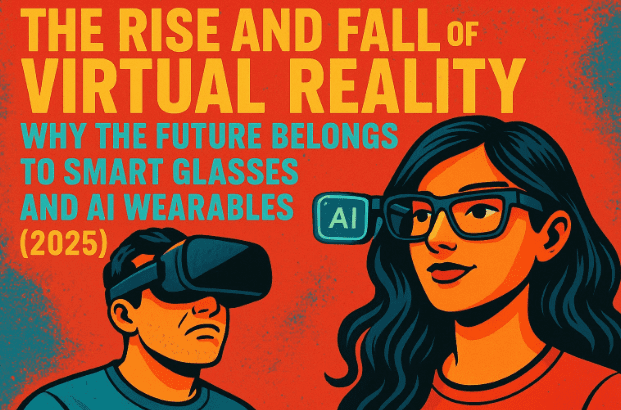
Let’s explore how virtual reality failed to become mainstream, why Apple and other giants are shifting their focus, and how AI-powered smart glasses are now shaping the real futuristic vision.
🎭 The Metaverse Promise That Never Happened
The early 2020s saw companies like Meta, HTC, and Sony aggressively pushing VR hardware. The vision was clear — instead of staring at screens, we’d wear a headset and step inside digital worlds.
VR promised everything:
- Virtual offices
- Digital concerts
- Gaming realms
- Even virtual travel
For a while, it seemed unstoppable. Meta launched the Oculus Quest 2, Sony advanced with PlayStation VR, and eventually, Apple entered the field with its ambitious Vision Pro headset.
Yet today, you’ll find most of these devices collecting dust on shelves. Users tried them once or twice and then put them away. The dream of everyday VR never materialized.
💸 The First Problem: Price and Practicality
Let’s start with the most obvious reason — cost.
High-end headsets like the Apple Vision Pro cost thousands of dollars, placing them firmly in the luxury gadget category.
And what do users get for that price?
A bulky device strapped to the face, limited battery life, and restricted usability. VR might be fun for short sessions, but it’s uncomfortable for long-term use. The average person doesn’t want to wear a heavy headset daily — especially not to check emails or scroll social media.
Even in professional setups, prolonged use leads to:












- Eye strain
- Motion sickness
- Neck discomfort
- Isolation from the real world
That’s a high price to pay — both literally and physically.
🕹️ The Second Problem: Limited Content and Ecosystem
Technology means nothing without content. Despite massive investments, the VR ecosystem remains limited.
You can play a handful of immersive games or try a few experimental apps, but beyond that, there’s little reason to put on a headset. Apple’s Vision Pro, for instance, launched with impressive demos, but most users quickly discovered that practical apps were scarce.
Apple even tried to build a unique ecosystem:
- Creating 3D recording features in iPhones
- Designing new camera systems
- Partnering with media companies for immersive experiences
Yet, after the initial excitement, usage dropped. The Vision Pro ended up being a conversation piece — not a lifestyle product.
🔋 The Third Problem: Technology Limits
Making a VR headset “perfect” is nearly impossible because of the laws of physics.
It needs to deliver:
- High-resolution visuals
- Smooth performance
- Lightweight design
- Long battery life
But these goals constantly conflict. To render complex 3D environments, you need powerful chips — which generate heat and consume more battery. To make the headset lighter, you must shrink components, reducing performance.
Even with advanced processors, thermal management, weight balance, and optical calibration remain engineering nightmares.
In short, VR technology is still too heavy, hot, and expensive for everyday life.
👓 Why Smart Glasses Are Becoming the Next Big Thing
Now let’s move to the next phase of this evolution — smart glasses.
Instead of isolating you in a virtual world, smart glasses add digital information on top of reality, known as Augmented Reality (AR).
You stay connected to the real world but gain an extra digital layer:
- Navigation directions appear in your vision.
- Notifications float gently near your peripheral view.
- You can talk to AI assistants without pulling out your phone.
This makes AR glasses practical, not just entertaining.
✨ Why Smart Glasses Make More Sense
- Lightweight and Comfortable: Unlike VR headsets, glasses can be worn daily.
- Non-intrusive: They enhance reality instead of replacing it.
- Cheaper to produce: The technology fits within consumer budgets.
- Easier integration: They connect seamlessly with smartphones.
The big shift we’re seeing is from “total immersion” to “subtle augmentation.” Instead of escaping reality, tech is returning to enhancing it.
🧠 Apple’s Shift from Vision Pro to Smart Glasses
Even Apple seems to have realized that the future doesn’t belong to bulky headsets. Reports indicate that Apple is reducing focus on Vision Pro 2 and channeling resources toward lightweight AI-integrated glasses.
These upcoming glasses are rumored to:
- Pair with iPhones
- Run a minimal version of VisionOS
- Display contextual data like navigation, calls, and messages
Apple’s move shows how the industry is correcting its course — from VR fantasy to practical AR reality.
🪶 How Technology Has Caught Up
A few years ago, fitting AI and display technology into eyewear seemed impossible. But in 2025, the situation is very different.
Here’s why:
- Qualcomm’s Snapdragon AR platform now powers efficient, lightweight AR devices.
- Companies like Lumos have perfected projection-based displays, using miniature projectors to beam images onto glasses.
- Meta’s Ray-Ban AI Glasses have already shown that voice-based interaction and basic photo/video features work flawlessly.
The Lumos system, for instance, uses a micro-projector hidden inside the temple of the glasses, reflecting images onto a special layer of the lens. This approach avoids the bulky, power-hungry micro-LED displays that plagued earlier prototypes.
Best of all — users can still wear prescription lenses, since projection doesn’t interfere with optical correction.
This combination of comfort, affordability, and smart functionality makes AR glasses far more consumer-ready than any VR headset ever was.
🤖 AI Integration: The Secret Ingredient
The difference between old AR glasses and new ones is AI integration.
Voice assistants are evolving into full-fledged contextual companions. With AI inside your glasses, you can:
- Ask what building you’re looking at.
- Translate text or menus instantly.
- Get turn-by-turn navigation without looking down.
- Identify objects or people through computer vision.
This shift from hardware novelty to AI utility is what will make smart glasses a success. They’re not just screens on your face — they’re intelligent extensions of your digital life.
🏍️ Beyond Glasses: The Next Wave of AR Hardware
The futuristic vision doesn’t stop at eyewear. Companies are exploring AR-enabled helmets, ear accessories, and even AI-powered jewelry.
Examples include:
- AR Helmets for Bikers: A heads-up display on a motorcycle visor showing maps, speed, and alerts.
- Smart AirPods with Cameras: Offering environmental awareness without wearing glasses.
- AI Earrings: Using bone-conduction audio to deliver private voice prompts.
These innovations suggest that AR won’t be limited to just one product category — it will expand into multiple wearable forms. Essentially, the “AI companion” will follow you everywhere, embedded in whatever you wear.
📱 Will Smart Glasses Replace Smartphones?
Here’s a question many people ask — will glasses kill the smartphone?
The answer, at least for the foreseeable future, is no.
Smart glasses will complement, not replace, smartphones. They’re ideal for glanceable information — directions, notifications, reminders — but not for typing messages, watching long videos, or editing photos.
Smartphones will continue to serve as the processing hub, storage, and communication center, while glasses act as smart extensions of them.
🧩 Why VR Failed but AR Will Succeed
Let’s summarize what differentiates AR glasses from traditional VR headsets.
| Feature | Virtual Reality Headsets | AI Smart Glasses (AR) |
|---|---|---|
| Experience | Fully immersive digital world | Augmented real world |
| Usage Duration | Occasional, short sessions | Daily wearable |
| Comfort | Bulky and heavy | Lightweight and casual |
| Content Availability | Limited apps and games | Universal AI + mobile integration |
| Price Range | $1000–$3500 | $200–$800 (expected) |
| Social Acceptance | Isolating | Seamlessly social |
| Target Market | Gamers, professionals | Everyday consumers |
Simply put — VR tried to replace reality, while AR aims to enhance it. That small difference changes everything.
💬 FAQs
Q1: Is Virtual Reality completely dead?
No, but it’s moving away from the consumer market. VR will continue to thrive in industrial training, architecture, and medical simulation — areas where immersion adds real value.
Q2: Why did people stop using Apple Vision Pro?
Because of limited content, high cost, and impracticality for daily tasks. It was impressive, but not essential.
Q3: Are AI glasses already available?
Yes, products like Ray-Ban Meta Smart Glasses are on the market. Others from Apple, Samsung, and Xiaomi are expected soon.
Q4: Will AR glasses cause eye strain?
Not necessarily. New projection and light-filtering methods reduce glare and minimize fatigue, though extended use still requires care.
Q5: What’s the next big trend after AR glasses?
Wearable AI devices — from helmets to earpieces — that integrate seamlessly into daily life, making technology invisible yet ever-present.
🚀 Conclusion: The Future Is in Front of Your Eyes
The age of virtual escapism is over. The world doesn’t need to escape reality — it needs to improve how we interact with it.
Virtual reality headsets promised new worlds but failed to fit into everyday lives. AI-powered glasses and wearables, on the other hand, enhance the world we already have.
In 2025 and beyond, the line between technology and lifestyle will blur even further — not by isolating us in virtual spaces, but by bringing intelligence directly into our sight, hearing, and touch.
The future isn’t about leaving reality.
It’s about augmenting it.
#VirtualReality #SmartGlasses #AugmentedReality #AIWearables #VisionPro #Metaverse #TechTrends #ARvsVR #AppleGlasses #FutureTech
Disclaimer:
This article is intended for informational and educational purposes only. All trademarks, logos, and product names such as Apple, Meta, and Qualcomm belong to their respective owners. The discussion here focuses on analyzing market and technology trends — not endorsing or promoting specific products.