Sometimes technology throws us into situations that feel almost surreal. You switch on a Windows 11 laptop you haven’t used for months, install updates, shut it down, and the next thing you see is a screen demanding an online Microsoft account — with no visible way to bypass it. You try to restart, hoping this strange detour will disappear, but the system keeps pulling you back into that forced sign-in page.
And then, just when you’ve accepted defeat, something unexpected happens: you power it on again, and suddenly your old desktop, your icons, your background, everything is back — as if nothing happened.
This experience isn’t unique. Many users of Windows 11 have run into this exact loop, and the confusion around it often leads to panic or frustration. So in this article, let’s walk together through:
- Why Windows forces the online account screen
- Why the screen sometimes disappears by itself
- Why System Error 5 happens when disabling the Administrator account
- How to fix the situation safely
- And how to open an Elevated Command Prompt in every possible way
Our goal is simple: clarity, not chaos. So let’s take it step by step.
🌩️ 1. The Core Problem: Windows Forces an Online Microsoft Account After Updates
Before we solve anything, let’s understand what really happened.
🟦 Intro
Microsoft has been tightening the requirements around signing into Windows with an online account. Certain updates — especially feature updates or cumulative updates — sometimes push users toward completing what Microsoft calls OOBE (Out-Of-Box Experience), even if the PC was already set up months ago.
This forced OOBE overlay can appear:
- After major updates
- After the device has been unused for a long time
- When Windows believes setup was “incomplete”
- When network or account policies have changed
- When the device is offline for months and suddenly reconnects
🟦 What the user sees
The screen demands:
- “Sign in with your Microsoft account”
- “Let’s finish setting up your device”
- “Continue with an online account”
And in many cases, Windows removes or hides the “Offline account” option to force the user into compliance.
🟦 Why the screen later disappeared
When you forcefully shut down the system multiple times during OOBE, Windows may interpret it as:
- A genuine user rejection,
- A stuck OOBE loop,
- A configuration failure, or
- An incomplete update process.
So after repeated failures, Windows has a safety fallback:



👉 It abandons the OOBE session and loads your previous desktop to avoid locking you out permanently.
This is why everything suddenly appeared normal.
🔒 2. Why You Saw “System Error 5: Access is Denied” While Running the Command
🟦 Intro
Even if you’re using an administrator account, Windows protects certain commands behind a stricter wall. This is why the command:
net user "Administrator" /active:no
fails with System Error 5 when run from a regular Command Prompt.
Let’s demystify this.
🟥 Why the error occurred
Because the Command Prompt you used earlier was:
- NOT elevated
- NOT running with admin rights
- Blocked by UAC (User Account Control)
Even administrators cannot run certain commands unless the CMD is explicitly launched as Administrator.
🟩 How Shift + F10 behaves differently
Interestingly, when opening CMD using Shift + F10 at the login screen, it runs as:
👉 SYSTEM — a level above Administrator.
This environment is more powerful than a normal elevated CMD and does allow running account-level commands.
So the earlier failure wasn’t because the command was wrong — it was because the environment you ran it in did not have the right permissions.
⚡ 3. How to Solve the Online Account Lock Problem Safely
🟦 Intro
Once we understand the cause, solving it becomes much easier. There are several approaches depending on the situation you find yourself in.
🟩 Method A: Let Windows Detect Setup Failure (The Method You Encountered by Accident)
When Windows detects:
- several forced shutdowns,
- incomplete OOBE setup,
- missing network,
- or repeated reboots,
…it often drops the OOBE flow and returns to your local account desktop.
This method is crude but effective:
- On the Microsoft Account screen → press Power button to force shutdown.
- Turn it on again.
- Repeat this 3–5 times.
Windows typically gives up and loads the old account.
🟩 Method B: The Offline Bypass Using Shift + F10
During the forced Microsoft Account OOBE screen:
- Press Shift + F10 to open Command Prompt.
- Now run this command:
OOBE\BYPASSNRO
- The system will restart.
- After reboot, choose “I don’t have Internet”.
- Select “Continue with limited setup”.
This breaks the forced-online lock.
🟩 Method C: Creating a New Local Administrator Account (Emergency Fix)
From Shift+F10 CMD:
net user tempuser /add
net localgroup administrators tempuser /add
Restart → log in with tempuser → regain control.
🟩 Method D: Disabling the Hidden Administrator Account
In an elevated CMD (all methods listed below):
net user "Administrator" /active:no
This prevents Windows from showing the admin account as part of the OOBE loop.
🧰 4. All Possible Ways to Open an Elevated Command Prompt (Complete List)
🌿 Intro
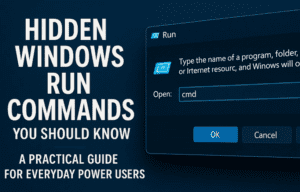
This is the part most people struggle with. Windows does NOT elevate CMD automatically, even if you’re an admin. You must open it specifically as Administrator.
Here are every single reliable method, including hidden ones, offline ones, and advanced ones.
🟦 Method 1 — Start Menu (Most Common)
- Click Start
- Type
cmd - Right-click Command Prompt
- Select Run as administrator
You will see Administrator: Command Prompt in the title bar.
🟦 Method 2 — Run Box (Fastest Shortcut)
- Press Windows + R
- Type
cmd - Press Ctrl + Shift + Enter
This forces elevation.
🟦 Method 3 — Windows Terminal (Admin Mode)
Works only if logged in, not at OOBE or login screen.
- Open Windows Terminal
- Click the arrow ▼
- Choose Command Prompt (Admin) or Windows PowerShell (Admin)
🟦 Method 4 — Power User Menu
- Press Windows + X
- Choose Windows Terminal (Admin) or Command Prompt (Admin)
🟦 Method 5 — Task Manager Method
Useful if Start Menu is broken.
- Press Ctrl + Shift + Esc
- Click Run new task
- Type
cmd - Tick Create this task with administrative privileges
🟦 Method 6 — From File Explorer
- Go to
C:\Windows\System32 - Right-click cmd.exe
- Select Run as administrator
🟦 Method 7 — Boot/OOBE Recovery: Shift + F10 (Runs as SYSTEM)
This works:
- during Windows setup
- on login screen
- during OOBE
- in recovery mode
Press:
Shift + F10
You get a SYSTEM-level Command Prompt — even stronger than admin.
🟦 Method 8 — Through Advanced Startup
- Settings → System → Recovery
- Advanced startup → Restart now
- Troubleshoot → Command Prompt
This always opens in elevated mode.
🟦 Method 9 — Using USB Installation Media
Start the installer → press Shift + F10 → full SYSTEM CMD.
🔧 5. Why Windows Pushes Microsoft Account Setup (Technical Explanation)
🌿 Intro
Windows isn’t malfunctioning — it’s following Microsoft’s new policies.
Here are the reasons.
🟥 Forced MSA Policy
Windows 11 Home officially requires a Microsoft account during setup.
Windows Pro also requires it now unless bypassed.
🟧 Update-Level OOBE Re-trigger
Some updates (especially 22H2, 23H2, 24H2, and 25H2 versions) contain:
- Privacy policy revisions
- Account requirement changes
- Cloud backup pushes
- Device linking features
These updates sometimes re-trigger OOBE on reboot.
🟨 Offline Machines
If your laptop was unused for months, Windows may assume setup is “incomplete”.
🟦 Microsoft’s Cloud Integration Strategy
More apps now require cloud identity:
- OneDrive
- Outlook
- Copilot
- Store apps
- Licensing hooks
So Windows tries to link local profiles with cloud credentials.
🌲 6. How to Prevent This Problem in the Future
🌿 Intro
Now that you’ve escaped the forced login, you can strengthen your system to avoid repeating the experience.
🟩 1. Disable annoying “Finish setup” notifications
Go to:
Settings → System → Notifications → Additional settings
Uncheck:
- “Suggest ways to get the most out of Windows”
- “Get tips and suggestions”
- “Show me the Windows welcome experience…”
🟩 2. Keep a local Admin user enabled
Disable the built-in Administrator:
net user "Administrator" /active:no
But keep your own local admin active.
🟩 3. Avoid signing into Wi-Fi during OOBE
This prevents automatic online login demands.
🟩 4. Keep backups
So recovery or reinstall doesn’t trap you.
⚠️ Disclaimer
This article describes legitimate and safe methods to manage Windows accounts and setup processes.
It does not promote account bypassing for unauthorized access.
Use these steps only on devices you own or are authorized to maintain.
#Windows11 #LocalAccount #TechGuide #CMD #Troubleshooting #dtptips