In a world dominated by tech giants and rapid digital transformations, stories of grassroots innovation sometimes get overshadowed. But today, let’s delve into one such compelling tale—the story of Map My India, an Indian digital mapping company born from sheer determination, brilliant vision, and relentless hard work, which faced extreme highs and lows in its journey.
This blog post unpacks the detailed journey of Map My India—from its humble beginnings in 1995, when its founders returned from successful careers abroad to create India’s first digital map in an internet-scarce nation, to their intense competition with Google Maps, and finally to the controversies and challenges the company encountered in recent years. Whether you are interested in the entrepreneurial spirit, digital innovation in India, or corporate ethics, this story holds valuable lessons.
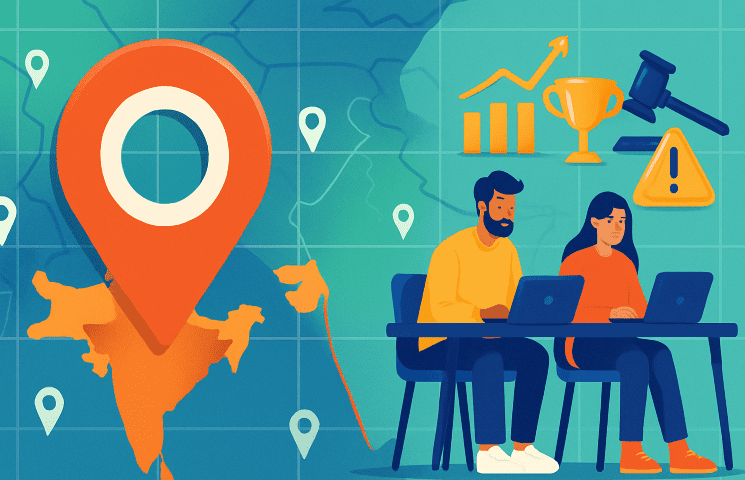
The Beginning of a Dream: 1995 and the Birth of Digital Mapping in India
Let’s start at the very beginning. Imagine the mid-1990s in India—barely anyone had heard of the internet, smartphones were decades away, and digital maps were almost unheard of. At this time, Rakesh Verma, a mechanical engineer from BITS Pilani with an MBA from the USA, noticed a striking opportunity while working abroad.
Why Did Rakesh Take the Leap?
While in the United States, Rakesh saw first-hand how the Geographic Information System (GIS) was changing businesses and governments. They used digital maps for logistics, planning, and management, but there was no comparable system in India.
Fueled by this vision, Rakesh and his wife Rashmi decided to quit their stable jobs in the US and return to India to build “India’s own digital map”, despite the internet barely existing in the country at that time.
Early Struggles and Skepticism
They started a tiny company named C Info Systems, focusing on a project called My India—an app aimed at revolutionizing Indian mapping. Their office was essentially a small room, and their team was just the two of them.
People doubted them heavily—many laughed at the idea, calling it madness. India had no GPS, no internet culture, and the concept of digital mapping was unknown. There were no investors willing to back them, no clients interested, and they had to resort to surveying roads manually.
The Herculean Task: Building India’s Map Manually
Without digital or automated tools, Rakesh and Rashmi took to the streets—quite literally.
- They manually collected data for over 6 lakh kilometers of roads.
- Digitized information about more than 1 crore buildings.
- Developed a proprietary geographic database from scratch.
They traveled thousands of kilometers, gathering information piece by piece—a feat unimaginable in today’s era of satellite maps and GPS. This painstaking work took years, and for a long time, My India did not generate any profit.
Q: How did they survive financially in those early years?
A: Primarily through sheer perseverance and a focus on B2B (business-to-business) clients rather than consumers, targeting companies and government bodies.
Turning the Tide: The Breakthrough in 2004
After nearly a decade of groundwork, 2004 marked a magical turning point.









- My India successfully developed the most accurate digital map system for India without external funding.
- They released their first digital mapping product.
- Big companies like Hindustan Unilever, Coca-Cola, and Maruti Suzuki began to rely on My India’s solutions to optimize their supply chains.
This phase brought the first steady stream of income and credibility.
Strategic Focus on B2B Market
Realizing the need for sustainable growth, My India concentrated on serving government bodies and local Indian businesses instead of competing in the consumer market. This move differentiated them from other competitors and earned them respect among Indian enterprise clients.
The Google Effect: Challenges After the Launch of Google Maps in India
Just as My India was gaining momentum, a seismic shift occurred in 2008.
Google launched Google Maps in India—and crucially, offered it free.
This was a massive blow for My India, whose business model was based on paid B2B contracts.
- Google’s free service quickly gained massive consumer adoption.
- My India’s potential client prospects and investors felt pressure due to this powerful new entrant.
- The company faced financial strain and internal challenges.
The founders realized that competing directly against a colossal like Google was not a viable strategy.
Reinventing the Business: Shifting to Data Licensing and Private Maps
Instead of giving up, Rakesh and his team pivoted cleverly.
- They started providing data as a service (DaaS)—licensing their detailed, government-approved, hyper-local mapping data.
- Focused on creating private maps tailored for government and enterprise clients.
- Launched India’s first digital navigation system for cars, gaining popularity in the automobile industry with partners like Maruti, BMW, Hyundai, and Honda.
This approach ensured a niche, defensible position focused on quality and customization rather than mass consumer reach.
The Mobile Revolution and New Challenges (2011-2014)
With the rise of smartphones and mobile internet, Google’s dominance in mobile mapping deepened.
- Android devices came pre-installed with Google Maps.
- Free access to Google’s services made it difficult for My India to grow its consumer presence.
- Investors began urging My India either to merge with Google or exit the market.
Despite mounting pressure, the company chose to fight on.
The Comeback: Government Partnerships and Digital India Campaign
From around 2016 onwards, the tide turned again for My India.
- The Indian government started promoting domestic technology platforms.
- My India gained significant contracts—partnering with ISRO, DRDO, GST departments, and government initiatives like Digital India.
- Popular companies such as PhonePe, Flipkart, Ola, Zomato, and several automobile manufacturers began using My India’s maps.
- By this stage, over 90% of My India’s revenue came from B2B and government contracts.
In 2021, My India conducted an IPO on the Indian stock exchange, which was oversubscribed 154 times and brought huge returns to early investors.
A Dramatic Twist: The 2024 Investor Controversy
However, trouble was on the horizon.
In 2024, roughly three years after their promising IPO, My India’s founders decided to spin off a business unit called Maples.
- Maples was separated from My India and controlled largely by Rakesh’s son, holding 90% stake.
- My India retained only 10%.
- Investors accused the company of unethical behavior, feeling betrayed since their investment was to help grow the whole company.
While legally permissible, this move severely damaged My India’s reputation and trust with investors.
What Does the Future Hold for My India?
Despite the setbacks, My India continues to focus on growth areas:
- Developing HD maps and 3D maps for vehicles.
- Providing APIs for logistics, insurance, and e-commerce companies.
- Aspiring to replace Google Maps on mobile devices in India—a tough but ambitious goal.
The key question remains: Can My India maintain its vision and hold its ground in a market dominated by Google and others?
Lessons From My India’s Journey
This story is rich with lessons for entrepreneurs and technologists alike:
- Vision and perseverance matter: Building India’s first digital map from scratch is a monumental achievement.
- Adaptability is crucial: Pivoting to B2B and data licensing models enabled survival.
- Competition with tech giants requires unique strategies: You can’t outspend Google, but you can out-specialize them.
- Ethics and transparency impact investor relations: The 2024 controversy underscores the importance of aligned incentives.
- Government support can be a game changer: Partnerships and national campaigns boosted their growth profoundly.
Frequently Asked Questions (FAQs)
Q1: What is My India exactly?
A digital mapping company started in 1995 aiming to build India’s own geographic data and navigation services.
Q2: Why was the company’s initial phase so challenging?
Due to lack of internet, no GPS system in India, no investors, and manual data collection requirements.
Q3: How did Google Maps affect My India?
Google Maps entered the Indian market in 2008 for free, impacting My India’s business, especially in consumer domains.
Q4: How did My India pivot successfully?
They shifted to B2B, government contracts, and offered data licensing services, focusing on private and enterprise solutions.
Q5: What caused the investor controversy in 2024?
Founders split off a business unit with major stakes controlled by family members, frustrating investors who expected unified growth.
Final Thoughts
My India’s journey, spanning three decades, exemplifies the rollercoaster of innovation—full of vision, obstacles, successes, and challenges. It’s a powerful reminder that determination and the ability to pivot can create tremendous impact, even in the shadow of global giants.
We will continue watching the company’s journey with interest—as it represents one of the most ambitious homegrown technology stories in India.
Disclaimer
This article is based on public information and aims to provide an insightful overview of My India’s business journey. It is not legal or financial advice. Readers should refer to official company communications and regulatory filings for authoritative details.
Relevant Link
For more about geographic information systems and digital mapping innovation, visit [My India – example official site] (Note: actual official web presence details may vary as per current info).
Tags: India, geospatial, digital maps, startup, entrepreneurship, GIS, Google Maps, B2B, technology, IPO, business ethics
Hashtags: #IndiaTech #GIS #DigitalMapping #StartupStories #Entrepreneurship #GoogleMaps #Innovation #MyIndia #TechEthics