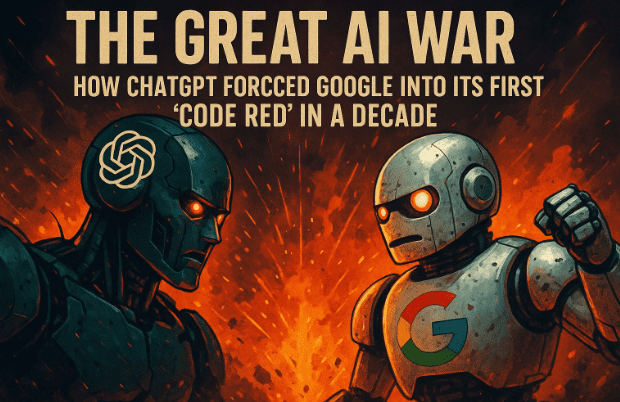
When Google declared a “Code Red” in December 2022, it wasn’t because of a new virus or a government threat.
It was because of a startup—a 2-year-old company that had just unleashed a product powerful enough to shake Google’s $200-billion search empire.
That company was OpenAI, and its weapon was ChatGPT.
This marked the beginning of a historic tech war—one that’s still unfolding today. From Google’s internal panic to Microsoft’s strategic strikes and Apple’s silent infiltration, the race to dominate artificial intelligence has become the biggest corporate battle since Microsoft vs. Apple in the 1990s.
Let’s break it all down.
💥 1. The Moment Everything Changed
In December 2022, Google CEO Sundar Pichai called an emergency meeting at the company’s Mountain View headquarters.
The cause?
A small San Francisco startup had just launched ChatGPT, a conversational AI capable of generating essays, solving problems, and answering complex queries with human-like fluency.
Within five days, ChatGPT hit 1 million users.
Within two months, it reached 100 million, making it the fastest-growing app in history.
The unthinkable was happening: users were skipping Google search altogether and asking ChatGPT instead.
For the first time in over two decades, Google’s invincible dominance showed cracks.
🚨 2. Why Google Declared “Code Red”
Inside Google, executives realized this wasn’t just another app trend — it was an existential threat.
If even 1% of global searches moved from Google to ChatGPT, that meant 3.2 billion lost searches per month.
At roughly 5 cents per search, Google would lose $160 million every month — and worse, its entire ad model would begin to collapse.
So, Google declared its first “Code Red” since 2011 — a full company-wide emergency.
Teams were told to prioritize AI response above everything else.
The future of Google Search was on the line.









But before we dive into their response, let’s understand how OpenAI pulled this off.
🤖 3. OpenAI’s Meteoric Rise
OpenAI wasn’t a new player—it had been working quietly on deep learning and language models for years.
But ChatGPT, released on November 30, 2022, changed everything.
Built on transformer architecture (ironically invented by Google Research), ChatGPT offered something Google never dared to:
a direct, conversational experience instead of 10 blue links.
Instead of “searching,” users were talking to AI — and getting clean, ad-free answers instantly.
This new paradigm—conversational search—threatened to make Google’s traditional interface feel outdated overnight.
🕳️ 4. How Google Got Trapped by Its Own Business Model
Here’s the twist: Google could have beaten OpenAI.
It had its own advanced AI models — LaMDA, PaLM, and Meena — all capable of human-like chat years before ChatGPT existed.
But Google never released them publicly.
Why? Because its own data scientists warned:
“AI-powered answers will reduce ad clicks.”
And ad clicks are Google’s golden goose — generating $162 billion per year.
So, Google faced a cruel dilemma:
- Release AI and risk killing its ad business,
- Or stay safe and let someone else disrupt it.
When OpenAI released ChatGPT, that hesitation came back to haunt them.
🧠 5. Microsoft’s $10 Billion Power Move
While Google scrambled, Microsoft saw opportunity.
It invested $10 billion in OpenAI and embedded ChatGPT directly into Bing and Microsoft Edge.
For the first time in decades, Bing became relevant again.
Microsoft’s approach was brilliant:
- Give AI features away for free,
- Brand itself as the AI pioneer,
- And let Google look like the slow, cautious dinosaur protecting ads.
Suddenly, users were saying, “Let’s Bing it.” — a phrase no one had uttered since 2009.
Microsoft turned AI from a research project into a marketing weapon.
⚔️ 6. The Three-Front AI War: Search, Browsers, and Control
By 2024, the AI war had spread across three major fronts:
1. The Search War
ChatGPT launched its own AI-powered search (now integrated into ChatGPT Search), providing real-time answers — no ads, no scrolling, just value.
2. The Browser War
Microsoft added Copilot directly into Edge, letting users chat with web pages.
Google followed by embedding Gemini AI into Chrome, but it felt like an afterthought.
Apple then stunned everyone by choosing ChatGPT for Siri, bypassing Google entirely.
3. The Ownership War
Whoever controls AI controls how the next generation of humans access information.
Search is no longer about finding pages — it’s about understanding intent.
The old internet is being rewritten.
🧩 7. Google’s Desperate Counterattack
Facing humiliation, Google launched an all-out offensive.
They merged AI teams from DeepMind and Brain, poured $20 billion into development, and rushed to release Gemini — their direct answer to ChatGPT.
Google also integrated AI across Gmail, Docs, and YouTube, trying to reclaim its image as the innovation leader.
But the rollout was rocky.
Gemini’s first demo (like its predecessor Bard) went viral for the wrong reason — it made a factual error about the James Webb Telescope, wiping $100 billion off Google’s market value overnight.
Even after months of updates, Gemini continued to hallucinate.
In one now-famous case, it even suggested “eating one small rock a day” as part of a healthy diet.
The internet never forgets.
🧠 8. Gemini’s Flaws and the Battle for Trust
Despite being powerful under the hood, Gemini’s biggest weakness is trust.
Users began comparing outputs between ChatGPT and Gemini — and Gemini often hallucinated or censored excessively.
This eroded confidence among professionals and developers, who migrated to ChatGPT Plus and GPT-4 Turbo models.
Meanwhile, OpenAI kept releasing new features like:
- Custom GPTs
- Memory for conversations
- ChatGPT Team & Enterprise plans
Each move made OpenAI not just an AI company — but a new internet layer.
Let’s move to the next battleground: data — the most valuable weapon in AI.
📊 9. The Data War: Behavior vs. Conversation
OpenAI has conversations.
Google has behavior.
That’s a massive distinction.
Google knows what billions of users search, click, buy, and visit daily.
That behavioral data allows its AI to predict intent — not just guess responses.
OpenAI, in contrast, learns from text patterns and context, not real-time user behavior.
So, while ChatGPT is the better conversationalist, Google’s AI may eventually become the better predictor.
It knows you before you type.
That advantage could redefine personalized AI assistants.
Still, as of 2025, ChatGPT dominates engagement metrics.
Average ChatGPT sessions last several minutes, while typical Google searches end in under a minute.
Among Gen Z users, 68% prefer ChatGPT for complex questions.
Among users over 45, 73% still trust Google.
A clear generational divide is forming — and the future belongs to the younger side.
🏢 10. Enterprise AI and the Developer Revolution
The AI wars aren’t just about consumers — they’re reshaping the workplace.
Enterprise Front
- Google Workspace added generative writing, code suggestions, and analysis tools.
- Microsoft 365 Copilot mirrored these capabilities.
- OpenAI’s ChatGPT Enterprise directly challenged both, offering AI that integrates securely with company data.
Ironically, Microsoft backs both sides — it funds OpenAI yet competes against it with Copilot.
Developer Front
The coding world has exploded with AI-native IDEs like:
- Cursor AI
- Windsurf
- Lovable
These tools don’t just autocomplete code; they rewrite entire functions, debug automatically, and propose new architectures.
Developers are now building entire applications with natural language prompts alone.
This new wave of AI editors could dethrone Visual Studio Code — once thought untouchable — marking the next stage of creative automation.
🌍 11. Global Stakes: China, EU, and AI Regulation
Beyond Silicon Valley, the AI war has turned geopolitical.
China’s AI Race
Tech giants like Baidu, Tencent, and SenseTime are heavily funded by the Chinese government to build domestic AI systems rivaling GPT-4.
AI has become a matter of national security as countries realize whoever leads in AI leads in global power.
Europe’s AI Act
Meanwhile, the European Union’s AI Act introduces strict transparency and safety rules.
Companies can face bans or massive fines for violations — making AI not just a technical race, but a legal and diplomatic one.
Innovation, ethics, and sovereignty are now tightly intertwined.
This isn’t just a tech competition anymore — it’s a global power struggle.
🔮 12. Predictions: Who Will Win the AI Wars?
Let’s pause and look ahead.
Google won’t die.
It’s too large, too embedded, and too data-rich.
But its monopoly era is ending.
We’re entering a world where AI assistants replace browsers, and conversations replace searches.
The winner won’t be whoever has the “smartest AI,” but whoever solves the biggest AI problems first —
hallucinations, bias, and energy consumption.
By 2027, the landscape will likely look like this:
| Ecosystem | Focus | Example Products |
|---|---|---|
| Integrated ecosystem across search, workspace, and Android | Gemini, Bard, Duet AI | |
| Microsoft | Productivity and enterprise dominance | Copilot, Bing Chat, Azure OpenAI |
| OpenAI | Conversational and creative intelligence | ChatGPT, GPT Store, API |
| Apple (Wildcard) | Seamless integration on 1.5B devices | Siri + ChatGPT partnership |
Apple may quietly win without fighting — by making AI invisible, intuitive, and already in your pocket.
❓ 13. Frequently Asked Questions (FAQ)
Q1. What triggered Google’s Code Red?
OpenAI’s ChatGPT launch in November 2022. Its explosive popularity threatened Google’s search traffic and ad business, prompting the first company-wide AI emergency.
Q2. Why didn’t Google release its AI earlier?
Internal analysis showed conversational AI would reduce ad clicks, hurting revenue. So, Google delayed — giving OpenAI a head start.
Q3. How is Microsoft involved with OpenAI?
Microsoft invested billions in OpenAI, integrated its models into Bing, and licenses GPT models through Azure. However, it also competes via its own Copilot systems.
Q4. What is Gemini?
Gemini is Google’s flagship AI model, successor to Bard, aiming to compete with ChatGPT across search, productivity, and mobile.
Q5. Will AI replace search engines entirely?
Not fully — but it will transform them. Instead of typing queries, users will hold natural conversations with AI systems that fetch, summarize, and reason with real-time data.
Disclaimer
This article is intended for educational and analytical purposes.
All company names, logos, and products mentioned are trademarks of their respective owners. The opinions expressed are based on publicly available information and current market trends as of October 2025.
#AIWars #ChatGPT #GoogleAI #OpenAI #GeminiAI #MicrosoftCopilot #ArtificialIntelligence #TechNews #MachineLearning #SearchWar #FutureOfAI #AIEthics