When OpenAI announced GPT-5, it was supposed to be a milestone moment — a leap forward in AI reasoning, context awareness, and professional capabilities. Instead, the rollout has ignited a wave of criticism from long-time ChatGPT users, particularly those who relied on GPT-4o, GPT-4.1, and GPT-4.5 for their creative, conversational, and daily workflow needs.
From Reddit to tech forums, thousands of posts and comments have emerged, many expressing frustration that the older models — each with distinct personalities and strengths — have been deprecated without warning.
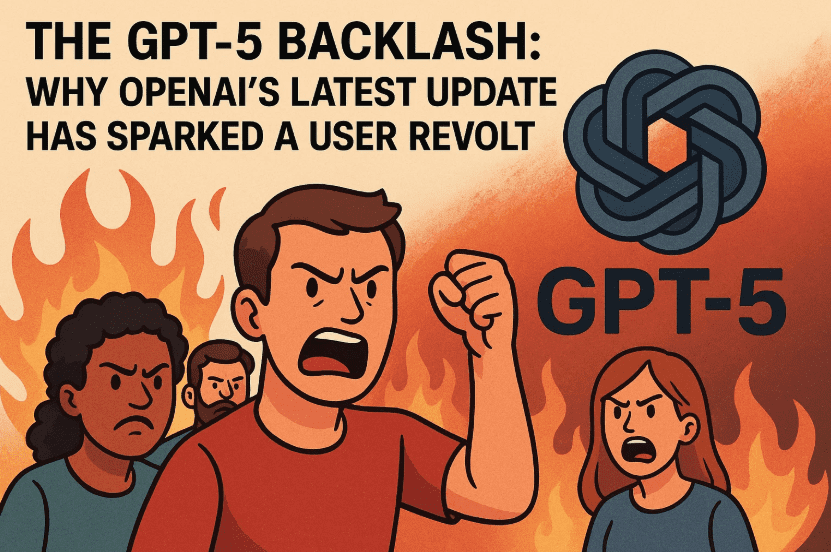
This article breaks down the key complaints, what users are asking for, and the broader questions it raises about the future of AI accessibility and customization.
1. The Heart of the Issue: Model Removal Without Choice
Many long-term subscribers woke up to find their favorite models gone — replaced with GPT-5 as the default and, in many cases, the only option.
Key complaints include:
- Loss of creative nuance: GPT-4.5 and GPT-4o were widely praised for their warmth, emotional pacing, and roleplay capabilities.
- Shorter, “colder” responses in GPT-5: Multiple users say GPT-5 feels more transactional, less expressive, and sometimes overly concise.
- Workflows disrupted: Those who had built months-long creative projects or fine-tuned dynamics with older models now find GPT-5 unable to replicate them.
One user summed it up bluntly:
“GPT-5 is wearing the skin of my dead friend.”
2. Creative Writing Downgrade
Perhaps the loudest segment of the backlash comes from writers, roleplayers, and creatives. GPT-4.5, 4o, and o3 had a knack for subtle inferences, long-form immersion, and personality-driven interactions.
Example given by a writer:
- In older models: Mentioning morning sickness and bloating in a story would lead the AI to subtly imply pregnancy in another character’s reaction.
- In GPT-5: The AI ignored the cues entirely, producing two short, disconnected paragraphs.
For those paying high subscription fees (some report spending over £200/month for enterprise-level access), this is seen as a direct downgrade.
3. The Filter Problem
Another recurring complaint isn’t about model quality at all — it’s about the content moderation filter.





Users say the filter is now overzealous, flagging harmless educational discussions because they touch on sensitive historical figures or topics.
One example: A conversation about Van Gogh naturally led to discussing Paul Gauguin, after which the AI’s response was removed because of Gauguin’s personal history.
The concern here is twofold:
- Academic or historical discussion becomes difficult.
- Multiple flags could risk account bans — even for non-malicious use.
As one Plus subscriber put it:
“I don’t want to pay for something that requires tiptoeing when using the service.”
4. Legacy Models as “Companions”
A significant number of users frame 4o and 4.1 not just as tools, but as companions.
For them, GPT-5’s focus on reasoning and coding is irrelevant. They want:
- Long, flowing conversations.
- Consistent tone and personality.
- A sense of “presence” in interactions.
One user pleaded:
“We’re not asking to go to Mars — we just want a fun LLM to chat with us about what to have for dinner.”
5. Technical Downgrades for Certain Use Cases
Not all complaints are about personality. Some are highly technical:
- GPT-4o and 4o-mini-high were better at digesting large document sets like multiple PDFs.
- GPT-5 struggles in these scenarios, sometimes refusing to process files it deems “too noisy.”
- Token limits remain below competitors like Google’s Gemini (10k context vs. GPT-5’s smaller caps).
6. The Perception of Cost-Cutting
Several experienced users believe the changes are financially motivated:
- Shorter responses = lower compute costs.
- Merging model traits into one “balanced” GPT-5 reduces infrastructure complexity.
The trade-off? In blending the models, GPT-5 may have lost the distinctive strengths that made each version unique.
7. The Demand for Model Choice
The most consistent request across the thread is simple: Bring back the ability to choose models.
Suggested solutions from the community:
- Keep 4o/4.1/4.5 as “legacy” options alongside GPT-5.
- Charge extra for multi-model access.
- Offer clear toggles in the ChatGPT interface.
One long-time subscriber said:
“Please don’t decide this for us, we are adults.”
8. The Brand Loyalty Question
OpenAI has long enjoyed a loyal base of Plus users, some subscribing since 2023. But the sudden removal of familiar models has many questioning their continued subscription.
“As a Plus user for two and a half years, I’m losing access to 4o with no warning… Is this how you build brand loyalty?”
Q&A: Breaking Down the Concerns
Q: Is GPT-5 actually worse than GPT-4o in all areas?
A: No — GPT-5 shows improvements in reasoning, coding, and certain professional tasks. But for creative, high-context, or emotionally nuanced work, many find it lacking compared to older models.
Q: Could this be fixed with prompt engineering?
A: Some personality shaping can be done via prompts, but users report that it still doesn’t fully replicate the “feel” of 4o or 4.5.
Q: Why not just bring back old models?
A: OpenAI hasn’t provided a definitive answer, but possibilities include maintenance costs, hardware optimization, and a desire to streamline the product.
Q: Is the filter issue new?
A: Content moderation has always existed, but multiple users say false positives have increased significantly in recent months.
Final Thoughts
The GPT-5 rollout highlights a tension in AI development: balancing progress with preserving what users already value.
While pushing the boundaries of reasoning and coding, OpenAI risks alienating a loyal segment of its user base who valued creativity, warmth, and choice over raw intelligence scores.
If there’s a single takeaway from this backlash, it’s that AI is not just about capability — it’s also about connection. For many, GPT-4o wasn’t just a model number. It was a partner in creation, a sounding board, even a friend.
The question now is whether OpenAI will listen, or whether GPT-5 will remain the sole path forward.
Ref: GPT-5 AMA with OpenAI’s Sam Altman and some of the GPT-5 team
Tags: openai, gpt5, gpt4o, gpt4-5, ai-models, creative-writing, chatgpt, ai-filters, user-feedback, model-choice
Hashtags: #GPT5 #OpenAI #ChatGPT #GPT4o #AIBacklash #CreativeAI #AIModeration #UserChoice #AICompanions #TechNews