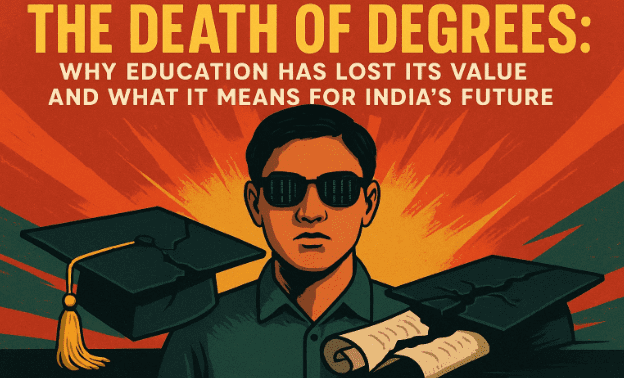
It was supposed to be a proud day. After four long years of hard work, a young engineer finally holds his B.Tech degree. His father calls, voice brimming with excitement — “Now your job is secure, son!” But months go by, and the excitement fades into silence. Dozens of job applications go unanswered. The degree that once symbolized a golden ticket to success now hangs quietly on a wall — a framed reminder of an outdated promise.
This is not just his story. It’s the story of millions of Indian graduates today — armed with degrees but not with employability. Despite spending years and lakhs of rupees on education, they discover that the value of their degree has collapsed. The phenomenon is now being called “The Death of Degrees”, a phrase capturing how traditional higher education has lost its relevance in a rapidly changing job market.
Let’s unpack how we got here, why employers no longer care about degrees, and what the future of education and employability might look like.
1. The Harsh Reality: Degrees Without Jobs
India’s unemployment crisis among graduates has reached historic levels. According to the latest India Skills Report 2025 by Wheebox, only 54% of graduates are employable, and that’s just by basic standards — not high-quality employment. The remaining 46% are considered unemployable, meaning they lack the skills to perform even entry-level roles.
What’s even more concerning is that this problem cuts across disciplines. Whether you hold a B.Tech, B.A., B.Sc., or B.Com, the pattern remains the same — degrees are no longer a guarantee of jobs, knowledge, or even respect.
Employers today don’t care where you studied or what degree you hold. Instead, they ask:
“Can you solve this problem? Do you have this skill?”
If the answer is yes, they’ll hire you — even if you never went to college. If the answer is no, your degree won’t save you.
2. Why Employers No Longer Trust Degrees
So far, we’ve done a good job identifying the symptoms — now let’s move to the causes.
Employers have lost faith in academic degrees because colleges no longer produce skilled graduates. In many cases, private institutions have become factories — selling certificates instead of teaching competence. The syllabus remains outdated, the exams are shallow, and the learning process lacks rigor.
Consider this: Many students graduating with a Bachelor of Computer Applications (BCA) cannot write a basic C++ program. The problem isn’t their intelligence; it’s the ecosystem. The education system that was supposed to build competence now merely sells credentials.








This leads to a fundamental shift: the employer’s trust has moved from degrees to skills.
Today, hiring managers prefer applicants with verified certifications from Google, Microsoft, or Coursera over a traditional degree. Why? Because skill certifications test what you can do, not just what you can remember.
3. The Rise of Skill-Based Hiring
The corporate hiring landscape has changed dramatically. Recruiters now use skill-based screening instead of degree-based shortlisting.
According to Coursera’s Global Skills Report, 99% of Indian employers now prioritize skill-based hiring over traditional qualifications. That means whether you’re a 12th pass student or a Ph.D., what matters is whether you can demonstrate the skills listed for the job.
Let’s move to the next step and understand what kind of skills are replacing degrees:
- Technical Skills: Coding, data analysis, digital marketing, UI/UX design, and cloud computing.
- Soft Skills: Communication, adaptability, leadership, and problem-solving.
- Digital Literacy: Basic AI tools, automation workflows, and data interpretation.
Short-term certification courses — often lasting 3 to 6 months — now offer more employability than a 3-year degree. That’s the new market reality.
4. The Economic Law Behind the Collapse
It’s not just about education quality — there’s also an economic rule at play here.
When supply exceeds demand, value drops. That’s exactly what has happened to degrees.
Over the past two decades, India witnessed an explosion of low-quality private colleges, especially in engineering and management. Many of them lacked infrastructure, qualified faculty, or practical training. As a result, degrees became mass-produced commodities — easy to get, hard to justify.
In earlier generations, earning a degree required years of rigor, mentorship, and evaluation. It symbolized both intelligence and perseverance. Today, some institutions allow students to pass without attending classes or writing serious exams. The result? The social trust that once surrounded degrees has evaporated.
5. The Collapse of Examination Integrity
So far, we’ve explored supply and skills, but let’s not forget another major factor: the decline of examination standards.
Across universities, the traditional “exam rigor” — which once validated a student’s capability — has eroded. Internal exams are often poorly monitored, online tests are easily manipulated, and attendance rules are ignored.
This erosion of credibility means that even when someone earns a degree, society no longer trusts what that degree represents. A graduate from a low-tier private university might carry the same title as one from an IIT — but not the same respect or competence.
When evaluation loses integrity, education loses meaning.
6. The Commodification of Education
Let’s move to the bigger philosophical issue: education as a business.
Over the years, universities began treating degrees like products — with students as customers. Instead of measuring learning outcomes, they focused on enrollment targets, marketing budgets, and infrastructure photoshoots.
The concept of “credits” — once an academic metric — turned into a financial one. Students could simply pay for more credits, enroll, and move on. It became a transaction, not a transformation.
This commodification directly eroded the moral and social foundation of education. The degree that once symbolized personal growth and intellectual maturity became a receipt — proof of payment, not learning.
7. Historical Context: What a Degree Used to Mean
In ancient and early modern education systems — from Nalanda and Takshashila to Oxford and Cambridge — a degree wasn’t just a certificate. It was a ritual of validation.
Students studied under mentors, demonstrated mastery, and were certified by a trusted community. A degree meant that society, the state, and educators had collectively endorsed your wisdom and ethical standing.
The modern system stripped away that sacred trust. Degrees are now printed, not earned. The ceremony remains, but the sanctity has vanished.
8. The Decline of Intellectual Depth
Another troubling trend is how knowledge has been replaced by “skill.” While skills are essential, they are not substitutes for wisdom.
Earlier, a degree represented the ability to think critically, analyze complex issues, and adapt to change. Now, most degree programs focus narrowly on employable tasks — not holistic understanding.
When we train students only to perform, not to think, we create workers, not innovators. And that is perhaps the greatest tragedy of all.
9. The MBA, B.Ed, and the Hollow Degrees Problem
Let’s take a few examples. The B.Ed degree, once respected as a rigorous teacher training program, is now plagued with fake colleges offering certificates without proper coursework.
Similarly, MBA programs have become oversaturated. With more than 3,000 management colleges in India, many graduates end up unemployed or working in low-paying jobs far outside their field.
Even MBBS, one of the most respected degrees, faces similar issues — with some private medical colleges charging ₹1 crore in fees while providing substandard training. The more expensive the degree, the less credible it often becomes.
10. The Psychological Cost of the Degree Myth
Let’s pause for a moment. Imagine being a young student who was told since childhood: “Study hard, get a degree, and your life will be secure.”
Then, after spending four or five years studying and your family’s life savings, you realize that the degree doesn’t even get you an interview. The emotional toll of this disillusionment is devastating.
This isn’t just an employment issue — it’s a generational identity crisis. The degree system built dreams it can no longer fulfill.
11. What Can Be Done: The Future of Learning
So far, we’ve explored what’s broken. Now let’s see how we can fix it.
- Integrate Skills with Degrees: Universities must collaborate with industry partners like Google, IBM, or AWS to embed skill certifications within traditional courses.
- Restore Exam Integrity: Strict monitoring, standardized evaluation, and external audits should return credibility to the examination process.
- Focus on Practical Training: Replace rote memorization with internships, projects, and real-world applications.
- Encourage Lifelong Learning: Instead of one big degree, promote continuous education through micro-certifications and modular courses.
- Rebuild Trust: Colleges must stop functioning as marketplaces and reclaim their purpose — nurturing intellect, ethics, and curiosity.
12. Frequently Asked Questions
Q: Are all degrees useless now?
A: Not entirely. Degrees from reputed institutions with strong academic integrity still hold value. The problem lies in quantity over quality.
Q: Should I skip college altogether?
A: No. College can still provide structure, mentorship, and social learning. But complement it with skill certifications and real-world exposure.
Q: What skills matter most today?
A: Technical skills (coding, data analysis), digital literacy, communication, and adaptability are highly in demand.
Q: Is online learning replacing universities?
A: It’s not replacing them but redefining them. The future likely involves hybrid education — where degrees and skills coexist.
13. Final Thoughts
The death of degrees isn’t just an academic issue — it’s a societal one.
A century ago, a degree symbolized trust, discipline, and capability. Today, it often represents bureaucracy, debt, and disappointment. Unless education reforms itself — reconnecting learning with life, theory with practice, and knowledge with ethics — the degree will remain nothing more than a decorative paper on a wall.
The future belongs to the skilled, the curious, and the lifelong learners — not merely the certified.
Disclaimer:
The insights shared in this article are based on current reports, surveys, and education trends observed in India as of 2025. Figures may vary based on updated data from government and private sources.
#EducationCrisis #DeathOfDegrees #SkillBasedHiring #IndiaUnemployment #HigherEducation #Employability #OnlineLearning #FutureOfWork #AIandEducation #SkillRevolution