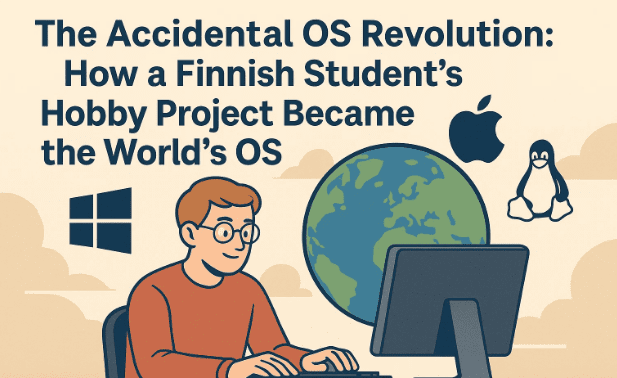
In the final years of the 20th century, amid the dot-com frenzy and millennial hype, a quiet revolution was underway. While headlines were dominated by IPOs and the promise of a new digital economy, a different kind of power was being built—not in a corporate boardroom, but in a Helsinki bedroom. This new force was an operating system born from curiosity, collaboration, and a belief that software should be free. Its name was Linux.
Seemingly overnight, this renegade software leapt from an idea shared by one student to a global phenomenon, infiltrating corporate strongholds and attracting millions of devoted users. By the dawn of the 21st century, it wasn’t just an underdog technology; it was the vanguard of a new, collaborative model that would forever change how technology is built.
To understand this incredible story, we have to go back to the beginning, to the ideals that made it possible and the accidental hero who started it all.
The Seed is Planted: Richard Stallman and the GNU Project
Our story doesn’t start in Finland, but in the hallowed halls of MIT’s artificial intelligence laboratory in the early 1980s. The atmosphere was one of academic freedom and shared knowledge, a true “hacker culture” in the original sense of the word—a community of tinkerers who believed in improving and understanding systems.
Here, we meet a young programmer named Richard Stallman. One day, he faced a frustratingly common problem: a brand new laser printer had jammed. For Stallman, the solution was usually simple—he’d tweak the printer’s software code to send a notification when it jammed, a fix he’d implemented on older models. But this time was different. When he went looking for the source code to make this change, he found it was locked away. The code was proprietary, a corporate secret.
He asked a researcher who had access for a copy and was met with a polite but firm refusal. The code was under a non-disclosure agreement. This moment was a profound shock to Stallman. The culture of openness and communal problem-solving he cherished was being eroded by proprietary software. He resolved to never feel so helpless again.
In 1983, he announced a bold plan on an internet newsgroup: he would create a complete, Unix-compatible operating system and give it away for free to everyone. He called it GNU, a recursive acronym for “GNU’s Not Unix,” blending hacker humor with a defiant message.
“Starting this Thanksgiving, I am going to write a complete Unix-compatible software system called GNU and give it away free to everyone who can use it.”
By the late 1980s, the GNU project had built most of a complete operating system—incredible tools like the GCC compiler and the Emacs text editor. But one critical piece was missing: the kernel (the core part of the OS that talks directly to the hardware). Stallman’s team had started work on a kernel called GNU Hurd, but progress was painfully slow.
The dream of a fully free operating system was tantalizingly close, yet incomplete. Little did anyone know, the missing piece would soon arrive from an unexpected source—not from MIT or any tech powerhouse, but from a modest university student hacking away in a far-off corner of the world.
The Missing Piece: Linus Torvalds and His “Hobby” Kernel
Helsinki, Finland, Summer 1991. A 21-year-old computer science student named Linus Torvalds sits hunched over his PC in a small apartment. He is shy, curious, and utterly absorbed in a personal project. He’s trying to write his own operating system kernel. Just for fun.


What led him here was a mix of curiosity and constraint. Linus was enamored with the Unix operating system but frustrated by the limitations of Minix, a small Unix-like system created by professor Andrew Tanenbaum for educational purposes. Minix was great for learning, but its creator was intentionally keeping it minimalist and wasn’t keen on outside improvements.
Eager to explore the full power of his new Intel 386 chip and build something he could truly call his own, Linus did what any restless hacker would do: he started coding.
Through the warm weeks of 1991, Linus worked in isolation, writing the core code to control the CPU, memory, and disks. He had no grand plan for world domination. He wasn’t thinking about fulfilling Stallman’s dream. In his own words, it was a personal challenge, a “geeky adventure” to learn about the 386 processor.
By late August, his kernel was starting to work. It could run some basic programs from the GNU project. It was primitive, but it was functional. At this point, many hackers might have kept tinkering in private. Instead, Linus made a decision that would alter the course of software history: he reached out to the world.
The Post That Started It All
On August 25, 1991, users of the Usenet group comp.os.minix saw a new post with a humble subject line: “What would you like to see most in minix?”
The message inside was unassuming and self-deprecating:
“Hello everybody out there using minix – I’m doing a (free) operating system (just a hobby, won’t be big and professional like gnu) for 386(486) AT clones… I’d like any feedback on things people like/dislike in minix, as my OS resembles it somewhat… I won’t promise I’ll implement them 🙂 “
He signed off simply. In a postscript, he almost casually mentioned the kernel’s technical specs. It was an honest disclaimer of the project’s humble scope. In short, Linus was saying, “I’ve made this thing. It works kind of. I plan to release it for free, but don’t expect too much.”
True to his word, he released version 0.01 in mid-September 1991, uploading the source code to an FTP server. The name itself was an accident. Linus had whimsically called it “Freax,” but the FTP server admin, Ari Lemmke, thought the name was silly and labeled the directory pub/os/linux instead, combining “Linus” with “Unix.” The name stuck.
With that quiet release, he opened the door for a world of co-developers. The threshold was crossed. There was no going back.
The Power of the Bazaar: Building a World-Wide Community
What happened next was unprecedented. Throughout late 1991 and 1992, Linux evolved at a breakneck pace. Contributions started as a trickle, then became a flood: bug fixes, device drivers, patches to add new features.
The process was organic and chaotic. Linus issued updates frequently, often several in a single week, incorporating patches from anyone that made sense. This style of development was later dubbed “Release Early, Release Often,” and it became a cornerstone of the open-source philosophy. Linus proved to be a pragmatic and easygoing leader, trusting contributors and fostering a meritocracy where the best code won.
This organic growth needed a philosophy, and it found one in hacker Eric S. Raymond’s seminal 1997 essay, “The Cathedral and the Bazaar.” He contrasted the traditional, top-down “Cathedral” model of software development (used by most corporations) with Linux’s open, peer-to-peer “Bazaar” model. He famously coined Linus’s Law: “Given enough eyeballs, all bugs are shallow.”
But this rapid growth wasn’t without conflict. In January 1992, a fiery debate erupted between Linus and his inspiration, Professor Andrew Tanenbaum. Tanenbaum criticized Linux for its “monolithic” kernel design, calling it “a giant step back into the 1970s.” Linus, fiercely protective, shot back. This very public debate, while technical, drew even more attention to the fledgling project.
The Crucial Licensing Decision
Perhaps Linus’s most pivotal decision was a legal one. Realizing his initial restrictive license was holding back collaboration, he switched Linux to the GNU General Public License (GPL) crafted by Richard Stallman.
This was a masterstroke. The GPL ensured that Linux would always remain free (in the sense of freedom, not just price). More crucially, it made the kernel legally compatible with the vast library of tools from the GNU project. The body of GNU finally had its heart. The combination—GNU tools + Linux kernel—created a complete, fully free operating system: GNU/Linux.
This synergy is why, to this day, proponents like Stallman argue the system should be called GNU/Linux. It was the perfect marriage of idealism (Stallman’s vision for free software) and pragmatism (Linus’s working kernel).
Challenges, Wars, and Corporate Adoption
With the kernel stabilized, the community faced a new challenge: making it usable for everyday people. This sparked the “Desktop Wars,” a period of intense rivalry that ultimately drove incredible innovation.
- KDE: One group created the K Desktop Environment (KDE), a powerful and polished graphical interface. However, it was built on a toolkit called Qt, which initially had a license that wasn’t considered fully “free” by Stallman and the Free Software Foundation.
- GNOME: In response, the GNU project initiated GNOME (GNU Network Object Model Environment). It was built from the ground up with a purely free software stack, reflecting Stallman’s uncompromising ideals.
This competition between the pragmatic KDE and the idealistic GNOME pushed both projects to become better, faster, and more user-friendly.
The Corporate World Takes Notice
As the 1990s closed, the Bazaar was about to become big business. A company called Red Hat had begun packaging Linux with all the necessary software into an easy-to-install “distribution.” Their genius was in their business model: they gave the software away for free and sold support, service, and certification.
In 1999, Red Hat’s IPO was a massive success on Wall Street. The hobby project had officially hit the big time. The ultimate validation came in 2000 when IBM, a titan of the old computing world, announced it would invest $1 billion in Linux development. This move signaled to corporations everywhere that Linux was ready for serious, mission-critical work.
The Backlash: “Linux is a Cancer”
This success awakened a giant. Microsoft, the undisputed king of proprietary software, saw this free operating system as a direct threat. CEO Steve Ballmer famously called Linux “a cancer that attaches itself in an intellectual property sense to everything it touches.”
Microsoft launched a campaign of FUD (Fear, Uncertainty, and Doubt), publishing studies claiming its Windows operating system was cheaper and better. But the real threat was legal.
In 2003, a company called SCO Group sued IBM for $1 billion, claiming that proprietary Unix code it owned had been illegally copied into the Linux kernel. It was an existential threat. If SCO won, Linux could be mired in legal battles for years or be forced to pay crippling royalties.
The entire open-source community rallied. After years of brutal legal warfare, the courts largely sided with IBM and the Linux community. The project was safe. The attempt to kill Linux with a lawsuit had instead strengthened its resolve and validated its development model.
Modern Linux: The Invisible Backbone of the World
Having survived corporate attacks and legal battles, the Linux project needed to professionalize. In 2007, the Linux Foundation was formed. This non-profit took on the role of stewarding the project, hosting its infrastructure, and even employing Linus Torvalds and other key developers. The revolution had an organized voice.
Today, the Foundation’s members include the biggest names in technology: Google, Intel, Oracle, and—in a final stunning irony—Microsoft, the old enemy that had now fully joined the revolution.
While the “Year of the Linux Desktop” never quite arrived for the average consumer, Linux won in a much bigger way: it became the invisible backbone of the digital world.
- Servers & Cloud: It runs the servers for Google, Facebook, Amazon, and Netflix.
- Supercomputing: It powers nearly all of the world’s top 500 supercomputers.
- Finance: The New York Stock Exchange runs on Linux.
- Consumer Electronics: It’s in your smart TV, your router, and your car’s infotainment system.
- Mobile: Through Android, which uses the Linux kernel, it’s in the pockets of billions of people.
The revolution didn’t happen by overthrowing the king. It happened by building the foundation for a new world right under its feet.
Frequently Asked Questions (FAQ)
Q: Should I say “Linux” or “GNU/Linux”?
A: This is a nuanced debate. Technically, the complete operating system is a combination of the GNU project’s tools and the Linux kernel. Purists, including Richard Stallman, argue it should be called “GNU/Linux” to give credit to the GNU project’s foundational work. In common practice, however, most people simply say “Linux” to refer to the entire operating system. Both are correct, but they emphasize different parts of its history.
Q: What’s the difference between Open Source and Free Software?
A: These terms are often used interchangeably, but their focus is different.
- Free Software: Focuses on the philosophical and ethical ideals of freedom—the user’s freedom to run, study, change, and redistribute the software. It’s about “free as in freedom.”
- Open Source: Focuses on the practical benefits of the development model—that allowing everyone to see and modify the source code leads to better, more secure, and more efficient software.
In practice, nearly all Free Software is Open Source, and vice versa. The difference is largely in the messaging and values behind the terms.
Q: Why didn’t Linux become the main desktop OS?
A: While Linux dominates almost every other computing sector, its desktop share remains small (~2-3%). This is due to several factors: the historical dominance of Windows pre-installed on PCs, a lack of support for certain popular commercial applications and games, and, historically, a steeper learning curve for non-technical users. However, modern distributions like Ubuntu and Linux Mint have made it incredibly user-friendly.
Q: How does Linus Torvalds make money?
A: Linus has never made money directly from selling Linux. Instead, he has been supported since the late 1990s by companies that benefit from its development. Since 2007, his salary has been paid by the Linux Foundation, which is funded by its corporate members.
Conclusion: The Legacy of an Accidental Revolution
The story of Linux is a powerful testament to what can be achieved through collaboration, openness, and a shared passion for building something great. It proves that passionate individuals, sharing code across borders, can change the world—not by planning a revolution, but by accidentally starting one from a Helsinki dorm room.
It’s a story that continues to evolve, underpinning the technology of tomorrow and reminding us that sometimes, the most powerful ideas begin as simple hobbies.
Disclaimer: This article is a historical overview intended for informational purposes. The mention of software projects, companies, and individuals is based on documented historical events and is not an endorsement. Linux is a registered trademark of Linus Torvalds. The author is not affiliated with the Linux Foundation or any other entities mentioned.
Tags: Linux, Open Source, GNU, Richard Stallman, Linus Torvalds, Operating Systems, Tech History, Software Development, Free Software, Kernel, IBM, Microsoft, Red Hat, Ubuntu
Hashtags: #Linux #OpenSource #GNU #TechHistory #OperatingSystem #LinusTorvalds #RichardStallman #Programming #Software #Tech