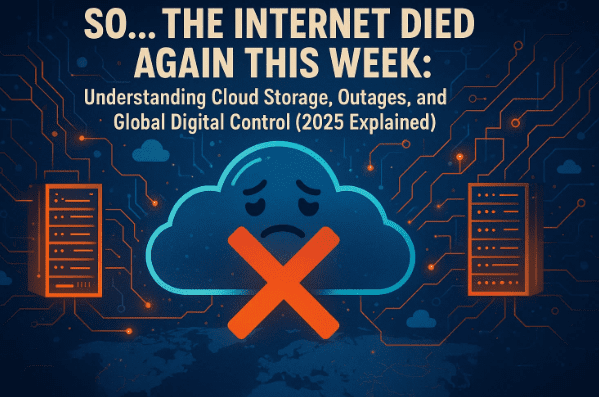
Have you ever unlocked your phone only to find that apps won’t load, bank transactions fail, or music just won’t stream—even though your internet connection is fine?
If that’s happened recently, you’re not alone. The internet “broke” again this week when a massive cloud outage disrupted thousands of websites and apps across the world. Platforms like Canva, Duolingo, Snapchat, Slack, WordPress, Roblox, Signal, and even some smart home devices suddenly went offline for hours.
But why can a single glitch take down so much of the internet?
To understand that, we first need to grasp how cloud storage and cloud computing actually work—and why almost everything you do online depends on them.
What Exactly Is Cloud Storage? ☁️
Let’s start simple.
Every photo you click, every document you save, every message you send—it all takes space. When your phone says “Storage Full”, your data is being saved only on your local device.
Cloud storage changes that. Instead of keeping everything on your device, your files are uploaded to a remote server—a specialized computer owned by a company like Google Drive, iCloud, or Dropbox. You can then access your data anytime, anywhere, as long as you’re connected to the internet.
In short:
Cloud storage = renting space on someone else’s computer that’s always online.
It solves the “storage full” problem for individuals. You get a few gigabytes for free, and beyond that, you can buy more space through monthly or yearly plans.
But individuals aren’t the only ones who need storage. Let’s move to the next level.










How Cloud Storage Actually Works Behind the Scenes 🏢
When we say “the cloud,” what we really mean is data centers—massive facilities filled with thousands of servers (powerful computers) running 24×7.
Each data center has:
- Racks of servers storing and processing data
- Backup power supplies (to survive outages)
- Cooling systems
- Security protocols
- Fiber optic connections linking them to other centers around the world
When you upload a photo to Google Drive, it isn’t stored in one place. It’s usually duplicated across multiple data centers for safety. If one center fails, your data can still be accessed from another.
That’s the magic of cloud redundancy—but it also means if the main system controlling these centers fails, millions of users are instantly affected.
Why Businesses Rent Cloud Infrastructure 💼
Now imagine you’re a company trying to run a website or an app. You need storage, servers, and computing power. Building and maintaining your own data center can cost millions—hardware, electricity, cooling, maintenance, and staff.
Instead, businesses rent computing power and storage from big providers like Amazon Web Services (AWS), Microsoft Azure, or Google Cloud.
This model is called Cloud Computing — paying for resources “as a service” rather than owning them.
You can think of it like electricity: instead of building your own power plant, you just pay for what you use.
This “on-demand” nature makes it perfect for startups, e-commerce websites, AI companies, and even governments.
The Big Three: AWS, Google Cloud, and Microsoft Azure 🌍
Today, the global internet runs largely on three American giants:
| Provider | Parent Company | Market Share (2025 est.) | Key Services |
|---|---|---|---|
| Amazon Web Services (AWS) | Amazon | ~32% | Cloud storage, servers, databases, AI services |
| Microsoft Azure | Microsoft | ~23% | Enterprise cloud, hybrid infrastructure, Office integration |
| Google Cloud Platform (GCP) | Google (Alphabet) | ~11% | Storage, ML tools, BigQuery, Kubernetes |
Together, these three companies control over 60% of global online infrastructure.
From entertainment apps to financial platforms, thousands of services rely on them daily. That also means: if one of them faces downtime, a huge portion of the web collapses simultaneously.
When the Internet Died: The AWS Outage Explained ⚠️
Let’s recall what happened.
An AWS (Amazon Web Services) data center in the U.S. suffered a major technical glitch—possibly due to a configuration error or internal power failure.
Within minutes, countless platforms went down:
- Canva, Duolingo, Snapchat, Slack, Roblox, Fortnite, Venmo, and even WordPress
- Streaming services, payment systems, and even some smart home devices stopped working
For several hours, users couldn’t access their accounts, creators couldn’t upload, and some online businesses lost thousands of dollars per minute.
All this because of one outage in one company’s data center.
That shows just how dependent our digital lives have become on a handful of corporations.
Why These Outages Happen 🧩
So how can something so advanced just fail?
Let’s understand the reasons behind these disruptions.
- Software or Configuration Errors:
Cloud systems are incredibly complex. A single wrong update or network configuration can cause cascading failures. - Hardware or Power Failures:
Even with backups, physical components like routers and servers can fail or overheat. - Network Congestion or Routing Problems:
If data can’t properly route between centers, services get stuck or slow down. - Cyberattacks or DDoS Events:
Hackers can overload servers intentionally, making systems unreachable. - Human Error:
Ironically, many cloud outages are caused by a simple command mistyped by an engineer.
Let’s move forward to see why, despite these risks, cloud computing is still the backbone of the modern web.
The Hidden Benefits of Cloud Infrastructure 🌐
It’s easy to focus only on the risks, but cloud technology has brought enormous benefits too.
Let’s explore three of the most important ones:
1. Redundancy
If one data center goes down, your data automatically shifts to another. This is why most apps recover quickly even after large outages.
2. Auto-Scaling
Imagine millions of users suddenly logging into an app (like during a flash sale or live stream). The cloud automatically allocates more computing power so the app doesn’t crash.
3. Global Compliance
Many countries require that citizens’ data stay within national borders. Since AWS, Google Cloud, and Azure have data centers worldwide, they can store data locally and still provide global access.
These features make cloud systems flexible, scalable, and legally compliant—one reason even governments now use them for national projects.
The Risks of Relying on Big Tech Cloud 🧠
Now that we’ve seen the strengths, it’s time to talk about the elephant in the room: centralization.
When three companies (all based in the United States) control most of the internet’s infrastructure, it creates a kind of digital monopoly.
Here are some key concerns:
- Single Point of Failure: One outage can impact thousands of platforms worldwide.
- Data Sovereignty: Countries depend on foreign companies to store their citizens’ data.
- Policy Control: If a government (like the U.S.) imposes sanctions or restrictions, it could theoretically limit access for certain regions.
- Cost Dependence: As cloud pricing increases, smaller startups and businesses suffer first.
That brings us to a critical question: what if these companies—Amazon, Google, or Microsoft—decided (or were forced) to restrict cloud access for a country?
Digital Power and Global Politics 🌍
In recent years, technology has become as powerful as oil or weapons once were.
During the Trump administration, U.S. officials openly discussed using American tech dominance as a strategic weapon—through tariffs, export bans, or data restrictions.
This raised alarms worldwide. If the U.S. can control global data flow, it could theoretically “turn off” parts of the internet for political reasons.
That’s why regions like the European Union, India, and China are investing in their own sovereign digital infrastructure—cloud systems that are locally owned and governed.
India, for example, has been encouraging companies to use “Make in India” cloud providers and is planning frameworks for national data centers to reduce foreign dependency.
But building such infrastructure is not easy. It requires:
- Billions in investment
- Technical expertise
- Long-term maintenance
- And international coordination
Experts say what we truly need is a global cooperative framework—where cloud governance becomes transparent and shared, not monopolized.
Should Countries Build Their Own Internet? 🌏
So, what’s the right answer? Should every nation build its own internet?
This is where opinions differ. Let’s look at both sides.
✅ The Case for National Clouds
- Data Security: Keeps citizen data under local jurisdiction.
- Reduced Dependency: Prevents foreign influence or service lockouts.
- Economic Boost: Encourages local tech industries and jobs.
❌ The Case Against It
- High Cost: Data centers are expensive to build and maintain.
- Fragmentation: Could lead to isolated networks (like China’s Great Firewall).
- Loss of Collaboration: The open, global nature of the web could weaken.
So perhaps the right approach lies in balance — shared global standards but stronger regional control over data governance.
FAQs ❓
Q1. What’s the difference between cloud storage and cloud computing?
- Cloud storage saves your files and photos online (e.g., Google Drive, iCloud).
- Cloud computing provides online processing power, letting apps or websites run without owning servers (e.g., AWS, Azure).
Q2. Is my data safe in the cloud?
Generally, yes—top providers encrypt your data and offer redundancy. But no system is 100% fail-proof, so always keep local backups.
Q3. Can AWS or Google access my personal files?
No, not directly. Your files are stored in encrypted form. However, under certain legal orders (like government warrants), data can be accessed through proper channels.
Q4. What happens if a data center is destroyed?
Cloud redundancy ensures your data is replicated in multiple locations. You might experience downtime, but not data loss.
Q5. Can India or other countries make their own cloud systems?
Yes, and many are trying. India’s “MeghRaj” and Europe’s “Gaia-X” are examples. But scaling them to match AWS or Google Cloud will take years of investment.
Disclaimer ⚠️
This article aims to educate readers about cloud storage, computing, and digital infrastructure. All examples and opinions are for informational purposes only. The names of companies like Amazon, Google, and Microsoft are used to explain industry trends, not to endorse or criticize. Data about outages and market share is based on publicly available 2024–2025 estimates. Always verify from official sites before relying on any cloud platform for business or critical operations.
#CloudComputing #AWS #GoogleCloud #Azure #TechExplained #InternetOutage #DataCenters #DigitalInfrastructure #IndiaTech #GlobalInternet