Razer’s latest Blade 16 is here, and it brings significant refinements over its predecessor—thinner chassis, AMD’s powerful Zen 5 processor, and NVIDIA’s new RTX 5090 GPU. But does it justify its premium price tag? Let’s dive into the details.
Design & Build Quality
Razer continues its tradition of premium craftsmanship with the Blade 16’s CNC-machined aluminum chassis and anodized matte black finish. The laptop feels solid, rivaling even Apple’s MacBook in build quality.
Key Improvements:
- 30% thinner than last year’s model (14.9mm vs. 21.9mm at the thinnest point).
- Lighter weight at 4.6 lbs (2.1 kg), down from 5.3 lbs (2.4 kg).
- Sturdy hinges that allow smooth opening and a 135-degree screen tilt.
- Reduced lid flex, though slightly more than last year due to weight savings.
Display: Stunning OLED with High Refresh Rate
The 16-inch QHD+ (2560×1600) OLED panel remains a highlight:
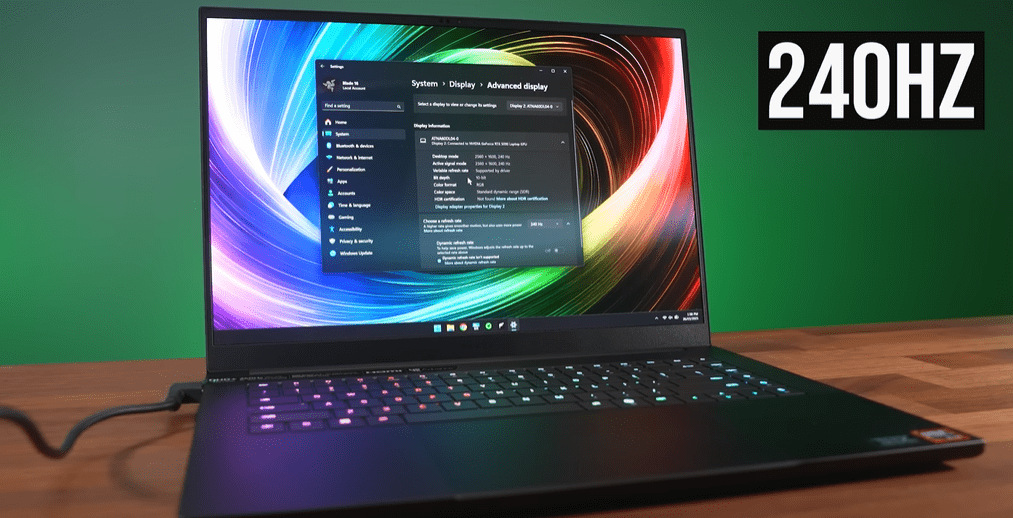
- 240Hz refresh rate for ultra-smooth gameplay.
- Excellent color accuracy (factory-calibrated, 100% DCI-P3 coverage).
- True blacks & vibrant colors thanks to OLED technology.
- Brightness peaks at ~400 nits (slightly higher in HDR).
OLED Trade-offs:
- Glossy finish can be reflective in bright environments.
- PWM dimming may bother sensitive users.
- Potential burn-in risk (though rare in modern OLED laptops).
Performance: RTX 5090 & AMD Zen 5
The Blade 16 we tested packs:
- AMD Ryzen AI 9 HX 370 (12-core Zen 5)
- NVIDIA RTX 5090 Laptop GPU
- 32GB LPDDR5X-8000 (soldered)
- 2TB PCIe Gen 4 SSD (expandable via second M.2 slot)
Gaming Performance:
- 4K gaming sees a ~13% boost over last year’s RTX 4090 Blade 16.
- 1440p & 1080p gains are smaller, likely due to CPU bottlenecks.
- DLSS 4 helps push frames further, but raw performance uplift is modest.
Thermals & Noise:
- Vapor chamber cooling keeps temps under 80°C under full load.
- Fan noise is manageable in Balanced mode but gets loud at max RPM.
- Keyboard stays cool, with warm spots only near the center.
Keyboard & Trackpad Upgrades
- New 1.5mm key travel (50% deeper than before) for a more tactile feel.
- Per-key RGB lighting with dual-layer illumination for secondary functions.
- Larger glass touchpad, though palm rejection could be better.
Ports & Connectivity
- 2x USB 4 (Type-C) (100W charging, DisplayPort 1.4)
- 2x USB 3.2 Gen 2 (Type-A)
- HDMI 2.1 (connects directly to NVIDIA GPU)
- UHS-II SD card reader
- Wi-Fi 7 & Bluetooth 5.4
Battery Life & Efficiency
- 90Wh battery (smaller than last year’s 95Wh) but 22% longer runtime due to efficiency gains.
- Battery Saver Mode limits charge to 50-80% for longevity.
- AMD’s power efficiency helps in lighter workloads.
Pricing & Verdict
The Blade 16 starts at $3,000 for an RTX 5070 Ti model, scaling up to $4,500 for our RTX 5090 review unit.
Is It Worth It?
✅ Thinner, lighter, and better-built than ever.
✅ Excellent OLED display & improved keyboard.
✅ Good thermals despite the slim design.
❌ RTX 5090 performance gains are modest.
❌ Soldered RAM limits upgradability.
❌ Very expensive compared to competitors.
Final Thoughts:
If you want one of the most premium Windows gaming laptops with top-tier specs, the Blade 16 (2025) delivers. However, if raw performance per dollar is your priority, alternatives like the ASUS Zephyrus G16 may offer better value.
Tags:
#RazerBlade16 #RTX5090 #GamingLaptop #AMDRyzen #OLEDGaming #ThinAndLight #LaptopReview #TechReview
For more details and current pricing, check out Razer’s official website.
Would you buy the new Blade 16, or are there better options? Let us know in the comments!