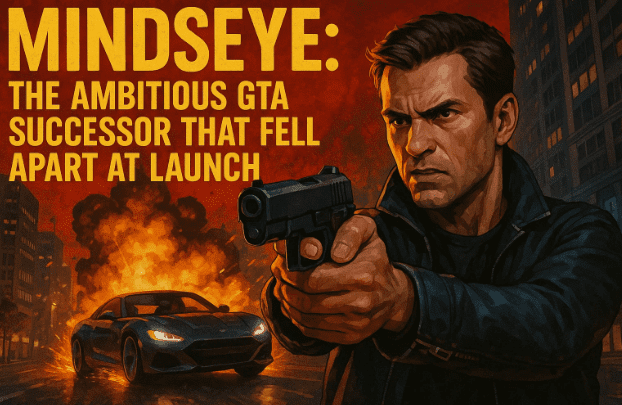
The gaming world loves a good redemption story. When news broke that Leslie Benzies—the legendary producer behind Grand Theft Auto V, San Andreas, and Red Dead Redemption—was creating a new open-world title called Mindseye, expectations went through the roof.
Fans imagined a spiritual successor to GTA 6 — a futuristic world full of freedom, storytelling, and cutting-edge visuals. But when the game finally launched, it turned out to be one of the biggest disappointments of recent years.
So, what exactly went wrong? How did a project with over $70 million in funding and a team of ex-Rockstar veterans stumble so hard?
Let’s break down the full story of Mindseye — from dream to disaster — and what lessons it teaches the entire gaming industry.
🎮 1. The Origins of Mindseye and the Dream of “Everywhere”
The story of Mindseye begins in 2016, when Leslie Benzies left Rockstar Games after an internal dispute and a $50 million lawsuit over unpaid royalties.
Rather than fading from the spotlight, Benzies formed his own studio — Build a Rocket Boy, headquartered in Edinburgh, Scotland — and hired several ex-Rockstar North veterans.
For years, the new studio worked in secret on an ambitious project called Everywhere — a metaverse-like creative platform that would combine user-generated content, online worlds, and storytelling. Inside that platform, a cinematic AAA-style narrative game would live. That inner game was Mindseye.
It sounded revolutionary — a game within a game, powered by Unreal Engine 5 and infused with Benzies’ GTA heritage.
👤 2. Who Is Leslie Benzies and Why His Name Matters
Leslie Benzies isn’t just another developer. He was the executive producer behind the most iconic entries of the Grand Theft Auto series — from GTA III through GTA V — helping shape them into cultural phenomena.
He was known for merging cinematic storytelling with open-world chaos — the very formula that made Rockstar Games a household name. When someone like Benzies announces a new project, it naturally attracts massive attention and trust.
So when the trailers for Everywhere and Mindseye appeared in 2023, gamers believed this could be the next step forward — a bold blend of world-building, freedom, and high-tech storytelling.
Unfortunately, what followed would prove that even legends can fall short.
🚀 3. The Grand Promise: “A Game Inside a Game”
In April 2023, Build a Rocket Boy unveiled the concept of Everywhere — a vast creative hub where users could make their own worlds, similar to Roblox but with cinematic realism.
Inside that digital space, Mindseye would exist as a narrative-driven single-player game — an action title featuring futuristic cities, corporate conspiracies, high-speed chases, and third-person shooting.







The protagonist, Adam, a soldier with a cybernetic arm and a mysterious past, would navigate a dystopian corporate empire filled with betrayal and advanced technology.
The marketing called it “the future of gaming” — a story so advanced that it blurred the line between the real and digital world.
Gamers expected a fusion of Cyberpunk 2077 and GTA 6, built with Unreal Engine 5 graphics and next-gen physics.
What they got instead… was a painfully broken experience.
💥 4. The Launch Day Disaster
The launch of Mindseye was meant to be historic. Instead, it became a textbook example of how not to release a game.
Within hours of release, players flooded Steam and Reddit with screenshots of missing textures, floating limbs, and disappearing characters.
Adam — the main protagonist — sometimes vanished entirely, leaving only his robotic arm suspended in mid-air.
The community joked it was “part of the lore.”
The game crashed randomly, corrupted saves, and melted high-end GPUs.
Even powerful RTX 4090 systems struggled to maintain 30 FPS in certain zones.
Reviewers described it as “Cyberpunk 2077’s launch — but worse.”
Let’s dig into each problem one by one.
⚙️ 5. Gameplay Breakdown: When Innovation Feels Outdated
One of the most disappointing aspects of Mindseye is its gameplay. Despite its futuristic setting and high budget, the mechanics feel frozen in 2010.
- Combat: The gunplay is stiff and unresponsive. Enemies absorb bullets like sponges, while your aim feels as if it’s on ice. Melee combat consists of pressing one button and watching Adam swing slowly like a construction crane.
- AI Behavior: Enemies often stand still, forget to attack, or get stuck staring at walls. The stealth system is practically useless — AI can spot you through solid objects.
- Driving Mechanics: Cars handle like butter-coated tanks. Collide with a lamppost and your vehicle explodes instantly. What should’ve been adrenaline-filled chases turn into slapstick physics chaos.
- Cover System: Taking cover doesn’t actually protect you — NPCs shoot through objects, or the animation bugs out entirely.
So far, so frustrating.
Let’s move on to what should’ve carried the game — its story.
📖 6. Story and Narrative: Ambition Without Direction
The plot of Mindseye wants to explore deep philosophical ideas — corporate control, human identity, and rebellion in a hyper-digital world.
But ambition alone isn’t enough.
The story follows Adam, a man with trust issues, a cybernetic arm, and zero charisma.
His mission involves infiltrating a mega-corporation and uncovering dark secrets — a premise that sounds like Deus Ex meets Cyberpunk.
Sadly, execution kills the excitement.
Dialogues are full of clichés (“You can’t trust anyone here,” “The system is watching us”).
Secondary characters appear, deliver a generic monologue, and vanish forever.
Half of the scenes feel disconnected, as if rewritten by different writers who never talked to each other.
Narrative pacing is another issue — long cutscenes interrupt short missions, and moral choices have no actual impact.
By the end, players feel detached from Adam and his world.
🐞 7. Technical Chaos: Bugs, Glitches, and Crashes
If there’s one thing everyone agrees on, it’s that Mindseye launched in a catastrophic technical state.
Some of the most infamous bugs include:
- The protagonist’s body disappearing, leaving a floating robotic arm.
- Cars clipping through buildings or driving underground.
- Sound effects looping endlessly.
- NPCs walking backward or spawning halfway inside walls.
- Game-breaking crashes during mission checkpoints.
Even after hotfixes, performance remained unstable.
Players began calling the game “Mindcrash” on forums, and refund requests skyrocketed within 48 hours.
Benzies’ team quickly announced an emergency patch, but the damage was already done.
In the modern gaming era, first impressions are everything — and Mindseye had just lost the trust of its community.
🌆 8. Graphics and Performance: Beauty on a Broken Canvas
Ironically, the game’s visuals are both its strength and weakness.
Built on Unreal Engine 5, Mindseye features breathtaking neon skylines, glowing reflections, and detailed character models.
But these visuals come at a heavy cost — poor optimization.
Even high-end PCs experience:
- Severe FPS drops in populated areas.
- Textures that load seconds late.
- Ray-tracing inconsistencies and shader glitches.
- Overheating GPUs.
In short, it looks great in trailers, but once you play it, the illusion fades.
It’s like “putting makeup on a corpse,” as one reviewer brutally summarized.
💬 9. Community Reaction and Refund Tsunami
The backlash was immediate.
Steam reviews labeled Mindseye as “Overwhelmingly Negative” within days.
Memes comparing it to Cyberpunk 2077, No Man’s Sky, and Anthem flooded Reddit and X.
Many players accused the developers of overhyping and underdelivering.
Others speculated that the game’s rushed release was meant to promote Everywhere, the metaverse platform that housed it.
A Reddit comment summed it up perfectly:
“Mindseye isn’t a game — it’s a $70 million tech demo that forgot to be fun.”
The studio has since promised multiple patches, but the trust gap will be hard to repair.
🧩 10. Lessons Learned from Mindseye’s Collapse
The fall of Mindseye isn’t just a sad story — it’s a valuable case study for the entire gaming industry.
1. A Big Name Can’t Guarantee Quality
Leslie Benzies was a creative powerhouse at Rockstar, but great games come from great teams — writers, designers, artists, and engineers working in sync. Outside that ecosystem, even a legend can stumble.
2. Hype Can Be Dangerous
Marketing that promises “revolutionary gameplay” raises expectations that are almost impossible to meet. If you fail to deliver, players turn on you instantly.
3. Never Ship a Broken Product
Gamers might forgive design flaws, but they won’t forgive instability. A game should work on day one.
4. Transparency Matters
Studios must communicate honestly about scope, technical limits, and realistic release timelines. “Silent optimism” destroys trust.
5. The Metaverse Dream Needs Focus
Everywhere tried to be a social platform, creative tool, and AAA game at once — a recipe for confusion. Sometimes less ambition means better execution.
❓ 11. Frequently Asked Questions (FAQ)
Q1. Is Mindseye connected to GTA or Rockstar Games?
No. Although Leslie Benzies was formerly a key producer at Rockstar, Mindseye is developed by his independent studio, Build a Rocket Boy, with no official ties to Rockstar or Take-Two Interactive.
Q2. Will Mindseye be fixed in future updates?
The developers have confirmed that major patches are on the way. While some bugs may be resolved, fundamental issues in design and gameplay may limit how much the experience can improve.
Q3. Is Mindseye part of the “Everywhere” platform?
Yes. Mindseye exists as a stand-alone narrative experience inside the larger metaverse-like platform Everywhere, which aims to let users create and explore digital worlds.
Q4. How much did Mindseye cost to develop?
Reports suggest that the budget exceeded $70 million, including marketing and metaverse infrastructure costs.
Q5. Is Mindseye worth buying right now?
Unless you want to experience a work in progress, it’s better to wait for patches. Currently, the game suffers from serious bugs and performance issues.
🧠 12. Final Thoughts
Mindseye isn’t the worst game ever made — but it’s a painful reminder that great ideas mean nothing without solid execution.
Leslie Benzies and his team tried to reinvent the wheel with a metaverse-powered AAA title, but they forgot to make sure the car could actually drive.
In time, patches might stabilize the experience, and maybe Mindseye will find its footing as a cult classic like No Man’s Sky.
But for now, it stands as a warning to every studio dreaming too big without testing enough.
If there’s one takeaway, it’s this:
Players don’t need revolutions — they need games that work.
Disclaimer
This article is for informational and educational purposes only. All game titles, logos, and names are the property of their respective owners. The analysis is based on publicly available information and player feedback as of October 2025.
#Mindseye #BuildARocketBoy #LeslieBenzies #EverywhereGame #GamingNews #GameDevelopment #GTA6 #Cyberpunk2077 #UnrealEngine5 #VideoGames #PCGaming #GameDesign