For years, Microsoft 365 has been one of those quiet essentials in almost every digital household — a dependable subscription that gives you Word, Excel, PowerPoint, and cloud storage in one neat package. But this year, that familiarity turned into frustration for millions of users in Australia, when a major price increase linked to Microsoft’s AI assistant, Copilot, suddenly arrived in their inboxes.
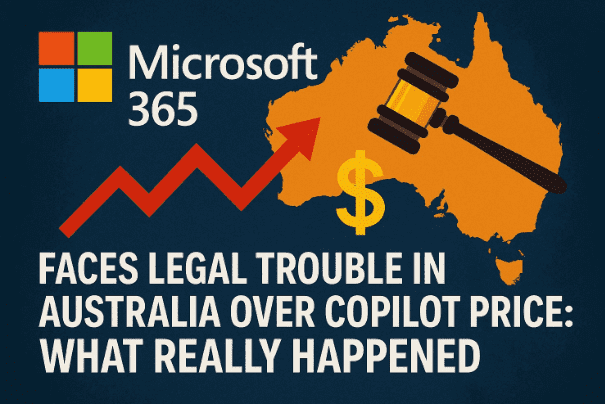
Now, it’s not just about price hikes anymore — it’s about trust. The Australian Competition and Consumer Commission (ACCC) has taken Microsoft to court, alleging that the company misled about 2.7 million customers. Let’s take a closer look at what went wrong, why it matters, and what lessons every digital consumer should take from this unfolding story.
The Rise of Copilot and the Sudden Price Shock
Microsoft’s Copilot was supposed to be the next evolution of productivity — an AI assistant that helps you write better, analyse faster, and save time across Word, Excel, and Outlook. It sounds futuristic, and honestly, it is. But innovation came with a price.
In late 2024, Microsoft rolled out Copilot into the personal and family versions of Microsoft 365 in Australia. Overnight, subscription prices went up — the Personal plan jumped from A$109 to A$159, while the Family plan rose from A$139 to A$179. That’s a sharp 45 percent and 29 percent increase, respectively.
At first glance, it seemed like a simple business move: you pay more, you get more. But users soon noticed that they weren’t really being given a choice.
Emails went out saying users needed to either accept the new Copilot-integrated plan or cancel their subscription. What wasn’t clearly mentioned? There was still a cheaper “Classic” plan available — the same features as before, minus Copilot, and at the old price.
The Hidden Option and the Legal Firestorm
According to the ACCC, Microsoft failed to properly disclose that lower-cost plan. In fact, many customers only discovered it when they clicked through to cancel — buried deep in the process, almost as an afterthought.
That’s what triggered the lawsuit. The ACCC argues that by hiding that alternative, Microsoft misled users into thinking they had no choice but to pay more or lose access entirely.
As ACCC Chair Gina Cass-Gottlieb explained, this wasn’t just about one software update — it was about fairness:
“We allege that Microsoft deliberately omitted reference to the Classic plans in order to drive uptake of the new Copilot-integrated plans. Millions of Australians may have suffered economic harm as a result.”
In essence, the regulator claims Microsoft designed a system that guided users — almost invisibly — toward paying more.









And since Microsoft 365 is such an essential service for students, families, and small businesses, cancelling outright wasn’t a realistic option for most. That’s what made this case so significant.
Why This Matters for Everyone Who Uses Subscriptions
Let’s pause here for a moment. Whether you use Microsoft 365, Netflix, or any other recurring subscription, this case shines a spotlight on a simple but important question:
Do you really have a choice — or are your choices being shaped for you?
Subscription models have quietly changed how companies make money. Once you’re inside the ecosystem, every renewal, every update, and every “new feature” can nudge you into higher-priced tiers. Often, the lower or older versions still exist — they’re just not front and centre.
That’s why regulators across the world, not just in Australia, are now watching these so-called “dark patterns” — subtle design tricks that push users toward certain actions. In this case, the alleged “dark pattern” was the hidden cheaper plan.
Microsoft’s Response: “We’re Reviewing the Claim”
Microsoft hasn’t denied the price increase — they’ve defended it as part of an evolving product line. But the company insists it acted transparently and that it’s cooperating with the investigation.
A spokesperson said:
“Consumer trust and transparency are top priorities for Microsoft. We remain committed to working constructively with the regulator and ensuring our practices meet all legal and ethical standards.”
In simpler terms, Microsoft is saying: “We didn’t mean to mislead — we’re just modernising our product lineup.”
Still, that argument might not satisfy the ACCC, which believes that burying an option deep in the cancellation process violates Australian consumer law. The law doesn’t only punish lies — it also covers omissions that might mislead a reasonable person.
How the Law Views “Choice Architecture”
Australia’s Consumer Law (ACL) is quite strict about transparency. If a company hides a material fact — like the availability of a cheaper plan — that can be considered misleading or deceptive conduct.
It’s not about whether the higher price is justified; it’s about whether customers could reasonably make an informed decision.
The ACCC is now seeking penalties that could exceed A$50 million per breach, alongside potential refunds for affected users. It’s also asking the court to order changes to how Microsoft presents subscription options in the future.
This isn’t just a warning shot at Microsoft. It’s a message to every tech company that runs a subscription model: be upfront about user choices, or risk being accused of manipulating them.
A Pattern We’ve Seen Before
If this story sounds familiar, that’s because we’ve seen echoes of it elsewhere. Remember when streaming platforms started quietly removing cheaper ad-free plans, or when cloud-storage providers reduced storage limits but kept prices the same?
Consumers are often caught in a grey area — told they’re getting “new and improved” features, but not always given an easy way to decline. The Microsoft-Copilot issue feels like a new chapter in that ongoing tension between innovation and autonomy.
Copilot itself isn’t the villain here. It’s a powerful AI system that genuinely improves productivity for many professionals. The problem is how it was introduced and bundled, leaving users feeling cornered rather than empowered.
What Users Can Do Right Now
If you’re a Microsoft 365 subscriber — in Australia or elsewhere — this case should make you rethink how you manage renewals. Here are a few practical steps worth taking:
- Check your current plan. Log into your Microsoft account and see whether you’ve been moved to a Copilot-integrated plan.
- Look for alternatives. If you don’t need AI features, check if there’s still a Classic or non-Copilot option available in your region.
- Review renewal emails carefully. Companies often rely on “auto-renew” inertia. Read every message before your renewal date.
- Disable auto-renew if unsure. This forces you to re-evaluate the plan each year, instead of paying by default.
- File a complaint if misled. In Australia, the ACCC has online forms where consumers can report misleading subscription practices.
A few minutes of attention now could save you hundreds later — and ensure you’re not paying for features you never asked for.
What Happens Next?
The case is still in early stages, and Microsoft has yet to file its detailed defence. If the court sides with the ACCC, it could lead to hefty fines, compensation for affected customers, and stricter rules around how subscription platforms communicate pricing changes.
More broadly, it might force a global conversation about how AI features are monetised. After all, we’re entering a world where every digital product — from photo editors to office tools — will include some kind of AI integration. The question is: will users get to choose how much AI they want, and how much they’re willing to pay for it?
A Broader Lesson About Digital Trust
This lawsuit isn’t about whether Microsoft 365 is a good product — it’s about how companies respect the trust that keeps users subscribed.
When you use a service for years, it becomes part of your routine, almost invisible. That trust is powerful, but fragile. When pricing changes are presented without clarity, it chips away at that foundation.
In an age where AI is rapidly reshaping the tools we use, transparency has to evolve along with technology. Users don’t just want smarter software — they want honest communication.
Final Thoughts
Microsoft’s courtroom battle with the ACCC will take months to unfold, but its implications are already rippling far beyond Australia. This is a test case for the AI-subscription era — a clash between innovation and accountability.
If regulators succeed, it could set a precedent for greater openness in how tech giants bundle and price AI tools. If Microsoft prevails, companies may feel emboldened to keep hiding cheaper options behind extra clicks.
Either way, one truth stands clear: in 2025, consumers are paying closer attention than ever to how “smart” their subscriptions really are — and not just in features, but in fairness.
Disclaimer:
This article is for informational purposes only. It summarises publicly available reports from reputable news outlets about ongoing legal proceedings. Readers should not interpret it as legal advice or an official statement from Microsoft or the ACCC.
#Microsoft365 #Copilot #Australia #ACCC #AIpricing #ConsumerRights #TechNews #DigitalTransparency