For decades, the idea of a humanoid robot that could live and work alongside humans was something we only saw in science fiction movies. But as we step into 2026, that dream is beginning to walk, talk, and — quite literally — fold your laundry.
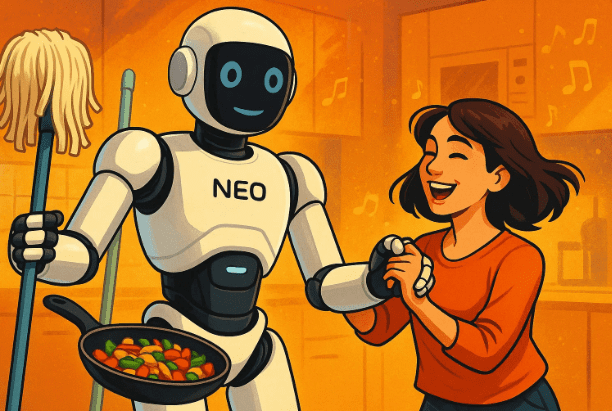
Meet Neo, the 5’6″ humanoid robot developed by 1X Technologies, a California-based robotics company that has officially opened pre-orders for the world’s first AI-powered humanoid home assistant. With a starting price of $20,000 or a subscription of $499 per month, Neo aims to redefine how we interact with machines in our everyday lives.
From vacuuming and washing dishes to taking out the trash and even remembering where you left your keys, Neo promises to become the first robot you might actually want as a roommate. But before you start imagining life with your robotic helper, let’s take a deep dive into how it works, what it can do, and the real limitations behind the hype.
1. What Exactly Is Neo and Who Built It?
Let’s start by understanding where this breakthrough came from. Neo is designed and built by 1X Technologies (formerly known as Halodi Robotics), a company that has been experimenting with humanoid machines and AI-driven actuators for nearly a decade.
Unlike industrial robots or robotic arms built for factories, Neo is the first humanoid robot designed for home environments. Think of it as a cross between a housekeeper, a personal assistant, and an AI-powered companion — except one that stands upright, moves on two legs, and can interact using human gestures.
1X describes Neo as “the world’s first humanoid helper ready for your living room.”
The robot weighs around 30 kilograms (66 lbs) and is constructed from a 3D lattice polymer, making it light yet durable. Its frame is sleek and minimalistic — available in blue, beige, or black — and is designed to blend into modern home interiors.
2. How Neo Moves: The Technology Behind Its Humanlike Motion
Now, let’s move to the engineering marvel that makes Neo’s movement so realistic. Unlike rigid robotic arms seen in manufacturing units, Neo uses a tendon-driven actuator system, which mimics the way human muscles and tendons work.
This design allows Neo to perform smooth, natural movements — bending, lifting, and turning with human-like fluidity. It’s powered by NVIDIA AI processors that handle both movement control and vision processing simultaneously.
Despite weighing only 30 kg, Neo can lift up to 154 lbs (around 70 kg), an impressive feat that makes it capable of carrying groceries, rearranging objects, or even opening heavy doors.
Each unit comes equipped with:












- 360° fisheye cameras for complete spatial awareness.
- Four microphones and three built-in speakers for clear two-way communication.
- A 4-hour battery life per charge, with the ability to auto-dock and recharge itself when running low.
These features combine to make Neo surprisingly capable of navigating domestic environments safely — identifying humans, furniture, and even pets in real time.
3. Neo’s Three Operating Modes: How It Adapts to You
So far, we’ve covered the hardware. Now, let’s look at Neo’s intelligence — where things get truly fascinating. The robot can function in three distinct modes, depending on what you need it to do:
• Companion Mode
In this mode, Neo behaves like an AI-powered friend and assistant. It can listen, see, and understand its environment. You can talk to it naturally and ask questions like:
- “Where did I leave my glasses?”
- “What can I make for dinner with the food in my fridge?”
- “Can you remind me to water the plants tomorrow?”
Neo remembers your surroundings, learns your preferences, and can even hold meaningful conversations. It can teach you new languages, provide step-by-step guidance for recipes, or help kids with their homework.
• Chore Mode
Here, Neo becomes the housekeeper you always wished for. It can vacuum floors, load dishwashers, take out the trash, and fold laundry. Using its sensors and tactile feedback system, it carefully handles objects without breaking them.
You can also schedule these chores through the Neo app, where you specify time slots for each task — like running the vacuum while you’re at work or preparing the kitchen before you get home.
• Autonomy Mode
This is the most advanced mode — designed for independent operation. Neo uses its built-in AI (called Redwood AI) and a Vision-Language Transformer to understand instructions and learn from real-world experiences.
For example, if Neo encounters a new dishwasher model, it can contact 1X’s remote training center where human engineers guide it through the process in real time. Once trained, it “remembers” the task and can perform it independently later.
The more it works, the smarter it becomes. Over time, your Neo adapts to your home and routines much like a human assistant would.
4. Core Features That Make Neo Stand Out
Let’s take a closer look at what makes Neo such a technological leap forward compared to traditional AI assistants or robots.
Before listing them, it’s worth noting that Neo is not just another smart speaker on legs — it’s a fully mobile, multi-sensory platform capable of physical interaction and emotional context recognition.
Here are some standout features:
- Full-body mobility: Walks, turns, and bends with balance similar to a human.
- Object recognition: Identifies items and locations using 360° cameras and AI.
- Voice interaction: Communicates naturally through microphones and speakers.
- Self-charging: Detects when power is low and returns to its dock autonomously.
- Load capacity: Can lift or move objects up to 154 lbs.
- Smart memory: Learns from past tasks to optimize future performance.
- Multi-device control: Works with the Neo smartphone app for remote scheduling.
- Customizable appearance: Comes in multiple color options to suit interiors.
However, it’s important to remember that Neo is still a first-generation consumer robot, and while it appears revolutionary, it’s not flawless.
5. What Neo Can’t Do (Yet) — The Limitations
Now that we’ve seen the exciting side, it’s time to take a realistic look at what Neo can’t do — at least not yet.
Recent demonstrations showed that Neo, despite its capabilities, still relies heavily on human remote control. During early testing sessions, many of its movements — from opening doors to picking up bottles — were not fully autonomous. Instead, they were controlled by a human operator inside 1X Technologies, known internally as a “touring.”
Observers described the motion as slow, shaky, and hesitant, raising doubts about how ready the robot really is for independent household work.
Additionally, Neo has a few notable technical constraints:
- Limited battery life: 4 hours per charge may not be sufficient for full-day chores.
- Partial waterproofing: Only the hands are waterproof; the rest of the body isn’t, so no outdoor rain cleaning or pool work.
- Limited emotional recognition: While it can recognize objects, reading complex human emotions accurately is still a challenge.
These limitations remind us that Neo is still part of a transition phase — a bridge between conceptual robotics and practical, everyday machines.
6. How to Buy or Preorder Neo
If you’re already imagining life with a robotic roommate, you’ll be glad to know that Neo is now available for pre-order directly from the manufacturer.
You can register your interest on the official website of 1X Technologies.
Here’s how the purchase model works:
- One-time purchase: $20,000 (with a 3-year warranty and priority delivery).
- Subscription plan: $499/month for ongoing use and support.
The first batch is expected to ship in early 2026, with priority given to those who pre-order now.
7. Comparing Neo to Its Rivals: Tesla Optimus and Figure AI
So far, we’ve done a good job understanding Neo’s capabilities, but it’s worth comparing it to other humanoid projects in development.
- Tesla Optimus: Elon Musk’s humanoid robot focuses more on industrial tasks and manufacturing support. It’s still in prototype phase and not yet available to consumers.
- Figure AI: Another U.S.-based robotics startup, Figure AI’s humanoid robot is designed for warehouse work and enterprise automation, not domestic chores.
This gives Neo a first-mover advantage — it’s not the most powerful, but it’s the first robot designed specifically for homes that you can actually buy.
8. Potential Benefits and Real-World Impact
Let’s move beyond the tech specs and look at how Neo could actually change daily life.
If the concept works as intended, Neo could help:
- Elderly or disabled individuals with daily household tasks.
- Busy professionals who need extra help around the house.
- Families with children, offering assistance and supervision.
- Small businesses for repetitive service work like cleaning or delivery.
It’s not hard to imagine future versions being able to take care of pets, organize home inventories, or even handle emergency calls in case of accidents.
But beyond utility, Neo also represents a cultural shift — a point where AI is no longer confined to screens or voices but takes physical form in our homes.
9. Ethical and Safety Considerations
No innovation is complete without addressing its ethical implications. Robots that can see, hear, and learn raise concerns about privacy and data security.
Although 1X claims all audio and visual data stays encrypted within the user’s environment, regulators will likely keep a close watch on how such information is stored and used.
There are also broader social questions:
- Could humanoid robots replace domestic workers in the future?
- How will society adapt to machines that mimic human behavior?
- What happens if Neo malfunctions or is hacked?
These issues are complex, and the robotics industry will need to evolve alongside laws and ethical frameworks to ensure user safety.
10. The Road Ahead — What’s Next for 1X Technologies
While Neo may not yet be flawless, it represents a major milestone in the robotics industry. For decades, researchers dreamed of a consumer-grade humanoid robot, and now one is finally entering production.
1X Technologies plans to expand Neo’s capabilities with future over-the-air software updates, better power systems, and improved motion control. The company has also hinted at integrating Redwood AI’s advanced reasoning engine to make future models more autonomous.
By 2030, we may see second- or third-generation humanoids that not only clean homes but also assist in healthcare, logistics, and education.
11. Frequently Asked Questions
Q: When will Neo start shipping?
A: The first batch is expected to ship in 2026, with priority given to pre-orders.
Q: Can Neo operate completely autonomously?
A: Not yet. Many tasks still require remote operator supervision, but future updates aim to improve this.
Q: How long does the battery last?
A: Neo can operate for about 4 hours per charge and then automatically recharges itself.
Q: Is Neo waterproof?
A: Only its hands are waterproof. The rest of the body must be kept away from water.
Q: Can Neo recognize faces or emotions?
A: Neo can identify objects and humans visually but is still limited in reading emotional expressions.
12. Final Thoughts
As we move closer to 2026, Neo symbolizes the dawn of a new era — one where AI literally stands beside us.
It’s exciting, a bit eerie, and full of possibilities. While the current version still needs human oversight, it’s a glimpse into the near future where humanoid robots will likely become part of our everyday routine — cleaning, teaching, helping, and maybe even keeping us company.
Neo might not yet be perfect, but it’s the first real step toward the age of intelligent, humanoid companionship.
Disclaimer:
This article is based on information available from 1X Technologies and related public sources as of November 2025. Specifications and capabilities are subject to change as the product develops.
Tags: Neo robot, 1X Technologies, humanoid robot, AI robotics, consumer robot 2026, Tesla Optimus, Figure AI, Redwood AI, home automation, future technology
#NeoRobot #HumanoidAI #1XTechnologies #ArtificialIntelligence #Robotics #HomeAutomation #FutureTech #AICompanion #TechInnovation #SmartHome