Have you ever had a brilliant video idea but struggled to write a script that truly justifies its power? You’re not alone. In fact, what separates a good creator from a great one isn’t just the idea—it’s how effectively you script it.
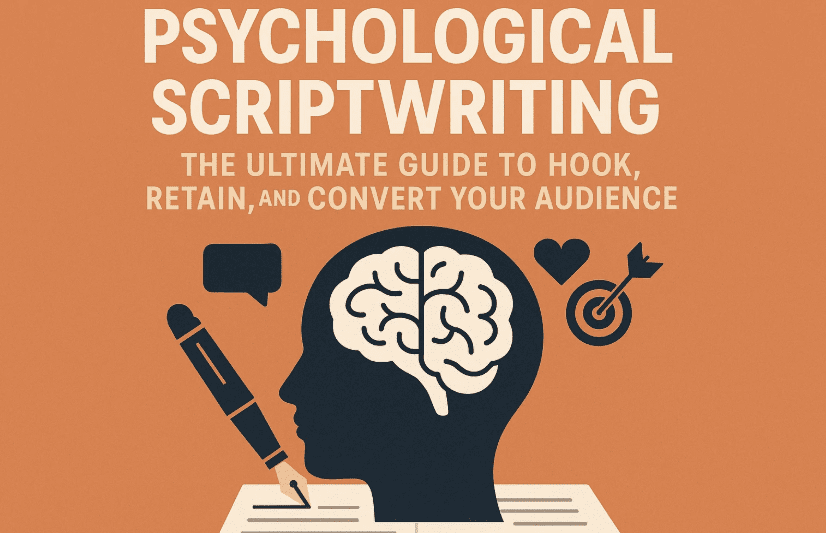
Psychological scriptwriting is more than art—it’s a science. One that taps into the very way our brains process emotions, curiosity, and decisions. And in today’s guide, we’re going deep into this craft—breaking down psychological triggers, frameworks, retention strategies, and even how to structure scripts using tools like Notion.
Whether you’re creating for YouTube, Instagram Reels, short films, or even theatre—this guide applies to all. Ready? Let’s dive in.
Why Psychological Scriptwriting Matters
Before we get technical, let’s talk about something relatable.
Imagine an ordinary man. One day, he dreams of seeing a 6-zero bank balance. The next day, he checks his phone—and there it is: 7 zeroes. You’re hooked, right?
Why?
Because you just experienced the dopamine gap.
The dopamine gap is a psychological concept where a viewer’s expectations are set high, and then instantly shattered or surpassed by an unexpected reality. This creates a neurochemical urge to continue watching—to close the loop.
In simple terms, when reality beats expectations, the viewer gets hooked.
Let’s move forward and understand how this principle forms the backbone of powerful scripts.
Step 1: Understand the Two Pillars – Expectation vs. Reality
Every compelling script plays with two core emotions:










- Expectation: What the audience assumes will happen.
- Reality: What actually happens.
When the reality exceeds the expectation, the viewer is hooked.
📌 Bad example: Telling them exactly what they expect.
📌 Great example: Subverting the expected path with a twist they didn’t see coming.
MrBeast, for instance, doesn’t just say, “My friend is trying to lose weight.” He builds it into a high-stakes challenge with cash prizes, a personal gym, unlimited healthy food, and… one twist—a red line. If crossed, it’s game over.
Boom. Hooked.
Step 2: The 30-Second Rule – Attention is Gold
Human attention spans are now shorter than a goldfish’s—about 8 seconds.
That’s all the time you have to prove your video is worth watching.
If your script doesn’t hook the viewer in 30 seconds, they’ll likely bounce. So here’s what you need to apply:
The 5 Psychological Triggers Every Script Must Use
Let’s break this down one by one—with examples.
1. Pattern Interruption
Our brain loves patterns. But it remembers the ones that break.
❌ “Hey guys, welcome to today’s video…”
✅ “Forget everything your teacher told you about productivity—it’s probably wrong.”
This interruption creates shock, which increases curiosity and retention.
2. Curiosity Gap
Our minds hate incomplete information.
❌ “Here are 5 tips for success.”
✅ “Tip number 5 will make you angry. I guarantee it.”
The second example triggers immediate questions: “What’s the 5th tip? Why would it make me angry?”
That’s the curiosity gap—and it keeps people watching.
3. Social Proof + FOMO
People don’t want to miss out. If they see others engaging, they want in.
✅ “Only 1% of people know why Bill Gates visits this café regularly.”
Now you want to know which café—and why. You don’t want to be in the 99% who don’t know.
4. Personal Stakes
If the viewer can’t relate, they won’t care. Tap into their identity or emotions.
✅ “If you also think this habit is ruining your life, this video is for you.”
That “you” instantly makes it personal.
You might be intrested in these topics too!
- The Viral YouTube Video Formula That Works Every Time: 9 Proven Steps You Can Copy Today
- How to Find Viral YouTube Keywords Using SEMrush (And Rank Long-Term)
- The Best Way to Upload and Make Your YouTube Shorts Go Viral (Step-by-Step Guide)
- How to Create Viral YouTube Thumbnails Using AI – No Design Skills Needed!
- The Secret Storytelling Formula Behind Viral Videos (With 8M+ Views)
5. Immediate Threat or Reward
Urgency triggers action. The brain wants to act now.
✅ “In the next 5 minutes, you’ll understand why you overthink so much.”
Instant reward = guaranteed engagement.
Step 3: Emotional Cycle – The Script’s Pulse
Now that you’ve got the viewer in, how do you keep them?
Enter the Emotional Cycle. Your script shouldn’t be flat—it should breathe like a wave.
Here’s the rhythm:
- 🔺 Peak: Hit them with a hook.
- 🔻 Valley: Build the backstory slowly.
- 🔺 Peak again: Introduce a twist that beats expectations.
This wave-like structure helps your audience feel connected, relaxed, shocked, and curious—all at once.
Step 4: Use the C.V.F Method
Even if you struggle with the Emotional Cycle, the C.V.F framework is your backup:
C – Context
Start by clearly stating what the video is about. No fluff.
“This is psychological scriptwriting. And it’s a science.”
V – Visual Cues
Engage multiple senses. Use visuals or descriptions that help the brain see.
Example: Use terms like “look at this” or “see how this changes” even in voiceover scripts to trigger mental images.
F – Framing
Every point must relate to the larger goal of your video.
Don’t just state facts. Show why this point matters in your story.
Step 5: Use the Reverse Engineering Trick
When you’re stuck, start with the end.
Great documentaries and films often start with the outcome, then trace back how it happened.
This not only simplifies complex topics but helps map the emotional beats backward.
Step 6: Scripting in Notion – Real Workflow
Let’s move into the technical side of writing.
🧠 Tool: Notion
I personally use Notion to structure all my scripts. Here’s how:
Part 1: Bullet Points First
Before writing any dialogue, I create a “Things to Add” section with bullet points.
Why?
- Prevents loss of ideas
- Helps test if your points are valuable
- Speeds up scripting
Part 2: Hooks with Visuals
For each hook, I note down what visual I want to show: B-roll, animation, stock footage, etc.
This prepares my editor—or my own mind—when executing.
Part 3: Intro & Body
I don’t write a formal intro. Instead, I go straight into value. Each bullet gets expanded into paragraphs—each paragraph includes:
- Visual cues
- Relatable phrases
- Framing language
Extra: I even add script pauses, emotion notes, and tonal shifts.
That’s how detailed and layered scripting can get.
Bonus Tip: Why You Should Avoid Ending Your Videos Abruptly
In modern content—especially social—don’t end the video with a boring outro. Viewers remember how something made them feel, not what it told them.
If you stop at a peak moment or leave a hint toward the next topic, retention on future videos improves.
Q&A Section
Q1. Can these techniques be used for educational or serious content?
Absolutely. Whether it’s financial advice, tech tutorials, or documentaries—hooking your audience is still essential.
Q2. What if I’m not good at writing creatively?
Start by focusing on the 5 psychological triggers and build simple bullet points. Over time, your writing muscle will grow.
Q3. Can I use AI to assist in scriptwriting?
Yes, tools like ChatGPT can help you structure and brainstorm, but the human touch in emotional storytelling is irreplaceable.
Final Thoughts: Scriptwriting is Only 25% of the Game
Here’s a hard truth:
Scriptwriting is just one-fourth of what makes a video work.
The rest?
- Storytelling
- Editing
- Thumbnails
- Titles
All contribute to viewer retention and reach. But none of them matter if your script fails to grab attention in the first 30 seconds.
Tags:
psychological scriptwriting, video script writing, dopamine gap, expectation vs reality, hook writing, retention triggers, curiosity gap, pattern interruption, fomo in content, content strategy, notion script template, cvf framework, storytelling tips, video production
Hashtags:
#ScriptwritingTips #VideoHooks #RetentionStrategy #PsychologicalTriggers #DopamineGap #NotionForWriters #ContentWriting #YouTubeScript #Storytelling #EngagementStrategies