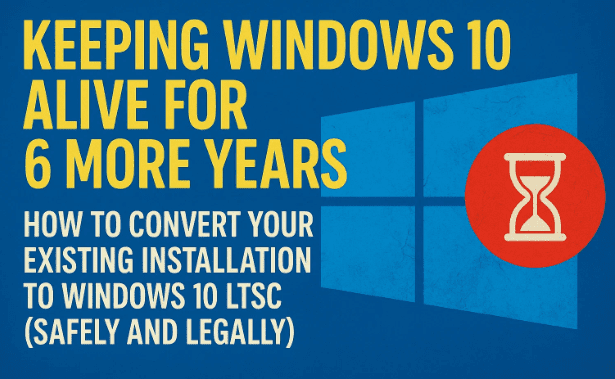
Windows 10 is nearing the end of its life. On October 14, 2025, Microsoft will officially end support for one of its most popular operating systems, meaning no more security patches, stability updates, or official support. While the company plans to offer paid extended security updates (ESU) for another few years, not everyone wants to pay to keep their computer safe — especially if they’re happy with how Windows 10 runs today.
But what if there was a way to keep using Windows 10 safely until 2032 without switching to Windows 11 or paying annual fees? That’s where Windows 10 LTSC (Long-Term Servicing Channel) comes in. In this article, we’ll explain what LTSC is, how it differs from standard Windows 10, and how some users have successfully converted their existing Windows 10 installation into LTSC — all while keeping their files intact.
⚠️ Disclaimer:
This article is for educational purposes only. Always use genuine Microsoft sources and valid product keys when installing or activating Windows. Never download or run unofficial activation tools. The guide below focuses on legitimate methods and safe system modification practices.
🕒 1. What Happens When Windows 10 Support Ends?
On October 14, 2025, Microsoft will stop providing:
- Security updates
- Driver updates via Windows Update
- Technical support or bug fixes
This leaves millions of PCs vulnerable — especially older ones that can’t run Windows 11 because of TPM or hardware limitations.
Microsoft will offer “Extended Security Updates (ESU),” but those will require a yearly subscription fee, starting at roughly $61 for the first year, and doubling each year afterward.
That’s why many users are turning to Windows 10 LTSC, a version of Windows 10 that’s still officially supported — for free — until 2032.
🧩 2. What Is Windows 10 LTSC?
LTSC stands for Long-Term Servicing Channel.
It’s a special enterprise version of Windows designed for:
- Industrial computers
- Medical equipment
- POS systems
- ATMs and kiosks
Unlike Home or Pro versions, LTSC doesn’t receive constant feature updates or new apps. Instead, it focuses on:
- Long-term stability
- Security updates only
- No bloatware or Microsoft Store apps
- Minimal background processes
The latest version, Windows 10 IoT Enterprise LTSC 2021, will receive updates until January 12, 2032 — nearly seven years beyond Windows 10 Home and Pro.
⚙️ 3. Why LTSC Is So Popular Among Power Users
Even though LTSC is intended for business environments, it’s become increasingly popular with tech enthusiasts for several reasons:
- No Windows 11 nags or upgrade pop-ups
- No bundled apps like Teams, Cortana, or Microsoft Edge bloat
- Lower RAM and CPU usage due to fewer background services
- Faster boot times
- No forced updates
- Better stability for legacy applications
Simply put, LTSC brings back the classic Windows 10 experience — light, efficient, and free of unnecessary cloud integration.
🔍 4. Key Differences Between Regular Windows 10 and LTSC
| Feature | Windows 10 Home/Pro | Windows 10 LTSC |
|---|---|---|
| Support End Date | October 14, 2025 | January 12, 2032 |
| Microsoft Store | Included | Removed |
| Cortana | Active | Removed |
| Microsoft Edge | Installed by default | Optional |
| Bloatware | Preinstalled | None |
| Updates | Frequent (feature + security) | Security only |
| TPM Requirement | Yes (for Windows 11 upgrade) | No |
| Ideal For | General users | Professionals, legacy systems |
As you can see, LTSC is leaner and more privacy-friendly by design. Now, let’s look at how to safely convert an existing Windows 10 installation into LTSC.
💾 5. Before You Begin: Back Up and Prepare
Before attempting any registry or installation-level changes, always:
- Back up all personal files — use an external drive or cloud storage.
- Create a system restore point (Control Panel → Recovery → Create Restore Point).
- Download the official LTSC ISO from Microsoft’s Volume Licensing Service Center or Evaluation Center.
- Ensure your product key is valid. Retail or OEM keys for LTSC differ from Home/Pro.
🧰 6. Step-by-Step: Converting Windows 10 to LTSC
Let’s now move through the process, one step at a time.
Step 1: Modify the Windows Registry
This step tells Windows that it should identify itself as the Enterprise LTSC version before the upgrade.
- Press Win + R, type
regedit, and press Enter. - Navigate to this path:
HKEY_LOCAL_MACHINE\SOFTWARE\Microsoft\Windows NT\CurrentVersion - Find the entry named EditionID.
- Double-click it and change its value to:
EnterpriseS - Optionally, if you want IoT LTSC (for extended support until 2032), use:
IoTEnterpriseS - Close Registry Editor.
This change effectively “tells” Windows that you plan to upgrade to the Enterprise LTSC edition.
Step 2: Mount the LTSC ISO
You can download the official Windows 10 LTSC 2021 ISO from Microsoft. Once downloaded:
- Right-click the file and choose Mount.
- Open the mounted drive and run setup.exe.
💡 Tip:
You don’t need to create a bootable USB drive unless you’re performing a clean install. Running from within Windows preserves your files and settings.
Step 3: Begin the Upgrade Process
- The Windows Setup wizard will appear.
- Choose “Not right now” when asked to download updates (to save time).
- Accept the license agreement.
- When prompted, select “Keep personal files and apps”.
- Click Install and wait.
The process can take 30–90 minutes, depending on your system. Avoid using your computer during this time. It will reboot multiple times.
Step 4: Verify Installation Success
Once the system boots up:
- Press Win + I → System → About.
- Under Windows Specifications, you should see:
Edition: Windows 10 Enterprise LTSC 2021 or Windows 10 IoT Enterprise LTSC 2021. - Your files and programs should remain intact.
If Windows displays “not activated,” you can enter your valid product key under Settings → Activation.
🧩 7. Troubleshooting and Common Errors
If you encounter an error like
“Installation failed in the first boot phase with an error during SYSPREP”,
try these fixes:
- Ensure the ISO file matches your system’s architecture (x64 or x86).
- Reboot and rerun the setup from your internal drive instead of a network folder.
- Temporarily disable third-party antivirus software.
- Make sure enough free space (at least 20 GB) is available.
If the installation resets back to your old version, recheck your EditionID registry entry — Windows sometimes restores it automatically.
🔑 8. Activating Windows 10 LTSC (Officially)
Once LTSC is installed, you can activate it using:
- A valid LTSC product key purchased from Microsoft or an authorized reseller.
- Command Prompt (Admin) and the following command:
slmgr /ipk XXXXX-XXXXX-XXXXX-XXXXX-XXXXX - Then activate:
slmgr /ato - Verify activation under Settings → Activation.
⚠️ Do not use unofficial “activation scripts” or cracked methods.
These can compromise your system security and may violate Microsoft’s terms of service.
🗓️ 9. Security Updates and Support Timeline
Here’s how long each LTSC version remains supported:
| Version | Release Year | Security Updates Until |
|---|---|---|
| Windows 10 LTSC 2019 | 2019 | January 9, 2029 |
| Windows 10 LTSC 2021 (IoT) | 2021 | January 12, 2032 |
So by switching to Windows 10 LTSC 2021 IoT, you effectively extend your Windows 10’s life by seven more years — without needing to move to Windows 11.
❓ 10. Frequently Asked Questions
Q1. Is converting Windows 10 Home/Pro to LTSC legal?
No, it’s not officially supported by Microsoft. The legitimate way is to perform a clean LTSC installation using an official ISO and license key.
Q2. Will this method erase my files?
If you choose “Keep personal files and apps,” your files should remain. Still, always back up important data.
Q3. Can LTSC run on older hardware?
Yes. LTSC is lighter and runs even on older CPUs and low-RAM systems that struggle with Windows 11.
Q4. What about drivers and updates?
All standard Windows 10 drivers work fine. You’ll continue receiving monthly security updates.
Q5. Can I revert back to Windows 10 Home/Pro?
Yes. You can reinstall your previous version using your original key or system recovery image.
Disclaimer:
This article is meant for informational purposes only. Modifying Windows registry entries or performing unsupported upgrades may lead to system instability. Always download ISOs and product keys directly from Microsoft. The author is not responsible for damage, data loss, or violations of Microsoft licensing policies.
🏷️ Tags & Hashtags
#Windows10 #LTSC #Microsoft #TechGuide #WindowsUpgrade #Windows11Alternative #Windows10Support #OperatingSystem #PCSecurity #WindowsTips