Email remains the backbone of our digital life — from bank alerts to work communication, nearly everything we do online starts with an email ID. For years, Gmail has dominated this space, becoming almost synonymous with “email.” But in recent months, a new shift is happening: many users in India and around the world are exploring alternatives like Zoho Mail — especially after high-profile figures such as India’s Home Minister reportedly created an account on the platform.
This has naturally raised an important question among internet users:
👉 Is Zoho Mail really safe?
Let’s find out in detail.
1. Why People Are Switching from Gmail to Zoho Mail
In recent years, users have started questioning the privacy policies of big tech companies, especially after multiple controversies about data tracking and targeted advertising. Gmail, despite being powerful and free, is part of the Google ecosystem — meaning your email data often gets scanned (in anonymized form) for better ad personalization and spam filtering.
Zoho, on the other hand, promotes itself as a privacy-first platform that does not depend on ads or sell user data. This simple promise — “Your email, your privacy” — is a big reason why many professionals, startups, and government officials are testing the platform.
Moreover, Zoho is an Indian-origin company with global operations and data centers in multiple countries, including India. Its growing credibility in both business and government sectors is driving users to take it seriously as a Gmail alternative.
2. Understanding Zoho Mail: An Overview
Before diving into security, let’s understand what Zoho Mail really is.
Zoho Mail is a part of Zoho Workplace, an integrated suite of productivity apps — similar to Google Workspace — offering email, calendar, document storage, and collaboration tools. It was built with privacy in mind and focuses on businesses that want a secure, ad-free email environment.
Some key highlights include:
- Ad-free interface even in the free plan.
- Data hosted in secure data centers managed by Zoho itself.
- Strict compliance with GDPR and other privacy regulations.
- Multi-device access via mobile apps, desktop clients, and webmail.
Now, let’s get into what really matters — security.
3. How Secure Is Zoho Mail? A Deep Dive into Its Protection Layers
When it comes to data security, Zoho Mail takes several measures to protect users. Let’s look at them one by one and understand how they work.










a. Data Encryption
Zoho uses 256-bit SSL encryption to protect all communication between your device and their servers. This ensures that any data you send or receive cannot be intercepted by hackers or third parties.
b. Secure Data Centers
Zoho hosts its servers in high-security data centers equipped with multiple physical and digital protection layers. These centers are constantly monitored for unusual activity, power failures, and environmental risks.
c. Two-Factor Authentication (2FA)
Users can enable two-factor authentication (2FA) to add an extra layer of security to their accounts. This means even if someone knows your password, they cannot log in without a secondary code — typically sent to your mobile device or generated via an authenticator app.
d. Spam and Threat Filtering
Zoho has a robust spam detection engine that identifies and blocks emails coming from blacklisted IPs or suspicious domains. It uses both AI-based pattern recognition and user reporting to improve detection accuracy.
e. Anti-Phishing and Anti-Malware Measures
The system actively scans attachments and embedded links to detect malicious behavior such as phishing attempts, spoofing, or hidden malware. Suspicious messages are automatically quarantined.
So far, we can say Zoho’s approach is very comprehensive — but how does it stack up against Gmail’s legendary security? Let’s compare.
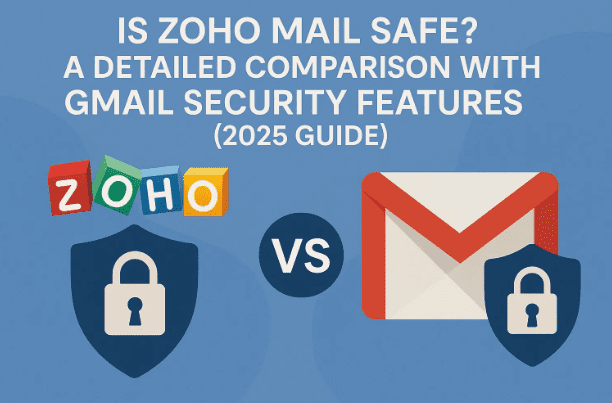
4. Zoho Mail vs Gmail: Side-by-Side Security Comparison
Before making a switch, it’s wise to compare both platforms objectively. Here’s a quick look at how Zoho Mail and Gmail differ in their security architecture:
| Feature | Zoho Mail | Gmail |
|---|---|---|
| Encryption | 256-bit SSL/TLS encryption | TLS encryption (with optional E2E for Workspace users) |
| 2FA / MFA | Yes, via Zoho OneAuth or Google Authenticator | Yes, via Google Prompt or Authenticator |
| Spam Filter Accuracy | Strong (customizable blacklists & IP filtering) | Extremely strong (claims 99.9% accuracy using AI) |
| Phishing Protection | AI-based scanning + URL inspection | Advanced phishing detection with ML |
| Ads and Data Scanning | No ads; data not sold or scanned for marketing | Ads supported in free Gmail; limited data scanning |
| Storage Privacy | Fully encrypted at rest | Encrypted but Google retains metadata access |
| Compliance | GDPR, HIPAA (for paid plans) | GDPR-compliant |
| Business Integration | Zoho Workplace apps | Google Workspace tools |
| Server Location Options | Multiple global data centers including India | Primarily US-based servers |
Both services are highly secure, but their philosophies differ. Gmail emphasizes scale and AI-driven automation, while Zoho focuses on user privacy and human-controlled data handling.
5. How Zoho Protects Against Spam, Phishing, and Malware
Spam and phishing are among the most common online threats — and both Gmail and Zoho take them seriously.
In Zoho Mail, you get:
- IP Blacklisting: Automatically blocks known spam sources.
- Advanced Heuristic Filters: Detects unusual sending patterns.
- Attachment Scanning: Prevents harmful executable files or macro viruses from entering your inbox.
- Spoof Detection: Identifies when someone tries to imitate a legitimate domain (a common phishing tactic).
To make this even clearer, Zoho’s internal systems analyze threat patterns across millions of emails daily to build a continually updated “danger profile.” If a sender or domain behaves suspiciously, it gets flagged and blocked in real-time.
For business accounts, administrators can also set custom spam policies, quarantine settings, and DKIM/SPF authentication for better control.
6. Data Encryption and Privacy: How Zoho Keeps Your Emails Confidential
Privacy is the main selling point of Zoho Mail. The company claims — and publicly commits — to never selling user data or scanning messages for ad targeting.
Let’s understand what this means technically:
- End-to-End SSL Encryption protects messages while they travel.
- Encryption-at-Rest ensures that even stored messages in data centers remain unreadable without authorization.
- Access Control ensures that only authorized users and automated systems can view or modify data.
Zoho’s transparency reports and compliance certifications are published online, detailing how it handles data access requests from governments or third parties.
This kind of openness has made Zoho particularly appealing to businesses, educators, and even government offices seeking a non-US-based secure email solution.
7. Account Protection Tips: Extra Security Steps You Should Take
While Zoho and Gmail both provide excellent built-in security, no email system is foolproof. Users themselves play a big role in keeping accounts safe.
So far, we’ve discussed platform security — now let’s move to user security.
Here are some key measures everyone should follow:
- Enable Two-Step Verification (2FA):
Always turn this on — it’s the simplest way to block unauthorized access. - Use a Strong Password:
Combine uppercase, lowercase, numbers, and special symbols. Avoid names, birthdays, or predictable words. - Change Passwords Regularly:
Even a strong password can be compromised over time. Update it every few months. - Avoid Public Wi-Fi for Login:
Public networks are prime spots for data sniffing attacks. Use VPNs or mobile data instead. - Activate Zoho’s Privacy Guard:
This feature helps detect suspicious access attempts and restricts new device logins. - Be Careful with Attachments:
Never download files from unknown senders — even if the email looks legitimate. - Check Sender Domains:
Attackers often mimic trusted addresses. A small typo (like “zoho-maiI.com” instead of “zoho-mail.com”) can be a trap.
By following these steps, you can dramatically increase your protection — whether you use Zoho, Gmail, or any other platform.
8. What Users Can Learn from the Amit Shah Example
When India’s Home Minister, Amit Shah, reportedly shifted to Zoho Mail, it drew public attention. While political leaders’ digital choices often become symbolic, this particular shift highlighted something deeper: trust in indigenous, privacy-focused technology.
This doesn’t mean Gmail is unsafe. It simply means that data sovereignty — the idea that your data should be governed by your country’s privacy laws — is becoming a key factor for institutions and government agencies.
By choosing Zoho, Indian authorities are signaling their preference for platforms that:
- Host data within India or allied jurisdictions.
- Provide strong privacy guarantees.
- Operate independently of ad-based business models.
For regular users, this should serve as a reminder that it’s important to know where your email data is stored and how it’s used — not just which interface looks nicer.
9. Final Verdict: Should You Switch from Gmail to Zoho Mail?
Both Gmail and Zoho Mail are excellent choices, but their priorities differ.
If you want:
- Deep AI-driven organization,
- Seamless Google ecosystem integration, and
- World-class spam detection — Gmail remains unbeatable.
However, if your goal is:
- Maximum privacy,
- Ad-free email environment,
- Indian data localization, and
- Full control over your digital identity — Zoho Mail is a serious contender.
Ultimately, security is not just about technology — it’s about trust. Zoho’s transparent approach, combined with its solid technical framework, makes it one of the safest email alternatives in 2025.
And for those wondering if Zoho is truly ready for mainstream use — the answer is yes. It’s safe, secure, and already being used by millions worldwide, including top professionals and organizations.
10. FAQs
Q1: Is Zoho Mail completely free?
Zoho Mail offers a free plan for personal use with limited storage and features, along with paid business plans under Zoho Workplace.
Q2: Can Zoho Mail be hacked?
Like any service, no system is 100% hack-proof. However, with encryption, 2FA, and spam protection, Zoho significantly reduces that risk.
Q3: Where are Zoho Mail servers located?
Zoho operates multiple data centers in the U.S., Europe, India, and other regions, ensuring compliance with local laws and redundancy for reliability.
Q4: Does Zoho scan my emails for ads?
No. Zoho does not display ads or scan emails for advertising purposes.
Q5: How does Zoho Mail compare to Gmail in terms of spam accuracy?
Gmail’s AI spam filter is slightly more mature, but Zoho’s filtering system is robust and continually improving — especially for business-grade accounts.
Q6: Can I migrate my old Gmail emails to Zoho Mail?
Yes. Zoho provides an in-built migration tool to import your emails, contacts, and calendars from Gmail or other platforms seamlessly.
Q7: Is Zoho Mail good for professional use?
Absolutely. Its ad-free design, integration with Zoho Workplace, and customizable domain hosting make it ideal for professionals and businesses alike.
Disclaimer
This article is written for informational purposes only. Security and privacy practices are based on publicly available information and company documentation. Users are encouraged to verify features and compliance terms directly from Zoho’s official website.
Tags
Zoho Mail, Gmail comparison, secure email, email privacy, encryption, two-factor authentication, spam protection, Indian email services
Hashtags
#ZohoMail #EmailSecurity #PrivacyOnline #GmailAlternative #CyberSafety #DataProtection #EmailEncryption