There was a time when using Google felt like magic. It was 2004, and the internet was full of potential. You could ask any question, type it into a clean white box, press enter—and in a fraction of a second, the exact blog or page you needed appeared. It felt like having all human knowledge at your fingertips. That was the golden age of Google Search.
But if you’ve used Google recently, you may have noticed that magic is gone. Ads dominate your screen, content is often written for algorithms instead of people, and you probably find yourself appending “Reddit” to your queries to get real answers from real humans. So, what happened to Google Search? How did it go from being the foundation of the modern web to something we now struggle to trust?
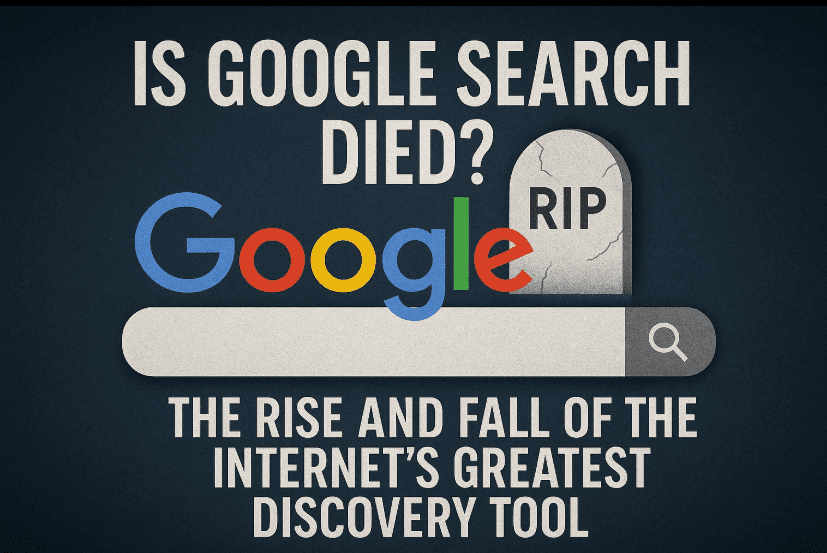
Let’s dive into the complete story of how Google Search lived, evolved, and started to fade.
🕸️ The Internet Before Google: A Library Without a Catalog
To understand Google’s rise, we need to understand what came before it.
In the mid-1990s, the World Wide Web was like a giant library—but without a catalog. Websites were not searchable in the way we know today. Instead, there were directories—curated lists of websites grouped by category, manually organized by humans.
If you were looking for a chess website, you’d go from:
- Recreation → Games → Board Games → Chess
It worked, but it was slow. And with thousands of new websites appearing every day, the system couldn’t scale. That’s where early web crawlers and first-generation search engines came in—like AltaVista, the king of that era.
AltaVista indexed millions of pages but didn’t care about quality or relevance. You might get 10,000 results for a query, but the useful one might be buried on page 50. It was chaotic and inefficient.
So people wanted a tool that didn’t just find content based on keywords—they wanted something that understood meaning.
📊 Enter PageRank: Google’s Breakthrough Moment
Here comes the turning point. In 1996, two PhD students at Stanford—Larry Page and Sergey Brin—were working on a research project to solve the information overload problem.
Most search engines at the time analyzed the content of a page itself. But Page and Brin had a radical idea:




“Don’t just analyze what a page says—analyze what the rest of the web says about that page.”
That’s how PageRank was born.
How PageRank Worked:
- Every hyperlink from one page to another was treated like a vote.
- Pages with more inbound links were considered more important.
- But not all votes were equal. A vote from a respected site (like a university or a government agency) was worth far more than a vote from an unknown blog.
- The algorithm recursively calculated the importance of pages based on the quality and quantity of these “votes.”
This method meant that authority had to be earned, not claimed.
Google took that power and wrapped it in a minimal, clean interface: a white box and a simple “Search” button. It was fast, accurate, and magical. For the first time, users felt trust in what they were seeing.
🌍 Google’s Mission and Promise
Google’s original mission was ambitious:
“To organize the world’s information and make it universally accessible and useful.”
And it had a philosophy that resonated with everyone:
“Don’t be evil.”
When Google went public in 2004, its founders made a bold promise in their IPO manifesto: search results would remain unbiased. They would never sell higher rankings. Their most valuable asset was user trust, not short-term revenue.
And you could see that in the product:
- Ads were clearly marked as “Sponsored Links.”
- Ads lived in a separate section, away from organic results.
- The user experience was sacred.
But like many good things—this too began to change.
🧾 The Advertising Invasion: When Money Took Over
In 2000, Google launched AdWords—a self-service ad platform. Initially, it stayed true to its promise:
- Ads were boxed off with colored backgrounds.
- Organic results remained pure.
But over the years, the separation between ads and content blurred:
- 2007: Ads started appearing above organic results.
- 2010: Background colors began to fade.
- 2013: Ad boxes disappeared entirely.
- 2019: Only a tiny “Ad” label distinguished paid content from real results.
Today, entire screens are filled with shopping carousels, local ads, and commercial content. You often have to scroll just to find actual search results.
This wasn’t a bug—it was by design. The goal was to make you click an ad without even realizing it.
🔍 The Rise (and Fall) of SEO: Gaming the System
As Google became the internet’s front door, a massive industry emerged: Search Engine Optimization (SEO).
In its early days, SEO helped sites become more readable to crawlers. But eventually, it turned into a battlefield:
- White-hat SEO followed rules.
- Black-hat SEO used keyword stuffing, fake link networks, and manipulative tricks.
Then came the content farms—companies like Demand Media that hired thousands of low-paid writers to churn out mediocre articles designed only to rank and make ad revenue.
They didn’t care about quality. They cared about ranking.
And then came the next big shift: Generative AI.
🧠 AI and the Death of Trust
Now, with tools like GPT-based models, it’s virtually free to create low-quality content at scale. Often, this content is misleading or entirely wrong, but it’s designed to game the algorithm, not help users.
Google itself admits that using AI to manipulate rankings violates its spam policies—but the web is now flooded with it.
As a result, users are left with search pages filled with:
- Ads
- Spam
- SEO garbage
- AI-generated junk
This phenomenon even has a name: enshittification—a term coined by writer Cory Doctorow to describe the predictable decline of digital platforms.
📉 The Three-Stage Death of Digital Platforms
According to Doctorow, digital platforms die in three stages:
- They’re great to users, even at a loss, to build trust.
- They start abusing users to favor business clients (like advertisers).
- They start abusing clients to maximize profits for shareholders.
Google has followed this path precisely.
🧭 The Information Map Is Breaking
Meanwhile, the web itself changed. The most relevant information now lives:
- Inside apps
- Behind logins
- In ephemeral stories
- In Discord servers, TikToks, Instagram reels
Google’s entire model was based on crawlers—bots that follow public links. But these new ecosystems can’t be crawled. They’re structurally incompatible.
Google is increasingly indexing a shrinking, outdated version of the web—old blogs, forums, static HTML pages—while missing out on modern, real-time human interactions.
💥 The Final Blow: AI Answer Engines
Google’s model is built on showing links. More clicks = more ad revenue.
But now, a new model is gaining momentum: Answer Engines.
Tools like Perplexity AI don’t give you links. They give you answers—summarized, cited, and direct.
Think of Google as a librarian who points you to a bookshelf.
Perplexity is a librarian who reads the books, finds the best parts, and summarizes them for you—complete with footnotes.
And if users stop clicking links, Google’s entire multi-billion dollar ad empire collapses.
So, ironically, Google started integrating summaries itself. This led to the launch of AI Overviews.
🧪 AI Overviews: A Desperate Reaction?
Instead of a bold leap into the future, AI Overviews felt like a defensive, rushed patch.
The problem? Large Language Models (LLMs) like those behind AI Overviews don’t store facts—they generate plausible-sounding sentences. And sometimes… they hallucinate.
This is disastrous for a company built on trust.
Worse, spammers realized they could manipulate these summaries to promote low-quality, self-serving websites as facts.
So now, Google faces a contradiction:
- It promises to rank trustworthy, human-created information.
- But it also generates new, often unverified content using AI.
You can’t be the world’s most trusted source and generate synthetic truth at the same time.
📉 Fragmentation of the Web and the End of the “One Box”
Google’s original idea was simple: a white box that connected the world’s knowledge.
But today, users go elsewhere:
- AI engines for quick answers
- Social platforms for trends and reviews
- Forums like Reddit for depth
Young users especially—Gen Z—never even experienced Google’s magic. They grew up in an internet flooded with ads, spam, and mistrust.
No wonder they turn to TikTok, Instagram, or Reddit. The experience is visual, authentic, and human.
❓ Where Do We Go From Here?
So what does all this mean for:
- Writers?
- Journalists?
- Educators?
- Site owners?
What happens when AI tools summarize their work and provide no credit or traffic?
What happens to the open web when fewer people visit real websites, and most traffic is swallowed by walled gardens and AI?
That’s the crisis we’re in.
📌 FAQs
Q: Is Google still useful for some searches?
Yes. For factual, academic, or localized queries, Google can still be helpful. But it’s no longer the one-stop magical box it once was.
Q: Will AI replace search engines entirely?
Not entirely. But it will fragment the landscape. Users will choose specialized tools: AI for fast answers, forums for deep insights, and social media for trends.
Q: Can Google recover?
Only if it radically rethinks its priorities—putting user trust and experience above ad revenue. But that’s easier said than done.
🚨 Final Thoughts: The Dream Is Dying
The dream was simple: a connected, open web where information is free and accessible.
But ads corrupted it, SEO spam diluted it, and AI may just be finishing it off.
Google Search isn’t dying because of one big mistake—it’s dying because of a thousand small compromises. A thousand forgotten promises. A thousand clicks we were tricked into making.
And the question now isn’t whether Google can fix it.
It’s whether we still believe in the dream of the open web at all.
Tags: Google Search decline, PageRank history, SEO spam, generative AI, AI overviews, open web, digital platforms, Perplexity AI, Google advertising, LLM hallucination, TikTok search behavior, enshittification
Hashtags:
#GoogleSearch #OpenWeb #DigitalHistory #AIOverviews #PageRank #SearchEngines #PerplexityAI #Enshittification #SEOSpam #AIvsSearch #InternetEvolution
Disclaimer:
This article is based on publicly available data, industry insights, and editorial analysis. It is intended for educational and informational purposes only. All referenced tools and platforms retain their respective trademarks.