Online games promise competition, thrills, and the small moments that keep us coming back for one more match. But under that surface there’s a parallel world where math, code and clever engineering are used not to create better games, but to break them. From memory editors that tweak single-player values to network proxies that try to rewrite server traffic — and the infamous aimbots that automatically place crosshairs for you — cheats are part technical craft, part shadow economy.
This article peels back that curtain. I’ll explain, in plain language, how cheats actually work, why entire businesses form around them, and what it takes (technically) to build the most powerful ones. Expect practical examples — memory editing, DLL injection, packet rewriting — plus why modern anti-cheat systems make this a constant cat-and-mouse game. If you play online or run a server, understanding these mechanics helps you spot, report, and defend against abuse.
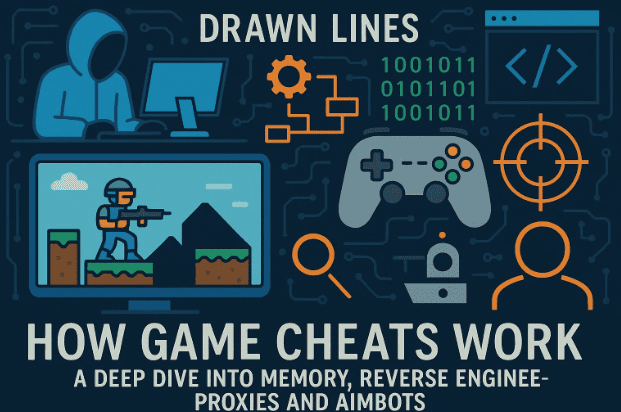
What is cheating in online games — short definition
Cheating in games covers any technique, software, or service that gives a player an advantage not intended by the game’s designers. That could be simple things — editing your single-player health value — or complex, server-impacting hacks that change how your client talks to the game server. In multiplayer games, the difference matters: a cheat that only changes your local visuals is different from one that changes server state (money, inventory, scores).
The economics and scale of cheating
Before we dive into technical details, a reality check: cheating is big money. Even if a small fraction of players pay for cheats or bot services, the revenue can be enormous. For many organized groups, cheats are a product: monthly subscriptions, lifetime licenses, support, and additional modules. That business model drives professionalization — better code, marketing, payment infra, and even “customer support” for cheaters.
So, when you see a polished cheat market offering subscriptions and docs, remember: it’s a productized, often-global service. The incentives to keep it running (and to keep improving it) are real — which is one reason game companies and law enforcement sometimes pursue legal actions.
Types of cheats: external, internal, and network
Broadly, cheats fall into three technical categories — and the distinction matters because the defensive techniques and legal risks differ.
• External cheats — programs that run outside the game’s process and manipulate memory or behavior from there.
• Internal cheats — code that is injected into the game process itself (DLLs or patched code) and can change logic at runtime.
• Network cheats — manipulations of network traffic (proxies, MITM) or forged packets that try to change server-visible data.
We’ll go through each and explain how they’re built and how they’re detected.
How external cheats work (memory editing)
Intro: external cheats are the simplest to grasp conceptually. Before we go step-by-step, here’s the idea in plain language: when a program runs, relevant values (player health, ammo count, coordinates) live in RAM. If you can find the memory address for “HP” and change it, your game will show the modified number.
A short primer before we dive in: many tools exist to scan memory and edit values — Cheat Engine and ArtMoney are classic examples. These tools let you search process memory for a value, narrow down candidate addresses, and then rewrite values or freeze them to a constant. Official sources: Cheat Engine (https://www.cheatengine.org/) and ArtMoney (https://www.artmoney.ru/eng.htm).
Step-by-step (external memory editing)






- Launch the game and the memory editor (e.g., Cheat Engine).
- Identify a value you can observe and change (e.g., current health = 100).
- Search the process memory for values matching 100. You’ll get a lot of candidates initially.
- Change the in-game value (take damage) and search again for the new value — repeat until you isolate the correct address.
- Write a new value (e.g., 9999) into that address or freeze it. The game will now show your modified number.
Limitations and scope
• Works best for single-player or offline games.
• Modern online games validate critical values server-side, so changing your local memory often has no effect on the server’s authoritative state.
• Many anti-cheat systems look for these memory editors and can flag or block them.
How internal cheats work (reverse engineering, DLL injection)
Intro: internal cheats are more advanced because they run inside the game process and can change code paths, function calls, or data structures before the game does anything with them.
What “reverse engineering” means (brief)
When developers ship a game, the human-readable source code is compiled into machine-readable binary. Reverse engineering is the process of analyzing that binary to understand how the program works. Tools like IDA Pro from Hex-Rays (https://hex-rays.com/ida-pro) allow expert users to examine functions, follow control flow, and map binary code back to a readable form for analysis.
How internal cheats are typically built
- Static analysis: use disassemblers and decompilers to find functions of interest (e.g., code that computes aim, damage, or visibility checks).
- Develop an extra module (a DLL) that exports functions to be used by the game if loaded. Many cheats are compiled as DLLs in C/C++ (the same languages games use).
- Inject the DLL into the game process. There are many injection methods: manual injection, loader programs, or even tricks that manipulate the OS loader.
- Hook or patch functions: replace or intercept the target game functions so your code runs instead of, or before, the original logic. For example, intercept the function that calculates whether an enemy is visible, and change it to always return “visible.”
- Hide from anti-cheat: modern cheats try to cover their tracks (obfuscation, encrypted modules, runtime unpacking, evading signature checks).
Risks and complexity
• Requires deep knowledge of C/C++, operating system internals, and reverse engineering.
• Anti-cheat systems monitor loaded modules, digital signatures, and suspicious behavior — so internal cheats are higher risk to operate and distribute.
• Because these cheats alter the process, they can be more harmful (cause crashes, data corruption, or be classified as malware by antivirus).
How network cheats and proxies work (packet manipulation)
Intro: some cheats try to change the traffic between your client and the server. This can be as simple (inspecting traffic) or as advanced (rewriting or forging packets).
Tools and the technical baseline
Wireshark is the most widely used packet analyzer to capture and inspect network data (https://www.wireshark.org/). It shows every packet that goes across the network interface and helps attackers understand the protocol and format games use.
Basic approach for traffic-based cheating
- Capture network traffic while performing an action in the game (e.g., spending virtual currency).
- Analyze packet structure and sequence to find patterns. Games typically pack data into specific packet formats or JSON-like structures.
- If traffic is not encrypted and the server trusts the client too much, you may be able to change client-sent values (e.g., pretend you had more currency).
- Implement a proxy that sits between the client and the server. The proxy can read and rewrite requests in real time. For example, rewrite “spend 100 coins” into “spend 100000 coins” before it reaches the server.
Why this often fails in modern games
• Most modern multiplayer games use encryption and server-side validation, so changing client packets either fails or triggers validation checks.
• Even with a proxy, if the game cryptographically signs or encrypts data, you must either break the encryption (hard) or change values before encryption (requires code inside the client). That pushes us back to internal/external methods.
The aimbot explained — vectors, angles and smoothing
One of the most reviled cheats in shooter games is the aimbot. Understanding it requires a small detour into 3D math.
Brief math primer (no heavy jargon)
• Player positions are 3D coordinates: X, Y, Z.
• To aim at an opponent you compute the vector that points from your camera (or player) to the opponent.
• From that vector, you compute pitch and yaw — the angles you must look to have your crosshair align with the opponent. Functions like arctangent are used to convert vector differences into angles.
• The cheat writes these angles into memory or simulates mouse movement to place the crosshair on the opponent. Many aimbots apply smoothing, humanization and target-selection filters so the movement looks “natural” and avoids immediate detection.
Why aimbots are complex and why they work
• Aimbots rely on precise game data (enemy coordinates) or on reading the rendered framebuffer (computer vision approaches detect sprites on screen and move the mouse).
• They may implement prediction (lead the target if the target is moving) and compensation for bullet travel time or recoil.
• The math is real — vector math, trigonometry and physics all power modern aimbots.
Who builds cheats and why (a quick look at the ecosystem)
Cheat development ranges from hobbyist tinkering to organized crime. On the lower end, you have modders and tinkerers learning reverse engineering for curiosity. On the higher end, firms or groups productize their cheats into subscription services, bot farms, or merchant operations that siphon virtual goods.
A few motivations:
• Money — subscriptions and bot services are lucrative.
• Convenience — players who don’t want to grind buy items or services.
• Skill gaps — players who can’t or won’t put in the hours may prefer shortcuts.
• Political or social — sometimes cheating escalates into harassment or targeted competitive sabotage.
Real-world enforcement examples
There have been large enforcement operations that show the scale of cheating rings. One high-profile case known as “Operation Chicken Drumstick” involved a large cheat network; police and industry collaboration led to arrests and the takedown of systems selling cheats in many jurisdictions. Media outlets covered the bust and the scale of recovered assets and customer bases.
More broadly, courts in China and elsewhere have prosecuted defendants for selling cheat plug-ins and related tools. Some cases have resulted in multi-year prison sentences or heavy fines — a sign that at least some governments treat large-scale cheat distribution as a serious crime.
How game companies fight cheats (anti-cheat tech)
Game companies deploy many defensive layers:
• Server-side validation — authoritative servers check that actions match a player’s known state.
• System-level drivers — kernel or driver-based anti-cheat modules watch for injected code, manipulated memory, or suspicious drivers.
• Behavior analysis — anomaly detection flags impossible or improbable actions (e.g., headshots every shot, impossible movement).
• Dedicated security teams — companies update signatures and banlists, and sometimes pursue legal action.
Even so, this is a cat-and-mouse game: cheats evolve to evade detection, and anti-cheat systems adapt in response.
Defending yourself: practical tips for players and server admins
If you run a server or just want a better experience, here are practical defenses:
For players
• Report suspicious players with detailed evidence (screenshots, clip times).
• Play on reputable servers with strong anti-cheat policies.
• Keep your own system secure — cheats sometimes bring malware.
• Avoid third-party programs that interact with games (injectors, overlays from unknown vendors).
For server operators / hosts
• Run authoritative server logic — do not trust the client with game-critical validation.
• Use established anti-cheat solutions and update them regularly.
• Keep server logs to detect suspicious patterns (rapid resource changes, abnormal scoring).
• Consider offering private servers for communities — closed servers reduce exposure to commercial cheats.
Q&A — common questions answered
Q — Is cheat development the same as malware?
A — They overlap. Code that injects into other processes, manipulates memory, or modifies system behavior can be classified as malware by antivirus solutions. Distribution of cheat tools sometimes uses obfuscation and packers similar to malware. Legal classification varies by jurisdiction, but technically dangerous behavior is similar.
Q — Can I detect a cheat with just one suspicious player?
A — One data point is rarely conclusive. Use patterns: improbable streaks, repeated impossible actions, and correlating evidence (network logs, replays) make detection more confident.
Q — Is there any legitimate use for memory editing tools?
A — Yes — for debugging, modding single-player experiences, or learning reverse engineering. Many tools explicitly state they are for educational use (for example, Cheat Engine’s website clarifies its intended use). But using them in online games is risky and often against the terms of service.
Q — Are all cheats made in specific regions?
A — No; cheat development is global. Some high-profile organized efforts have been disrupted in East Asia, and some markets have stronger legal penalties. But the supply side is worldwide, and monetization often leverages global payment systems and under-the-radar hosting.
Disclaimer, resources and links
Disclaimer — This article explains how cheats work for defensive, educational and awareness reasons only. I do not condone cheating or the distribution of cheating software. Building, distributing, or using cheats in online games may violate terms of service and local law. If you suspect illegal activity, contact the game publisher or local law enforcement.
Official tool links (mentioned in the article)
• Cheat Engine — https://www.cheatengine.org/ (memory scanner/debugger).
• ArtMoney — https://www.artmoney.ru/eng.htm (memory editor).
• IDA Pro / Hex-Rays — https://hex-rays.com/ida-pro (disassembler and reverse-engineering tools).
• Wireshark — https://www.wireshark.org/ (packet analyzer).
Further reading on enforcement and major takedowns
• News coverage and reporting on major cheat ring takedowns like Operation Chicken Drumstick.
#GameSecurity #AntiCheat #CheatEngine #Wireshark #ReverseEngineering #Gaming