If you’ve ever received a call from an unknown number and wondered whether to pick up or not, there’s good news coming your way. The Indian government, through the Telecom Regulatory Authority of India (TRAI) and the Department of Telecommunications (DoT), is rolling out a new nationwide system that will display the real name of every caller — without using any third-party app like Truecaller.
This new initiative, called CNAP (Calling Name Presentation), aims to bring transparency to mobile communication and curb frauds, spam, and scam calls that have become rampant in recent years. For the first time, your phone will automatically show not just the number but also the official name of the person calling — the same name used on their government ID when obtaining the SIM card.
Let’s explore what CNAP is, how it works, when it will launch, and what it means for your privacy, safety, and day-to-day phone experience.
1. What Is CNAP and How Does It Work?
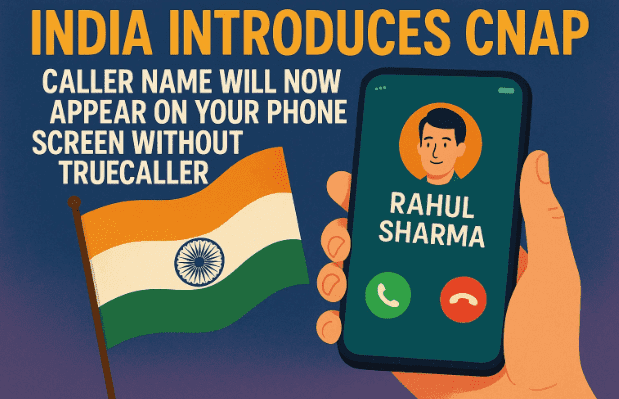
CNAP stands for Calling Name Presentation — a feature developed by TRAI and DoT to ensure that the true identity of every caller appears on your screen, even if the number isn’t saved in your contacts.
Unlike third-party caller ID apps, CNAP doesn’t rely on community-submitted names or data scraping. Instead, it draws directly from the official telecom database linked to your SIM registration. That means if someone bought a SIM card using their Aadhaar or voter ID, the same verified name will appear when they call.
Example:
If someone named Rahul Sharma purchased a SIM using their Aadhaar card, then every time Rahul calls you, “Rahul Sharma” will appear on your phone — even if you’ve never saved his number.
Key points about CNAP:
- It works natively on all phones — no app installation required.
- The system uses data provided by telecom operators.
- Names are drawn from verified ID proofs, not user-generated databases.
- It’s being implemented as a default service for all users.
This approach makes CNAP not just a convenience feature but a strong layer of protection against fraud and impersonation.
2. Why India Needed CNAP
So far, most people have relied on apps like Truecaller for caller identification. While those apps have been useful, they come with privacy trade-offs — they often collect and upload your contact list to their servers, building a global database of numbers and names without explicit consent.
CNAP solves that by keeping all data within telecom infrastructure, eliminating the need for third-party tracking.
The main goals behind this initiative are:









- To reduce spam and scam calls that target millions daily.
- To prevent impersonation and fraud in financial or government-related communications.
- To improve user trust in digital communication systems.
It’s also a direct response to rising cybercrime cases in India, such as digital loan scams, fake KYC updates, and phishing calls pretending to be from banks or government offices.
3. When Will CNAP Launch?
TRAI and DoT have already conducted successful pilot trials in Mumbai and Haryana, where the feature worked smoothly across major telecom operators.
After analyzing those results, both agencies approved a nationwide rollout plan, which is expected to begin soon. Once live, CNAP will be gradually activated across all telecom circles, including Jio, Airtel, Vi, and BSNL.
Default activation:
- The feature will be turned on by default for all users.
- However, users who don’t wish to use it can opt out manually.
That’s an important step, as it ensures the system respects both transparency and individual privacy preferences.
4. How CNAP Protects You From Fraud and Spam Calls
Let’s move to one of the most practical parts — the why behind CNAP’s growing importance. Every day, countless Indians receive calls from unknown numbers claiming to offer loans, insurance, or KYC verification. Some even use fake police or RBI names to trick victims.
With CNAP in place, such scams become far easier to detect.
Here’s how it helps:
- Instant identification: You can immediately see the caller’s registered name.
- Better decision-making: You can decide whether to answer or block the call based on the displayed name.
- Traceability: Authorities can more easily trace fraudulent callers through the telecom ID.
- Transparency: Legitimate businesses or government departments calling you can now be recognized clearly.
As per TRAI estimates, the average Indian receives three to four spam calls a day, with nearly 60% of users regularly reporting unwanted promotional or fraudulent calls. CNAP is designed to drastically cut those numbers by exposing the real identity behind each call.
5. What Happens to Truecaller and Similar Apps?
This move doesn’t necessarily eliminate the need for apps like Truecaller — but it reduces dependence on them.
Truecaller’s model relies on crowdsourced contact data, which can often be inaccurate or misleading. CNAP, on the other hand, uses verified identity information directly from the SIM registration database.
In essence:
- Truecaller shows the name someone else saved in their phone.
- CNAP shows the name on the caller’s official ID proof.
That’s a big difference — one based on speculation, the other on government verification.
6. Privacy and Opt-Out Options
While CNAP is being introduced as a default system, TRAI has confirmed that users will retain the right to deactivate the service.
You’ll be able to disable CNAP if you prefer not to display your registered name when calling others. However, disabling it may limit your ability to identify incoming callers as well.
Certain high-security users, such as law enforcement or intelligence officers (who already use restricted caller IDs), will be exempted from displaying their names under CNAP — similar to how CLIR (Caller Line Identification Restriction) works today.
7. How to Stay Safe Until CNAP Arrives
While CNAP is still being rolled out, it’s crucial to protect yourself from ongoing spam and scam calls. Here are some steps you can take right now:
Let’s move step-by-step through them.
1. Enable DND (Do Not Disturb):
You can activate TRAI’s DND 3.0 service through your network provider or by using the TRAI DND App. This helps block promotional and unwanted calls.
2. Turn on Spam Protection:
Most Android and iOS devices have built-in spam protection under “Phone Settings → Caller ID & Spam Protection.” Keep it on to automatically detect suspicious numbers.
3. Avoid sharing OTPs or bank details:
Never share personal information, especially one-time passwords, over calls claiming to be from banks or government agencies.
4. Ignore unknown WhatsApp or Telegram calls:
Scammers now use internet-based calling platforms to bypass traditional caller ID. If an unknown number calls or sends you a link on WhatsApp or Telegram, don’t engage or click.
5. Report fraud attempts:
You can report scam calls and messages to India’s National Cybercrime Helpline at 1930 or through cybercrime.gov.in.
8. The Technology Behind CNAP
So far we’ve understood what CNAP does; now let’s briefly discuss how it technically works.
When a call is initiated, your mobile network sends not just the number but also the verified name field associated with that number through a secure signaling layer. This data then appears on the recipient’s screen in real-time, similar to how Caller ID currently works but with verified information.
Key benefits:
- Works across both 4G and 5G networks.
- Compatible with feature phones and smartphones alike.
- Doesn’t depend on internet connectivity.
- Fully integrated into telecom signaling — meaning low latency and high reliability.
The backend verification is handled by telecom operators, while TRAI ensures compliance, transparency, and data privacy.
9. Cybersecurity Implications and Benefits
CNAP is also being seen as a cybersecurity advancement for India. Here’s why:
- It strengthens user authentication during calls.
- Makes impersonation or “spoof calling” significantly harder.
- Helps authorities identify fraud networks faster.
- Encourages responsible use of SIM cards, as each name becomes visible.
Cyber experts have described CNAP as “a bright light in the dark web era,” since many scams originate from anonymous or cloned numbers.
10. The Real Impact on Everyday Life
Imagine this: you’re driving, working, or attending a meeting — your phone rings. Instead of seeing just an unknown number, you now see the registered name of the person calling. Instantly, you know whether to answer, ignore, or block.
That small improvement can save time, prevent scams, and bring peace of mind to millions.
For business users, it adds a layer of authenticity and credibility — clients can confirm they’re dealing with the right company representative.
For ordinary users, it helps stop telemarketing harassment and keeps conversations safer.
11. Challenges and Limitations
Of course, no system is perfect. There are a few areas where CNAP will need careful handling:
- Data privacy: Even though names come from verified sources, users should retain full control over their display preferences.
- Legal names vs nicknames: The name shown will be your official ID name, not the one you might prefer socially.
- Implementation costs: Telecom companies need to upgrade systems and may face technical hurdles in rural areas.
- Accuracy for older SIMs: SIMs registered years ago with outdated IDs may need re-verification.
Nonetheless, these challenges are manageable with strong coordination between TRAI, DoT, and telecom providers.
12. Frequently Asked Questions
Q: What does CNAP stand for?
A: CNAP means Calling Name Presentation, a system that shows the verified name of a caller alongside their number.
Q: Do I need to install any app to use CNAP?
A: No. CNAP will be built into your mobile network and work automatically.
Q: Can I disable CNAP if I don’t want my name displayed?
A: Yes, TRAI confirms that users can opt out if they wish.
Q: Will CNAP show my nickname or contact name?
A: No, it will show the official name used in your SIM registration document.
Q: What about Truecaller — will it stop working?
A: Truecaller will continue to work as usual, but CNAP will make it unnecessary for caller name identification in India.
13. Final Thoughts
So far, we’ve done a good job understanding the purpose and process behind CNAP — and it’s clear this is more than just a new telecom feature. It’s a security milestone for India’s mobile ecosystem.
By displaying verified names for all incoming calls, CNAP reduces scam risks, improves accountability, and helps both individuals and authorities handle digital fraud more effectively.
While there will be early challenges in its nationwide rollout, the long-term benefits far outweigh them. For everyday users, this means safer communication; for scammers, it means less room to hide.
Disclaimer:
The information provided in this article is based on public reports and official TRAI/DoT announcements as of late 2025. Implementation timelines and regional availability may vary depending on telecom operators. Always follow updates from trai.gov.in and your service provider for official details.
#CNAP #TRAI #DOT #CallerID #TruecallerAlternative #SpamProtection #MobileSecurity #DigitalIndia #CyberFraud #TelecomNews