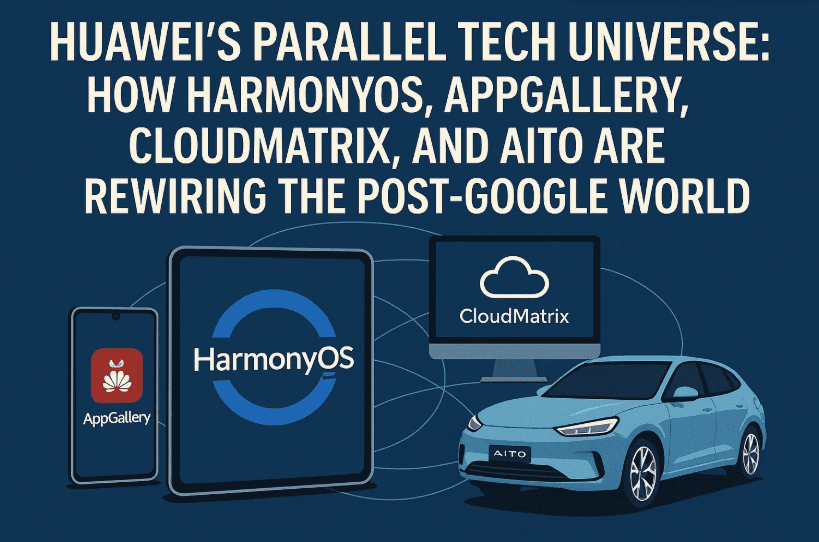
Imagine waking up tomorrow and finding every Google service on your phone—Gmail, YouTube, Maps, the Play Store—gone. Sounds wild, right? For hundreds of millions of people, that “Google-free” reality is already normal. A company many outside China once wrote off has quietly built a complete digital universe—phones, PCs, watches, cars, cloud AI, the works—and it’s growing fast.
This is the story of Huawei: the 2019 U.S. sanctions, the pivot away from Google’s ecosystem, the birth of HarmonyOS, and a broader “device + cloud + AI” strategy that’s reshaping the tech map. We’ll go layer by layer, from the geopolitics to the engineering, and finish with a practical, step-by-step roadmap for readers who want to understand—or build for—this parallel universe.
Before we dive in: wherever software or platforms are mentioned, you’ll find official links so you can explore or verify details yourself.
- HarmonyOS (official): https://www.harmonyos.com/en/
- HarmonyOS Developer Docs: https://device.harmonyos.com/en/documentation/
- DevEco Studio (IDE): https://www.harmonyos.com/en/develop/
- HUAWEI AppGallery (user): https://consumer.huawei.com/en/mobileservices/appgallery/
- AppGallery (developers): https://developer.huawei.com/consumer/en/appgallery/
- AppGallery Connect: https://developer.huawei.com/consumer/en/agconnect/
- Huawei Cloud: https://www.huaweicloud.com/intl/en-us/
Table of Contents
- The Spark: Sanctions, Shock—and a Reinvention
- What HarmonyOS Actually Is (and Isn’t)
- Adoption at Scale: The “Almost a Billion Devices” Moment
- Phones Without Google: Kirin’s Return and the Mate Series
- The App Problem: How AppGallery Fills the Gap
- HarmonyOS 6 and AI Agents: Beyond Simple Assistants
- Beyond Phones: PCs, Cross-Device Magic, and “Super Device” Ideas
- CloudMatrix & Pangu: The AI Cloud Backbone
- Wheels in Motion: Huawei’s Automotive Tech and AITO
- Does This Threaten Google’s Dominance? A Reality Check
- If You’re a Developer: A Step-by-Step “Start Here” Plan
- If You’re a Business or University: Practical Ways to Engage
- Pros, Cons, and Trade-offs (Be Honest With Yourself)
- FAQs
- Disclaimer
- Tags & Hashtags
The Spark: Sanctions, Shock—and a Reinvention
In May 2019, U.S. restrictions severed Huawei’s access to Google Mobile Services (GMS). Overnight, the familiar Android-with-Google world was off the table for Huawei’s global phones. Many assumed that was the end of the story.
It wasn’t. Huawei shifted hard—toward HarmonyOS on devices, AppGallery for apps, and Huawei Cloud with homegrown Pangu models and new CloudMatrix AI infrastructure. The core idea: if you can’t use someone else’s ecosystem, build your own—end-to-end.
What HarmonyOS Actually Is (and Isn’t)
HarmonyOS is not a skin on Android. Huawei positions it as a distributed operating system: one software foundation that spans phones, tablets, watches, TVs, PCs—and even cars—so tasks and apps can move across devices like they’re one computer. The promise is continuity: pick up a file on your laptop, continue it on your tablet, use your phone as a trackpad, share camera feeds, and hand off calls seamlessly. See the official overview here.
Small pause to breathe. That may sound like marketing, but the concept is simple: instead of treating each gadget as a silo, HarmonyOS tries to treat your entire setup as the computer.
Adoption at Scale: The “Almost a Billion Devices” Moment
Here’s where it gets serious. By mid-2024, multiple reports put HarmonyOS’s installed base at roughly 900 million devices—and climbing. That number signals a credible, large-scale alternative stack operating outside Google’s orbit.
On the business side, Huawei’s 2024 revenue hit roughly CNY 862 billion (about $118B), up ~22% year-on-year—evidence that the pivot didn’t just keep the lights on; it refueled growth.
And in China’s smartphone market, Huawei has roared back: research firms reported big shipment gains across 2024–2025, with some quarters showing Huawei jumping near the top while Apple’s shipments fell in China amid fierce local competition.
Phones Without Google: Kirin’s Return and the Mate Series
If HarmonyOS is the software story, the Mate 60 (and subsequent Mate 70) are the hardware plot twists. In 2023, Huawei stunned watchers by shipping Mate 60 Pro phones with domestically produced Kirin chips—despite export controls designed to prevent exactly that. Analysts and press saw it as a symbolic break of the “no advanced chips” ceiling.




You don’t need the geopolitics to appreciate the user-level impact: Huawei was suddenly shipping fast, 5G-class phones again, expanding updates and pushing new camera and charging features in the Mate line—without Google services. The Mate 70 line later underscored a deeper shift: HarmonyOS NEXT, which aims to remove legacy Android app support in favor of native HarmonyOS apps. That’s bold… and risky—because it forces a real ecosystem bet.
The App Problem: How AppGallery Fills the Gap
No Google Play? Then apps are the big question. Huawei’s answer is AppGallery, its own app distribution platform. Huawei and third-party sources have talked about ~580 million monthly active users and millions of registered developers—indicators of a large, active storefront. You’ll find both global and regional apps, plus Huawei-specific integrations built on HMS Core.
The developer side matters because HarmonyOS is pushing native apps (especially with HarmonyOS NEXT). That means more performance and deeper device features—but also more porting work for teams.
HarmonyOS 6 and AI Agents: Beyond Simple Assistants
Now, let’s move to what’s new in HarmonyOS 6. The big headline: AI agents. In plain English, Huawei is shipping a framework that lets apps and system services chain together to automate multi-step tasks—think “plan that weekend trip end to end” (search, book, confirm), or “compile this day’s photos into a story and send it to X.” It’s less “voice assistant” and more “task orchestrator.” Huawei discussed these AI agents with developers as HarmonyOS 6 entered beta.
If Huawei executes, this could be a quiet shift in how we use devices: less tapping through 15 screens, more “set the goal, review, approve.”
Beyond Phones: PCs, Cross-Device Magic, and “Super Device” Ideas
We’ve done a good job tracing phones; now let’s widen the lens. Huawei has started unveiling HarmonyOS PCs, with deep integration across phones, tablets, and laptops thanks to the OS’s distributed architecture. The goal is continuity: pick up tasks across devices, mirror screens, and pass content around without friction. Analysts highlight device interoperability and AI features as key differentiators.
Is it perfect? No ecosystem is. But if your life is already full of Huawei gear, this “One setup = One computer” feeling is the value prop.
CloudMatrix & Pangu: The AI Cloud Backbone
A parallel ecosystem needs a cloud brain. Enter Huawei Cloud with two pillars:
- Pangu Models – Huawei’s family of large AI models (including Pangu 5.5 announced in 2025) used for everything from code assistance to weather forecasting. Huawei’s own annual report references Pangu-Weather’s capabilities, and official releases outline the broader model roadmap.
- CloudMatrix 384 – an AI-native cloud architecture built around peer-to-peer supernodes designed for high-throughput inference and efficient MoE (mixture-of-experts) serving. Think of it as Huawei’s answer to “How do we serve huge models with low latency at scale?” Official comms and a 2025 paper describe the design.
This matters to developers and enterprises because device experiences (agents, on-device AI) increasingly hinge on cloud orchestration. If you’re operating in regions where Huawei Cloud is the preferred or permitted vendor, CloudMatrix+Pangu is the backend stack you’ll run into.
Wheels in Motion: Huawei’s Automotive Tech and AITO
Huawei also builds intelligent automotive solutions—from sensing and compute to infotainment (HarmonyOS in the cockpit). One headline brand is AITO (with partner Seres). Industry press has noted strong sales for models like the M9, while Huawei states that its automotive solutions business turned profitable for the first time in 2024—a milestone for a division many outsiders assumed was experimental.
Even if you never buy a Huawei-linked EV, the lesson is bigger: the HarmonyOS device model extends to cars. Your phone, watch, and vehicle are treated as peers in a system, not isolated endpoints.
Does This Threaten Google’s Dominance? A Reality Check
Short answer: it depends where you live, work, and ship products.
- In mainland China, Huawei’s stack is already at massive scale. HarmonyOS device counts and smartphone share gains show a formidable home market machine.
- Globally, the picture is more nuanced. App availability, regional regulations, carrier relationships, and developer priorities all matter. Some developers will happily invest where their customers are; others will wait for clearer global demand. AppGallery’s reach and developer programs aim to bridge that gap.
- For Google, this isn’t an immediate global collapse scenario—it’s the emergence of a robust parallel tech universe at scale. That alone is historic.
If You’re a Developer: A Step-by-Step “Start Here” Plan
Let’s move to the practical bit. If you build apps and want to explore the HarmonyOS track, here’s a clean path that avoids hand-wavy advice.
1) Map Your Users and Regions
- Where do your active or target users live? If you have meaningful mainland China usage (or partners there), native HarmonyOS support may unlock growth.
2) Review the Docs, SDKs, and IDE
- HarmonyOS Developer Docs: architecture, abilities, APIs.
https://device.harmonyos.com/en/documentation/ - DevEco Studio (IDE): download, install, create a sample project.
https://www.harmonyos.com/en/develop/ - Application Dev Overview: app models, patterns, guidelines.
https://developer.huawei.com/consumer/en/doc/harmonyos-guides/application-dev-guide (Huawei Developer)
Why this matters: the distributed mindset is different—think “multi-device abilities” rather than a single-device app with dumb cast features.
3) Decide: Native HarmonyOS vs. Transitional Approaches
- With HarmonyOS NEXT, Huawei is prioritizing native apps. If you need deeper device features and better performance, go native now. If you’re testing demand, evaluate a minimal port with a clear roadmap.
4) Integrate HMS / App Services
- AppGallery Connect handles app lifecycle (build, release, analytics, A/B, serverless).
https://developer.huawei.com/consumer/en/agconnect/ - AppGallery (developer portal): publish, manage listings, policies.
https://developer.huawei.com/consumer/en/appgallery/ (Huawei Developer)
5) Ship One “North Star” Use Case
- Don’t boil the ocean. Pick the single feature your HarmonyOS users will value most (e.g., cross-device handoff, native widget/atomic service, or a battery-sensitive background task). Ship a tight v1, learn, iterate.
6) Embrace AI Agents Where It Makes Sense
- If your workflow can be automated (trip planning, content compilation, data triage), prototype an AI agent flow in HarmonyOS 6. Keep a human-in-the-loop step for approvals.
7) Measure, Localize, and Support
- Watch retention and conversion in AppGallery analytics, localize for Chinese language audiences (simplified Chinese first), and ensure regional payment options are seamless.
If You’re a Business or University: Practical Ways to Engage
- Pilot on Huawei Cloud if your market or compliance profile favors a China-first or China-friendly vendor. Ask specifically about CloudMatrix capacity and Pangu model access.
- Co-develop native HarmonyOS apps for devices your employees or students already use. University labs are beginning to include HarmonyOS coursework; partnering early helps you build local talent.
- Automotive/IoT: if you manufacture hardware, study HarmonyOS’s distributed model. Device families that share tasks cleanly have a UX moat.
Pros, Cons, and Trade-offs (Be Honest With Yourself)
Where Huawei’s universe shines
- Scale inside China: devices, app store, and services at huge volume.
- Distributed UX: cross-device continuity feels native, not bolted on.
- Cloud + Model strategy: Pangu and CloudMatrix give the ecosystem an AI backbone.
Where you’ll hit friction
- Global app gaps persist in some categories; you may need extra workarounds.
- Native commitment: HarmonyOS NEXT nudges you off compatibility crutches—great for performance, harder for teams with limited bandwidth.
- Policy/market complexity: success varies by region; plan per-market strategies.
The honest middle ground
- If your users or partners are in China, HarmonyOS support can be mission-critical.
- If not, treat it as a strategic option: prototype, measure, and expand where it pays.
FAQs
Q1) Is HarmonyOS just Android with a skin?
Huawei describes it as a distributed OS built to run across device types. While there’s historical Android compatibility in some releases, HarmonyOS NEXT emphasizes native apps and an Android-free runtime going forward.
Q2) How big is HarmonyOS really?
Reports placed it around ~900 million devices by mid-2024, with projections to pass a billion. That’s not niche.
Q3) Can Huawei sustain this financially?
For 2024, Huawei reported ~CNY 862B in revenue (~$118B), up ~22% YoY—its fastest pace in years, per official and media reports.
Q4) What’s the app situation without Google Play?
AppGallery is Huawei’s store; Huawei cites ~580M MAUs and millions of developers. The dev tooling (AppGallery Connect) covers build, release, analytics, and more. Evaluate your category coverage before committing.
Q5) Are HarmonyOS “AI agents” just a voice assistant?
No—think task pipelines that can stitch multiple services into one flow, with human approval where needed. Huawei showed these to developers with the HarmonyOS 6 beta.
Q6) What about chips—aren’t they blocked?
The Mate 60 series used domestic Kirin silicon, surprising many analysts. It demonstrated that Huawei could field advanced devices under constraints, though costs/yields remain debated.
Q7) Is Huawei actually competitive in cars?
Huawei supplies intelligent automotive solutions (ADS, cockpit, etc.) and partners with automakers like Seres (AITO). The division reported first-time profitability in 2024; some AITO models, like M9, have posted strong sales.
Q8) Should my startup target HarmonyOS now?
If you have—or want—users in China, yes: build a small but polished native app and iterate. Elsewhere, prototype to learn, then expand if metrics justify it.
Disclaimer
This article is an educational, good-faith synthesis based on public information as of August 9, 2025 (IST). Market shares, device counts, and product features change quickly. Always consult official resources and documentation for the latest details, and confirm your compliance, data residency, and regulatory obligations in each market. Nothing here is financial, legal, or investment advice.
Tags & Hashtags
Tags: Huawei, HarmonyOS, HarmonyOS 6, AppGallery, Huawei Cloud, CloudMatrix, Pangu, Kirin, Mate 60, Mate 70, AITO M9, distributed OS, AI agents, China smartphone market, AppGallery Connect, DevEco Studio, HMS Core, multi-device computing, Android alternative, parallel tech ecosystem
Hashtags: #HarmonyOS #Huawei #AppGallery #Pangu #CloudMatrix #HMSCore #DevEcoStudio #AITO #AIAgents #DistributedOS #ChinaTech #MobileEcosystem