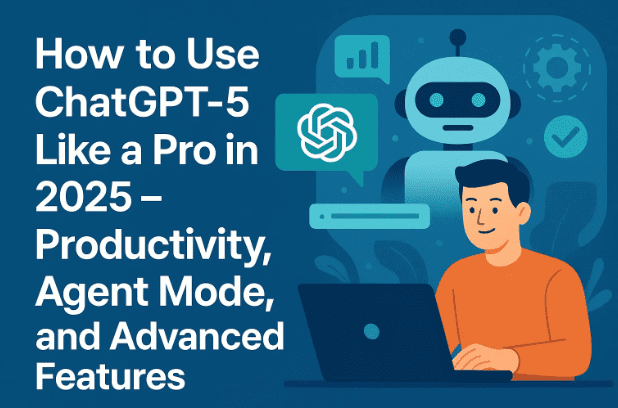
Artificial intelligence has reached a stage where productivity, creativity, and automation can all be handled from a single chat window — and at the center of it all stands ChatGPT-5.
This latest version of OpenAI’s flagship assistant is not just a smarter chatbot; it’s a full-fledged AI ecosystem that can connect with your tools, remember context, run code, and even act as a personal digital agent.
In this detailed guide, we’ll explore how to unlock ChatGPT-5’s hidden capabilities step by step — from setting up your workspace to mastering Agent Mode and building Custom GPTs that work exactly like your personal assistants.
1. Understanding ChatGPT-5: What’s New
If you’ve used ChatGPT-4 or even GPT-4.5, you’ll immediately notice that ChatGPT-5 feels more alive. It remembers, reasons, and acts. OpenAI has rebuilt the model architecture to handle multimodal inputs (text, voice, image) while adding advanced tool integrations like file reading, web browsing, code execution, and third-party connectors.
Here’s what makes it a leap forward:
- Persistent short-term memory for improved continuity in chats
- Enhanced “Agent Mode” for autonomous, multi-step tasks
- New “Projects” feature for team collaboration
- Deep coding integration through Codex Agent
- Canvas Mode for real-time writing and editing
- Study Mode for learning complex subjects interactively
Let’s move step by step through the full setup and learn how to turn ChatGPT-5 into your productivity powerhouse.
2. Step 1: Configure Custom Instructions
Before diving into features, let’s personalize your AI.
Think of this as training your assistant to know who you are and how you like things done.
💡 How to do it:
- Open ChatGPT-5 and click on your profile picture → Custom Instructions.
- You’ll see two main boxes:
- “What would you like ChatGPT to know about you?”
- “How would you like ChatGPT to respond?”
- Fill them out carefully. For example:
- “I’m a freelance content strategist who writes blogs about AI and tech.”
- “Use a confident, friendly tone and concise explanations.”
This setup ensures ChatGPT automatically tailors every answer to your professional style.
It’s like onboarding a new employee — invest five minutes here, and save hours later.
3. Step 2: Privacy and Data Settings
Now that your AI knows you, let’s make sure it protects your privacy.
Go to Settings → Data Controls and review the following:
- Turn off chat training if you’re handling sensitive data like client projects or business plans.
- Use temporary sessions for private discussions — once closed, they’re not stored.
- Clear old conversations periodically to reduce clutter.
- Toggle off memory if you prefer stateless chats that forget after 30 days.
🔒 Pro Tip: When handling confidential tasks, open a new chat in Incognito mode.
This keeps your session isolated and unrecorded.
Once you’ve configured privacy, ChatGPT-5 becomes a safe assistant that respects your boundaries while remaining incredibly capable.












4. Step 3: Connecting External Tools and Apps
Here’s where things get exciting. ChatGPT-5 now integrates directly with apps you already use — like Google Calendar, Gmail, Slack, Notion, or Dropbox.
To connect them:
- Open the Tools menu inside ChatGPT.
- Under Connectors, choose the app you want.
- Approve access through the secure OAuth screen.
Once connected, ChatGPT can:
- Fetch files from your Google Drive
- Summarize unread emails
- Schedule or rearrange calendar events
- Search Dropbox or OneDrive for documents
Imagine saying:
“Find yesterday’s meeting notes in my Drive and summarize them in 5 bullet points.”
…and having ChatGPT handle it instantly. This turns it from a writing tool into an actual digital assistant.
5. Step 4: The Five-Box Prompting Framework
Even with all its power, ChatGPT’s accuracy depends on how you talk to it.
That’s why expert users rely on the Five-Box Prompt Formula — Role, Task, Context, Constraints, and Format.
Here’s how it works:
- Role: Tell ChatGPT who it is. “You are an experienced marketing strategist.”
- Task: Describe what it must do. “Create a 30-day content plan for an AI productivity blog.”
- Context: Give background info. “My audience is small business owners exploring AI tools.”
- Constraints: Define limits or tone. “Keep each idea under 80 words and use friendly language.”
- Format: Specify structure. “Present the results in a markdown table.”
This formula eliminates ambiguity and makes outputs 90% ready to publish.
The more detail you provide, the smarter ChatGPT-5 becomes in understanding your intent.
6. Step 5: Iterative Prompting – Working Smarter, Not Harder
Many users still dump a giant task into one message — and wonder why the results look messy.
Instead, build your request step by step.
Let’s take an example:
- Ask for an outline first: “Give me an outline for a business plan for a fitness AI startup.”
- Then work on each section one by one. “Now write the market analysis section in 3 paragraphs with real statistics.”
- Finally, ask ChatGPT to combine everything into a formatted report.
You’re essentially sculpting the result layer by layer, just like a professional editor would.
This approach also prevents truncation and ensures consistency across longer projects.
💬 Pro Tip: After the final draft, ask:
“Review this document for logical errors or missing points.”
ChatGPT will act as its own proofreader.
7. Step 6: Agent Mode – Let ChatGPT Work on Autopilot
Now we enter the most powerful feature of ChatGPT-5 — Agent Mode.
Think of Agent Mode as giving ChatGPT a set of goals and letting it figure out how to complete them autonomously.
It can browse the web, read documents, use APIs, and run calculations — all while updating you step by step.
🧠 Example use:
“Find the latest three competitors to my startup, analyze their websites, and summarize their pricing models in a table.”
ChatGPT-5 will:
- Open the browser
- Visit multiple websites
- Extract and compare data
- Present the results in a formatted table
And yes, it will ask for confirmation before performing any action like sending emails or booking events.
⚙️ Agent Mode Tip:
Enable it under the Tools → Agent panel (available for Plus, Team, and Enterprise users).
You’ll see a small “Activity window” showing its progress — like watching your AI intern in action.
The result? Hours of research or admin work completed while you focus on higher-level decisions.
8. Step 7: Codex Agent – Debug, Write, and Test Code Instantly
For developers and tech enthusiasts, ChatGPT-5’s Codex Agent is a dream come true.
It’s not just a code writer — it reads, debugs, and executes your code right inside the chat.
Example workflow:
- Upload your Python or JavaScript file.
- Say: “There’s a bug in this payment module. Find and fix it.”
- ChatGPT will open the code in a sandbox, highlight errors, patch them, run tests, and verify the fix.
It even explains what went wrong and why.
You can go further —
“Add a new feature that sends users a welcome email when they sign up.”
The Codex Agent will create the code, generate a unit test, and verify execution before returning it to you.
⚠️ Note: Always review code before deploying to production, especially for private repositories.
The agent runs in a secure sandbox, but you still own the responsibility for final changes.
9. Step 8: Using Canvas Mode for Live Editing and Collaboration
Canvas Mode feels like blending Google Docs with ChatGPT.
It opens a split interface where your document appears on one side and AI suggestions appear on the other.
This is extremely useful when:
- Editing long articles or reports
- Refining legal or policy documents
- Writing code collaboratively
You can highlight any sentence and ask:
“Make this more concise” or “Add a friendly intro paragraph here.”
ChatGPT edits directly within the document, showing tracked changes so you stay in control.
No more switching between chat and editor windows — everything happens in one place.
10. Step 9: Multimodal Inputs – ChatGPT Can See, Hear, and Speak
ChatGPT-5 isn’t just text-based anymore. It can understand images and respond to voice.
Here’s what you can do:
- Upload screenshots, charts, or handwritten notes and ask: “Summarize the key information in this image.”
- Take a photo of a whiteboard or flowchart — ChatGPT will analyze and recreate it in text form.
- Use voice input on mobile or desktop to dictate ideas hands-free.
You could literally speak out, “Draft a summary of my morning meeting,” and have it typed out instantly.
For creative users, you can even request quick illustrations or visual concepts within the same chat.
11. Step 10: Study Mode – Learn Faster with Interactive AI Tutoring
Learning new topics with ChatGPT-5 feels like having a private tutor who adjusts lessons to your level.
When you activate Study Mode (under the Tools menu), the AI shifts from answering questions to teaching interactively.
For example:
“Teach me the basics of blockchain step by step.”
ChatGPT will respond with:
- A structured learning roadmap
- Questions to test your understanding
- Feedback on your answers
- Optional follow-up exercises
It’s especially effective for learning programming, business strategy, or even foreign languages.
You can say:
“Quiz me on yesterday’s lesson.”
and it’ll create interactive exercises based on your last chat.
This turns ChatGPT from a Q&A bot into an actual personal learning coach.
12. Step 11: Custom GPTs – Build Your Own AI Assistants
Here’s one of the most empowering features: Custom GPTs.
You can now create specialized versions of ChatGPT for different areas of your life or business — no coding needed.
Steps to create one:
- Visit https://chat.openai.com/gpts
- Click Create and start chatting to configure it.
- Describe its purpose, tone, and expertise. “You are a project management assistant that helps plan weekly sprints.”
- Upload reference documents or brand guidelines.
- Enable tools like browsing or code interpreter if needed.
Once done, your new GPT acts as a dedicated mini-assistant — always following those rules and remembering its training context.
You can share it with teammates or keep it private.
It’s ideal for tasks like resume screening, brand writing, content planning, or even client support.
13. Step 12: Projects and Workspaces – Organize Your Work Like a Pro
One of the biggest challenges users faced with older versions was losing track of chats.
ChatGPT-5 solves this with Projects (or Workspaces) — your new organization hub.
Imagine having one workspace per client, topic, or project.
Each workspace contains:
- Multiple chat threads
- Uploaded files and context
- Shared memory specific to that topic
So, if you have a “Website Redesign Project,” every chat inside remembers the tone, goals, and files you uploaded earlier.
No more repeating context or digging through 50 old threads.
You can even assign different tones per workspace — formal for business, reflective for journaling, or casual for brainstorming.
14. FAQs
Q1. Is ChatGPT-5 free to use?
Basic access may be available, but advanced features like Agent Mode, Codex, and Projects usually require a Plus or Team plan.
Q2. Can Agent Mode perform real-world actions automatically?
Yes, but with confirmation prompts. ChatGPT will always ask before sending emails, creating calendar events, or modifying files.
Q3. What’s the safest way to use ChatGPT-5 for sensitive data?
Turn off training, use incognito chats, and store sensitive files locally rather than cloud uploads.
Q4. Can I use ChatGPT-5 offline?
Currently no, but OpenAI is experimenting with local runtime versions for enterprise users.
Q5. Will Custom GPTs share data with OpenAI?
Each GPT follows your privacy settings — you decide what’s stored, what’s shared, and whether memory is active.
15. Disclaimer
This article is intended for educational purposes only.
While ChatGPT-5 can perform automation, code execution, and data processing tasks, users should always verify outputs, protect confidential information, and comply with data privacy regulations before deploying AI-generated content or actions in real environments.
Tags:
chatgpt-5, openai, productivity, ai tools, agent mode, ai automation, codex, custom gpt, workspace organization, study mode
Hashtags:
#ChatGPT5 #OpenAI #ProductivityTools #AIAutomation #AgentMode #CodingWithAI #ArtificialIntelligence #AITutorials #GPT5Guide