Have you ever tried to format or copy something to your USB drive or SD card, only to be hit with the frustrating message:
“The disk is write protected”?
Don’t worry—you’re not alone! This is a common problem, but the good news is that there are multiple ways to remove write protection and get your drive working again.
In this blog post, I’ll walk you through three practical and effective methods to remove write protection from your USB drive or SD card—step by step. Whether it’s a hardware lock or a software issue, one of these solutions will most likely work for you.
Let’s get started with the easiest fix first.
🔐 What Is Write Protection?
Before diving into solutions, it’s helpful to know what write protection actually is. Write protection prevents data from being changed or deleted on a storage device. It’s meant as a safety feature, but it can get in your way when you want to format or copy files.
Write protection can be:
- Physical (via a hardware switch)
- Software-based (via system or registry settings)
🧰 Method 1: Check for Physical Write Protection Switch
Let’s start with the most straightforward solution.
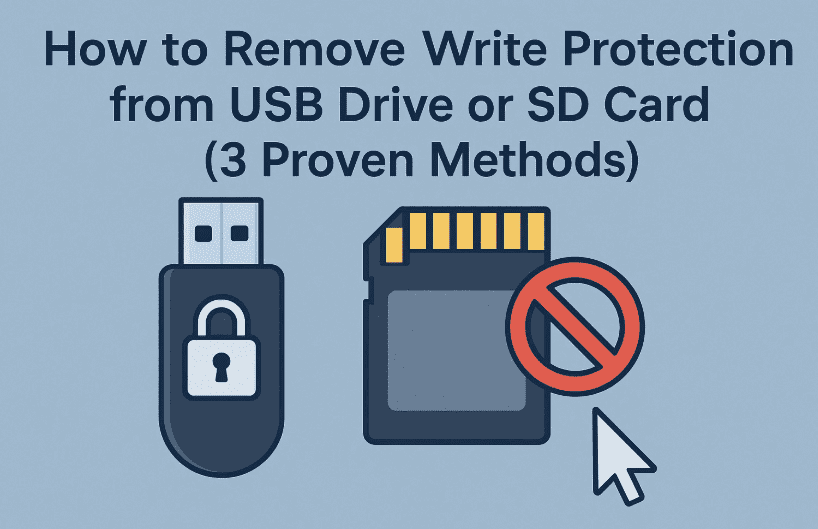
Many SD cards and some older USB drives have a tiny physical switch that enables or disables write protection. It’s easy to miss, so take a close look!
Here’s what to do:
- Remove your USB drive or SD card.
- Look along the side edges for a sliding switch.
- If it’s set to LOCK, slide it to the UNLOCK position.
- Reinsert the device and try again.
🔁 Restart your computer if the change doesn’t seem to apply immediately.
If your device doesn’t have a physical switch—or this doesn’t solve your issue—don’t worry. Let’s move to a slightly deeper solution using the Registry Editor.
🛠️ Method 2: Use Windows Registry Editor
Sometimes, write protection is enabled through your Windows system settings. You can change this by editing a registry key.





⚠️ Important Note: Be cautious when editing the registry. One wrong change can affect system functionality. Always back up your registry before making changes.
Step-by-step instructions:
- Press Windows + S and search for Registry Editor.
- Right-click and choose Run as administrator.
- Navigate to this path:
HKEY_LOCAL_MACHINE\SYSTEM\CurrentControlSet\Control - Check if you see a folder named StorageDevicePolicies.
- If it exists, click on it.
- If not:
- Right-click on Control
- Select New > Key
- Name it:
StorageDevicePolicies
- Now right-click inside the right pane, and select:
- New > DWORD (32-bit) Value (yes, even on 64-bit systems)
- Name the new entry:
WriteProtect
- Double-click on
WriteProtectand set:- Value data to:
0 - Click OK
- Value data to:
- Close Registry Editor and restart your PC.
Now, try using your USB or SD card again. If the issue still persists, we’ll go one level deeper with the Command Prompt.
💻 Method 3: Remove Write Protection via Command Prompt (Diskpart)
This method uses the powerful DiskPart tool in Windows to clear the write protection attribute at the disk level.
Let’s move to this final and advanced fix.
Step-by-step guide:
- Press Windows + S, search for Command Prompt.
- Right-click and select Run as Administrator.
- Type the following commands one by one:
diskpart list diskIdentify your USB or SD card from the list by its size.
Example: If it shows as Disk 1, continue using that number. - Then type:
select disk 1 attributes disk clear readonly exitReplacedisk 1with the appropriate number shown in your system. - Close the command prompt and try again to open or format the USB drive.
🎉 If everything went well, you should no longer see the write protection error message!
❓Frequently Asked Questions
Q1. What causes write protection on USB drives?
It can be a physical switch, a Windows system setting, or a malfunctioning or corrupted file system.
Q2. What if none of these methods work?
If none of the three solutions solve the issue, your USB drive or SD card may be damaged or at the end of its lifespan. You can try third-party low-level formatting tools or consider replacing the drive.
Q3. Can a virus enable write protection?
Yes, malware can sometimes force devices into write-protected mode. Always run a full virus scan if you suspect suspicious activity.
🧹 Final Thoughts
So far, we’ve covered:
- A simple physical check
- A registry tweak
- A command-line fix
Using these three methods, you should now be able to remove write protection from most USB drives or SD cards. These steps are safe and effective if followed correctly.
Sometimes the solution is simple; sometimes it requires a little more digging—but you’ve got this!
🛑 Disclaimer
This article is for educational purposes. Editing the Windows Registry or using DiskPart improperly can lead to system issues. Always back up important data and consult an expert if you’re unsure. We are not responsible for any data loss or hardware damage.
🔗 Helpful Resources
- Fix “Windows Could Not Format a Partition on Disk 0” Error During Installation – Complete Step-by-Step Guide
- How to Fix USB Flash Drive Errors: No Media, 0 Bytes, and Format Issues (2024 Guide)
🏷️ Tags & Hashtags
Tags:
remove write protection USB, USB format error fix, SD card write protection, diskpart USB fix, registry edit USB protection, windows USB troubleshooting
Hashtags:
#USBFix #SDCardError #WindowsTips #TechHelp #DiskPart #RegistryEditor #WriteProtectionFix
If you found this guide helpful, feel free to share it with someone who’s facing the same USB issue. And if you’ve got more tips or questions, drop them in the comments—we’re here to help!